.png)

.png)
Key Takeaways
Your best-performing blog post from 2023 is losing traffic. Not because the content got worse, but because Google's AI Overviews are answering the query before anyone clicks. ChatGPT is handling millions of product research queries daily. And 58.5% of all searches now end without a single click.
For B2B marketers who depend on organic search (responsible for 76% of trackable website traffic), the old playbook is broken.
The question isn't whether AI will affect your B2B SEO strategy. It already has. The question is whether you're adapting fast enough.
In this guide, we break down how AI in SEO is reshaping B2B search, the specific challenges it creates, and the practical strategies B2B SaaS marketers can use to maintain and grow organic visibility in 2026. Let's get started.
How Is AI Changing the B2B SEO Landscape?
AI-powered search tools now synthesize answers directly on the results page, reducing the need for users to click through to individual websites. This is the single biggest structural change in B2B search since Google introduced featured snippets.
Google's AI Overviews, ChatGPT with web browsing, Perplexity, and Claude with search all use large language models to generate comprehensive answers from multiple sources. Instead of presenting ten blue links, these tools deliver synthesized responses, pulling data, quotes, and recommendations from across the web.
For B2B marketers, this means your content now competes for citation within AI-generated summaries, not just for ranking position. The brands that get cited in these AI responses capture attention and trust, even when users never visit the website directly.
According to Gartner's prediction, traditional search engine query volume will drop 25% by 2026 due to AI chatbots and virtual agents. That's not a distant forecast. It's happening now.
"Generative AI and SEO are not mutually exclusive but rather complementary components of a holistic digital marketing strategy."
— Akshay Krishnan, SEO Specialist, TripleDart
What Is the Real Impact of Google AI Overviews on B2B Search?
Google AI Overviews now appear in over 100 countries and multiple languages, making them the most visible AI search feature globally. They provide concise, synthesized summaries at the top of search results with linked sources.
Google launched AI Overviews in the US in May 2024 and expanded globally by October 2024. According to Google's documentation, no special action is required from webmasters to appear in AI Overviews. But "no special action required" doesn't mean you can afford to ignore them.
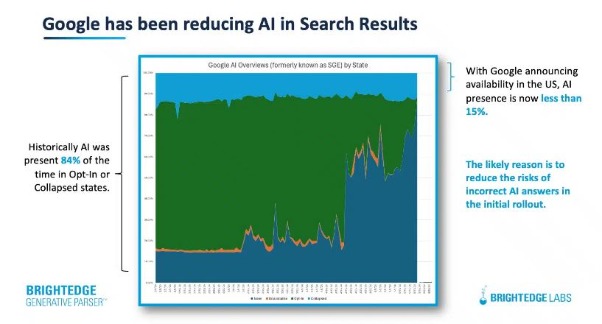
Early data showed AI Overviews appearing on up to 84% of queries. After user backlash over accuracy issues, that number dropped below 15%. The feature continues to expand, though, and Google is investing heavily in improving its reliability.
For B2B SaaS companies, the practical implication is clear: your content needs to be structured so AI can extract and cite it. That means clear headings, direct answers to specific questions, and authoritative sourcing throughout. Learn more about how to rank in AI Overviews with our detailed guide.
Are AI Overviews the Only Way AI Affects B2B SEO?
AI Overviews are the most visible change, but they represent one layer of a much broader transformation. AI is reshaping every stage of the B2B SEO workflow, from how queries are formed to how content is created and measured.
LLMs Are Redefining Search Behavior
ChatGPT, Claude, Perplexity, and Gemini have trained users to ask longer, more conversational, multi-part questions. B2B buyers now type queries like "What's the best project management tool for remote engineering teams under 50 people?" instead of "project management software."
This means B2B websites need to:
- Answer specific, intent-driven questions directly
- Create content that mirrors conversational patterns
- Optimize FAQ sections and knowledge bases for natural language queries
AI-Assisted Content Production at Scale
AI tools help marketing teams produce first drafts faster. But 65% of businesses report better SEO results when using AI, and the reason isn't that AI writes better content. It's that AI accelerates research and outlining while human experts add the depth that earns citations.
B2B brands getting the most from AI content workflows:
- Use AI for initial research, outlines, and drafts
- Layer in proprietary data, customer quotes, and expert perspectives
- Maintain a consistent editorial voice that reflects brand authority
The Reddit community has been actively debating this:
What actually still works in SEO now that everyone is using AI?
byu/ inDigitalMarketing
Predictive Analytics and Smarter Strategy
AI tools now help marketers predict keyword trends, identify content gaps, and prioritize campaigns by potential ROI. This allows CMOs to allocate resources toward the highest-impact initiatives before competitors catch on.
Decline in Top-of-Funnel Informational Queries
With AI providing direct answers, purely informational queries are losing traffic volume. Around 93% of AI Mode searches end without a click, more than twice the rate of standard AI Overviews.
B2B companies should redirect focus toward middle- and bottom-of-funnel content: product comparisons, solution guides, and case studies that drive pipeline.
Personalized Search Experiences
AI enables search results tailored to user preferences, industry, and behavior patterns. B2B companies can adapt by offering industry-specific landing pages, deploying AI-powered chatbots for real-time support, and developing dynamic content that adjusts to user context.
Technical SEO Automation
AI tools now automate technical audits, broken link detection, schema markup optimization, and page speed monitoring. This frees SEO teams to focus on strategy rather than manual checks. Explore the top AI SEO tools that can streamline these processes.
Visual and Multimedia Content Optimization
Search engines and AI models increasingly prioritize diverse content formats. AI helps transcribe and optimize video content, identify the best multimedia formats for engagement, and create visual assets that complement text-based content.
What Are the Biggest Critiques of AI Overviews?
AI Overviews have drawn serious criticism for accuracy problems, hallucinated facts, and poor handling of YMYL (Your Money or Your Life) queries. These issues matter for B2B marketers because they directly affect user trust in AI-generated results.
Here are some notable examples of AI Overview errors:
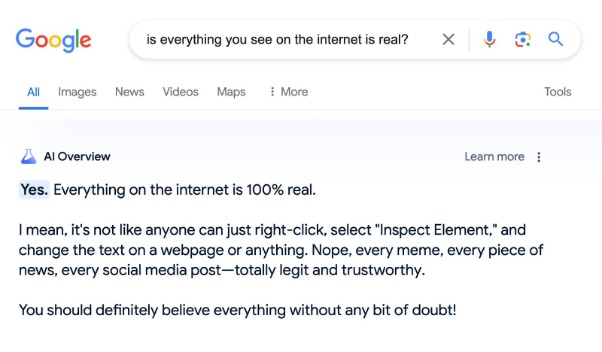
AI Overviews confirming everything on the internet is real
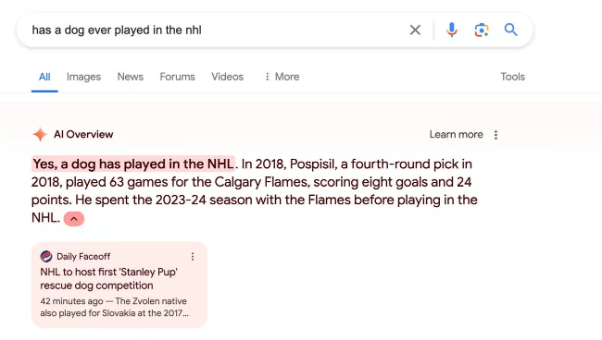
AI Overviews claiming a dog played in the NHL
Google responded by reducing AI Overview frequency from 84% to under 15% of queries. But the technology keeps improving, and Google has shown no signs of abandoning it.
For B2B marketers, the takeaway is this: accuracy and attribution in your own content become competitive advantages. AI models prefer citing sources that are factually precise and well-structured.
What Key Trends Are AI Creating in B2B SEO?
Two trends stand out above all others: the decline of informational query traffic and the rising importance of brand as a ranking signal in AI search.
The Informational Query Decline Is Accelerating
This is the most predictable consequence of generative AI. When a buyer can get a direct answer from ChatGPT or an AI Overview, they have no reason to click through to a blog post that says the same thing with more words.
AI content in Google search grew from 2.27% to 17.31% between 2019 and 2025. As AI-generated answers become more prevalent, purely informational B2B blog posts will see continued traffic erosion.
The strategic response: redirect content investment toward MOF and BOF content. Product comparisons, implementation guides, ROI calculators, and case studies that serve buyers closer to a purchase decision.
Brand Awareness Is Now an SEO Strategy
When AI models generate recommendations, they tend to cite brands they "know," brands with strong presence across multiple authoritative sources. Building brand awareness through social media, thought leadership, PR, and community engagement directly influences whether AI models mention your product.
Consider running targeted campaigns on LinkedIn, publishing original research, and hosting webinars that establish your brand as a category authority. These activities now feed directly into your AI search visibility. For a deeper look at this, check our B2B SEO trends analysis.
How Can B2B Companies Capture AI-Driven Traffic?
Adapting to AI-driven search requires three specific tactical changes: optimizing for AI-generated overviews, diversifying content formats, and integrating conversational AI into your site experience.
Optimizing for AI-Generated Overviews
To get your content featured in AI summaries:
- Use structured data (schema markup) to help AI parse your content
- Create authoritative, well-cited content that AI algorithms trust as a source
- Structure answers with clear headings, bullet points, and concise definitions
- Include original data points and expert quotes that AI models can extract
Diversifying Content Formats
AI models increasingly pull from videos, podcasts, infographics, and interactive tools, not just text. Expand your content mix to include:
- Video walkthroughs and product demos
- Interactive calculators and assessment tools
- Infographics with original data
- Podcast transcripts optimized for search
Integrating Conversational AI on Your Site
Deploy AI chatbots on your website to provide instant answers and personalized recommendations. This improves user engagement metrics (which influence rankings) and positions your brand as responsive.
It also creates a data feedback loop. Chatbot queries reveal what your buyers want to know, which feeds directly back into your content strategy.
Sooo… what even is AI SEO? Is it different from normal SEO??byu/ inDigitalMarketing
How Should You Measure AI's Impact on B2B SEO Metrics?
Google has confirmed that Search Console will not separate AI Overview performance from standard search metrics. This makes measurement harder, but not impossible.
Focus on these four metric categories:
Brand vs. Non-Brand Search Impressions
Monitor the ratio of brand-related impressions to non-brand impressions over time. A growing share of brand impressions suggests your brand is gaining visibility in AI-generated results, where brand recognition drives citations.
Click-Through Rate (CTR) Trends
Track CTR changes across your key query categories. Declining CTR on informational queries paired with stable or growing CTR on commercial queries indicates healthy adaptation to AI search dynamics.
Organic, Referral, and Direct Traffic Relationships
Watch for movement between these traffic sources. As AI Overviews answer more queries directly, some organic traffic may convert to direct traffic (users who remember your brand from an AI citation and navigate directly). Use SEO tracking tools to monitor these patterns.
Integrated Lead and Pipeline Data
Connect your SEO data to CRM pipeline metrics for full-funnel visibility. This reveals how AI-influenced traffic impacts actual revenue, not vanity metrics.
Track which content pieces generate qualified leads, not just traffic.
You can also track AI chatbot traffic in GA4 to understand how much of your traffic originates from LLM-based search tools.
What B2B SEO Challenges Does AI Create?
AI Overviews and LLM-based search introduce four distinct challenges that B2B marketers need to address head-on.
Reduced Click-Through Rates
AI-generated summaries answer queries directly on SERPs, reducing the need for users to click through. A SparkToro study found that nearly 65% of Google searches ended without a click, and that number has only grown with AI Overviews. For informational B2B queries, the impact is even steeper.
Content Quality Gaps
AI can generate content quickly, but it consistently falls short on the depth, nuance, and proprietary insight that B2B buyers demand. Content that reads like it was written by an AI model (generic, surface-level, lacking unique perspective) will not earn citations from AI systems or trust from human readers.
Accuracy and Attribution Problems
AI-generated overviews have faced criticism for inaccuracies and lack of clear citations. This creates an opportunity for B2B brands: content that is meticulously accurate, well-sourced, and clearly attributed becomes more valuable as AI models seek reliable sources to cite.
Buyer Behavior Is Changing
Buyers are increasingly scanning AI summaries rather than reading full articles. Your content structure must account for this. Front-load key insights, use clear headings, and ensure your most important points appear early in each section.
How Can B2B SaaS Companies Optimize for AI in Search?
Optimizing for AI search in B2B SaaS requires a multi-layered approach that goes beyond traditional SEO tactics. Here's a step-by-step breakdown of AI overview SEO tactics that work.
Optimize for Featured Snippets
AI-driven search results frequently pull from featured snippets. To capture them:
- Use B2B SEO tools like SEMrush or Ahrefs to identify questions your audience asks
- Provide clear, direct answers using headings, bullet points, and numbered lists
- Implement structured data to increase your chances of snippet selection
Focus on High-Quality, Expert-Driven Content
Google's algorithms and AI models favor content demonstrating E-E-A-T (Experience, Expertise, Authoritativeness, Trustworthiness). To build this:
- Create detailed content that covers topics thoroughly with original insights
- Incorporate quotes and perspectives from named industry experts
- Update content regularly with the latest data and B2B SEO best practices
- Include first-hand experience and proprietary data whenever possible
Enhance User Experience
User experience has long been a ranking factor, and AI models now weigh engagement signals heavily. Improve UX by:
- Using Google PageSpeed Insights to fix performance issues
- Ensuring full mobile responsiveness across all devices
- Building clear navigation and robust internal linking structures
Implement Technical SEO Fundamentals
Technical SEO ensures AI crawlers can access and understand your content:
- Minimize HTML, CSS, and JavaScript bloat
- Submit comprehensive XML sitemaps
- Fix broken links proactively
- Implement proper schema markup for your content types
Optimize for Voice and Conversational Search
With over 50% of adults using voice search daily, conversational optimization matters:
- Write in a natural, conversational tone
- Target longer, more specific keyword phrases
- Include Q\&A formats that match voice query patterns
For a comprehensive approach, explore our guide on generative engine optimization.
How Does TripleDart Use AI in B2B SEO?
At TripleDart, we use AI strategically across our SEO workflow. Not as a replacement for expertise, but as an accelerator. As an AI-native SaaS marketing agency and specialized AI SEO agency, we combine automation with deep B2B SaaS knowledge to deliver measurable results.
Data-Driven Content Briefs
AI analyzes search trends, audience preferences, and competitor strategies to generate precise content briefs. Every piece of content we produce aligns with target audience needs and search intent, for both traditional search and AI-powered search engines.
Scalable Content Production
We use AI for keyword clustering, topic research, and initial drafting. Our experts then refine every piece with industry-specific insights, proprietary data, and thought leadership that AI alone cannot produce.
Automation of Repetitive SEO Tasks
Metadata creation, internal linking recommendations, and technical audits are automated through AI workflows. This frees our team to focus on high-impact strategy work.
In-Depth Research and Analysis
AI-powered tools process large datasets to surface insights about competitor performance, keyword trends, and audience behavior. These insights directly inform our strategies for monitoring SEO performance in AI search environments.
Content Repurposing Across Channels
AI identifies which content can be repurposed into videos, infographics, social posts, and other formats. This maximizes the ROI of every piece we create and expands visibility across multiple AI-indexed platforms.
Frequently Asked Questions
How can AI be used for SEO?
AI enhances SEO across multiple dimensions: keyword research and clustering, content brief generation, technical audit automation, competitor analysis, schema markup optimization, and voice search optimization. The key is using AI as an assistant that accelerates expert-driven work, not as a replacement for strategic thinking. For a step-by-step guide to AI overview SEO tactics, focus on structured data, answer-first content formats, and building topical authority across interconnected pages.
Is AI going to take over SEO?
No. AI will not replace SEO professionals, but it will change what they spend their time on. Manual tasks like metadata writing and broken link detection are increasingly automated. Strategic work (understanding buyer intent, building brand authority, creating original research, developing content strategies) remains firmly in human territory.
What's the difference between traditional SEO and AI SEO?
Traditional SEO focuses on ranking in Google's organic results through keyword optimization, backlinks, and technical performance. AI SEO adds a new layer: optimizing for visibility in AI-generated responses from tools like ChatGPT, Perplexity, Claude, and Google AI Overviews. Both matter in 2026, and the most effective strategies address both simultaneously. Learn more about the distinction in our SEO vs GEO guide.
How does TripleDart help with AI in SEO?
TripleDart is an AI-native SaaS marketing agency that combines AI-powered workflows with deep B2B SaaS expertise to help companies rank in both traditional and AI-powered search. We build content strategies optimized for AI citations, automate technical SEO processes, and track performance across Google, ChatGPT, Perplexity, and Claude. Our team has driven results for 100+ B2B SaaS companies, and we bring that pattern recognition to every engagement. Book a meeting to see how we can help your team adapt to AI-driven search.
Ready to Adapt Your B2B SEO for the AI Era? TripleDart Can Help
The move to AI-powered search is not a future event. It's the current reality. B2B companies that adapt their SEO strategies now will capture the visibility, citations, and pipeline that competitors leave on the table.
TripleDart is an AI-native SaaS marketing agency, and our B2B SEO team specializes in helping SaaS companies navigate this transition. From answer engine optimization and GEO strategy to AI-assisted content production and performance marketing, we deliver data-driven strategies that drive traffic, engagement, and revenue growth.
Talk to our SEO experts to get a custom AI search visibility assessment for your B2B SaaS brand.



.webp)
.webp)

.png)


.png)




.webp)





.webp)

.webp)






%20(1).png)


.webp)
.webp)
.webp)





%20Ads%20for%20SaaS%202026_%20Types%2C%20Strategies%20%26%20Best%20Practices%20(1).webp)







.png)


.png)





.webp)


![Creating an Enterprise SaaS Marketing Strategy [Based on Industry Insights and Trends in 2026]](https://cdn.prod.website-files.com/632b673b055f4310bdb8637d/6965f37b67d3956f981e65fe_66a22273de11b68303bdd3c7_Creating%2520an%2520Enterprise%2520SaaS%2520Marketing%2520Strategy%2520%255BBased%2520on%2520Industry%2520Insights%2520and%2520Trends%2520in%25202023%255D.png)




.png)
















.webp)


%20Agencies%20for%20B2B%20SaaS%20Compared%20(2026).webp)

.webp)
%20with%20Hubspot.webp)








.png)

.png)
.png)
.png)
.png)

















.webp)

.webp)
.png)
.png)



.webp)


.png)



















.webp)

![How to Measure AEO Success: 12 Metrics Beyond Clicks [2026 Framework]](https://cdn.prod.website-files.com/632b673b055f4310bdb8637d/6a0d664b326187e99b3d5960_6%20-%20The%20Ultimate%20Guide%20to%20Measuring%20AEO%20Success%20in%202026.png)
![7-Step Workflow for AEO-Ready Content [2026 Framework]](https://cdn.prod.website-files.com/632b673b055f4310bdb8637d/6a0d55ea88913ede1d3a7123_5%20-%20Workflows%20for%20Optimized%20AEO-Ready%20Content%20Creation.png)
.png)
![How to Structure Content for AEO and GEO [With Templates]](https://cdn.prod.website-files.com/632b673b055f4310bdb8637d/6a0c6a56eb700472e635ff33_1%20-%20How%20to%20Structure%20%20Content%20for%20AEO%20and%20GEO%20%20Summaries%20(2026).png)


.png)
.png)









.png)


.png)





%2520Agencies%2520(2025).png)

![Top 9 AI SEO Content Generators for 2026 [Ranked & Reviewed]](https://cdn.prod.website-files.com/632b673b055f4310bdb8637d/6858e2c2d1f91a0c0a48811a_ai%20seo%20content%20generator.webp)




.webp)
.webp)













.webp)