

.png)
Key Takeaways
About This Guide
Data Methodology
This guide is based on TripleDart's portfolio of 84 actively managed B2B SaaS Google Ads accounts (January 1 - December 31, 2025). Total managed spend: $60M+. All performance benchmarks represent campaigns with a minimum of 1,000 clicks and 50+ conversions (95% confidence level). Data was anonymised across client accounts; no individual account data is disclosed. Benchmarks cover six industry verticals: FinTech, MarTech, HR Tech, Sales Tech, Document Management, and Customer Support. Attribution model: last non-direct click, validated against CRM pipeline data. Where a benchmark varies by vertical, we note the range.
Throughout this guide, we clearly distinguish two types of data:
- TripleDart Portfolio Data — figures derived from our 84-account dataset, labelled
- Industry Benchmarks — third-party research, cited inline with source and year
Opening Keynote: The State of SaaS PPC in 2026
Sabarinathan R, Co-founder, TripleDart
I've led TripleDart's PPC operations for almost five years now, and it's safe to say that the landscape has never changed as much as it has in the past 18 months. What's surprising isn't just the growth in technology — it's how rapidly our clients have had to adapt to stay competitive.
2024: Three seismic shifts
In 2024, three changes forced us to rethink our approach entirely:
- 1. Buyer journeys became more complex. B2B SaaS deals required 266 touchpoints in 2024 — roughly a 20% jump from 2023 according to HockeyStack. Two factors drove this: rising CPCs in competitive niches like MarTech and FinTech, and evolving search behaviour as users increasingly bypass Google for complex queries, turning to ChatGPT and Perplexity instead.
- 2. Traditional search volume dipped. With AI tools becoming the go-to for research-stage queries, some keywords we once relied on started to underperform. We had to shift budget toward high-intent, bottom-of-funnel terms where searchers still came to Google to buy.
- 3. AI capabilities moved from 'nice to have' to table stakes. By mid-2024, Performance Max, AI bidding, and real-time optimisation were simply expected. The brands that stood out experimented with new channels and didn't put all their PPC eggs in one basket.
What is working in 2026
Today, the PPC strategies delivering the best results for our clients share three principles:
- 1. Bottom-of-funnel focus. With rising CPCs, we double down on high-intent keywords. The math is simple: a $25 CPC for an active buyer is far more effective than five $5 clicks from early-stage researchers. In our portfolio, PPC leads close at 12% compared to 8% for SEO leads. [TripleDart, 2025]
- 2. Signal-based marketing. We have helped top clients shift from waiting on form completions to proactively identifying buying signals across multiple platforms and starting outreach immediately. This approach has produced 2.3x more leads from PPC than SEO on average across our managed accounts. [TripleDart, 2025]
- 3. AI agents. From dynamic budget reallocations to flagging CPC spikes and tracking competitors, AI now powers the backend of our highest-performing campaigns. What was once enterprise-only is now accessible to any SaaS team with the right partner.
Where we are headed
Looking ahead, three trends define where SaaS PPC is going:
- The human plus AI agent model becomes the new baseline. Marketing teams will include roles partly or fully focused on AI-based execution and KPI tracking.
- Video advertising becomes essential. Shorter attention spans and the need for distinctive creative are driving the best SaaS companies to build platform-specific video content, not just repurpose assets.
- Hyper-targeting gets smarter. The ability to bucket audiences based on buying signals, intent data, and CRM overlap will allow more precision in B2B SaaS advertising than was possible even 12 months ago.
A note on the fundamentals
None of these developments invalidates the basics. Account structure, landing page optimisation, and compelling ad copy remain essential. In 2026, your PPC strategy must build on top of these — not replace them. This guide walks through every layer, starting with fundamentals and moving into advanced strategies, real account data, and the AI capabilities now powering top-performing SaaS campaigns.
The SaaS PPC Landscape in 2026
According to Gartner, the SaaS industry grew from $31 billion to $161 billion between 2015 and 2022 — a 420% increase in seven years. The sector is expected to reach $195 billion by the end of 2025. [Gartner, 2023]
That growth is good news. It also means an intensified influx of new SaaS businesses, accelerating competition for your target audience's attention, and a harder climb to:
- Acquire new customers at a sustainable cost
- Scale beyond your initial market without blowing the budget
- Generate satisfactory revenue despite rising customer acquisition costs
We have worked with hundreds of SaaS businesses and understand how unpleasant each of these scenarios can be — especially for those relying primarily on SEO for lead generation. That is exactly where SaaS PPC comes in.
What is SaaS PPC?
SaaS PPC, or Software-as-a-Service Pay-Per-Click, is a digital advertising strategy in which you promote your SaaS product on platforms like Google and pay a set amount only when someone clicks your ad. Unlike pay-per-view models, where you are charged per 1,000 impressions regardless of action, SaaS PPC charges you only for real, intent-driven engagement.
How it works — a simple example
Imagine you own a CRM tool:
- You register on Google Ads and create campaigns to promote your product
- Google displays your ad to a relevant audience — they either view and scroll past, or click
- If they click, Google charges you a set cost-per-click (CPC). If they only view, you pay nothing
Google Ads is the dominant PPC platform, but it is not the only one. Other channels include Microsoft Bing Ads, LinkedIn Ads, Meta (Facebook and Instagram), and X (formerly Twitter). Each platform charges different CPCs — as low as $0.44 per click on Facebook, up to $3.00 per click on LinkedIn, and higher in competitive B2B categories on Google. You can read more about different PPC channels and their respective costs in our B2B PPC article.
PPC vs organic: why both matter, and why PPC gives you something SEO cannot
Both PPC and SEO belong in a mature SaaS marketing stack. But PPC offers something SEO fundamentally cannot: control. Immediate visibility. Precise targeting. Adjustable budget. The ability to pause, scale, or pivot within hours instead of months.
Why PPC Matters for SaaS Companies
1. Proactive, high-quality lead generation
If you ask any SaaS founder about their biggest challenge, generating quality leads will top the list. SaaS buyers are not impulse purchasers — they are company leaders, senior executives, and well-informed decision-makers who research extensively before committing.
SEO can reach these buyers, but only when they come looking. The internet is oversaturated, algorithms change constantly, and ranking for competitive B2B terms can take 6–12 months. SaaS PPC reverses this dynamic — it puts your product in front of your exact target audience at the moment they are searching, regardless of your organic ranking.
Across our managed portfolio, we see 2.3x more leads from PPC than from SEO on average.
2. Better customer lifetime value
Customer lifetime value (CLV) is the total revenue you expect from a customer across their relationship with you. For a customer paying $200 per month who stays for one year, CLV is $2,400.
PPC improves CLV in two ways. First, PPC leads convert 1.8x better than organic leads in our portfolio, because PPC buyers arrive with higher intent — they clicked on an ad that matched their need, which means expectations are pre-aligned.
Second, PPC forces granular messaging precision from the start. When prospects know exactly what you offer before they click, you attract buyers who genuinely need what you sell. That reduces churn from mismatched expectations — one of the biggest CLV killers in SaaS.
3. Predictable, algorithm-proof revenue
The SaaS market is subject to seasonal swings and macro trends. If SEO is your primary lead generation channel, any algorithm update or content de-indexing event can cut your pipeline overnight.
SaaS PPC provides a stable, adjustable revenue lever that operates independently of search algorithm changes. You decide the budget, the audience, the timing. Regardless of what Google does to organic rankings, your paid campaigns continue running.
Portfolio insight
Clients running both SEO and PPC experience 43% less quarter-over-quarter revenue volatility than those relying on SEO alone. This is not because PPC is more stable in isolation — it is because the two channels complement and buffer each other through disruptions.
7 SaaS PPC Mistakes to Avoid (Found in 80% of Audits)
"I invested 10% of my company's revenue in PPC and got almost nothing back." We hear this regularly from founders who tried PPC before finding us. SaaS PPC is not complex — but it requires disciplined execution across a specific set of variables.
At TripleDart, we run a 47-point diagnostic on every new account. These seven issues appear in over 80% of underperforming accounts — and every one of them is fixable.
1. Targeting too narrow — or too broad
The conventional wisdom is: the narrower your target, the better qualified your leads. In practice, extremely narrow targeting creates a bidding war over a tiny audience pool, driving CPCs to levels that make the economics unsustainable.
Think of it like an auction for a rare item. When 100 bidders compete for one sapphire vase, the final price becomes absurd relative to its actual value. The same thing happens when 15 B2B SaaS companies all target the same job title in the same city on LinkedIn.
The opposite failure — targeting too broadly — generates clicks from people who will never buy. Both extremes destroy ROI. The fix is audience segmentation by funnel stage, not by demographic narrowness. Splitting by intent stage (awareness vs consideration vs decision) consistently lowers cost-per-lead without sacrificing lead quality.
2. No baseline CPC — and pulling the plug too early
One of the most common frustrations: "Our cost-per-click is too high." The typical reaction is to pause the campaign, cut the budget, or switch platforms. This is almost always the wrong move.
Ad platforms need time to learn. Google Ads' algorithm requires data — usually 1–2 weeks of run time — before it can optimise delivery effectively. In the learning phase, CPCs are often elevated and ROAS looks poor. Teams that pull the plug at day 10 never give the algorithm a chance to find its footing.
The fix
Set a baseline CPC range before launch — a lower limit, an upper limit, and a tolerance threshold for acceptable fluctuation. Treat month one as a data-collection period, not a performance benchmark. Budget accordingly. CPCs typically drop by 20–40% after the initial learning phase in competitive SaaS categories, based on our portfolio data.
Real CPC benchmarks from our 2025 portfolio:
Our portfolio average: $5.48
These numbers come from 10 accounts we analyzed in depth (out of 84 total).⁴
Notice HR Tech ranges from $2.45 to $18.34? That’s because “HR Tech” includes everything from simple time-tracking tools to enterprise recruiting platforms. Your specific CPC depends on what you sell and who you’re targeting.
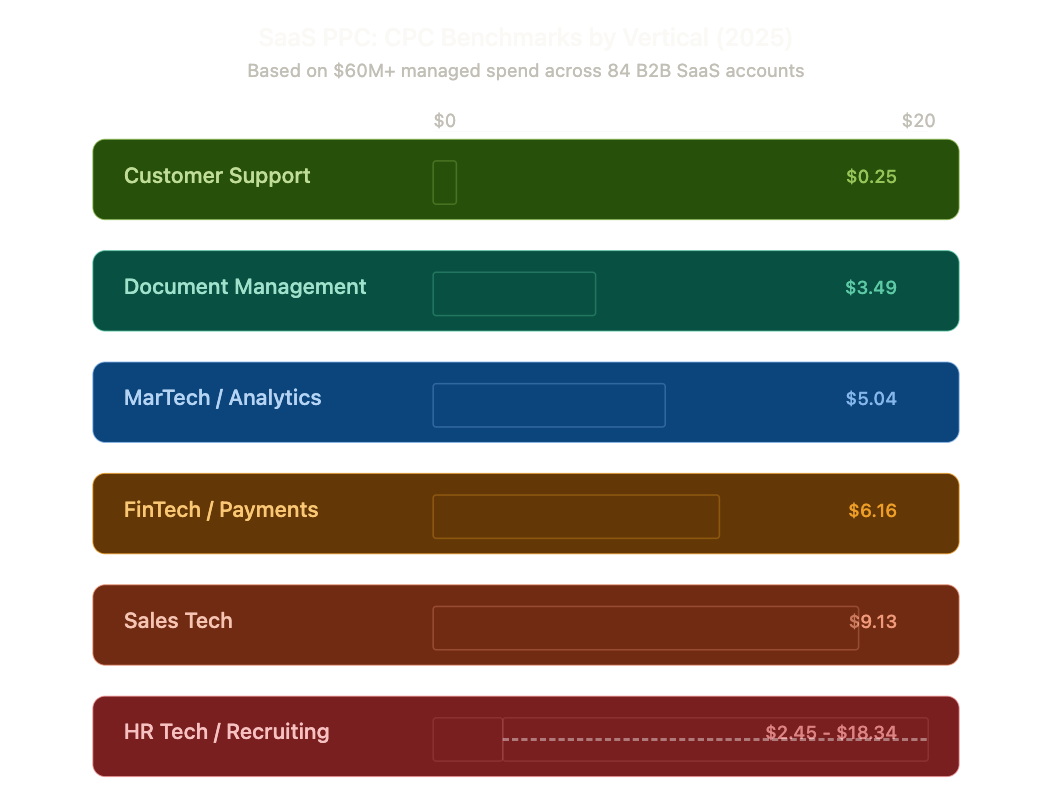
Why is Customer Support CPC so low ($0.25)?
Four reasons drive this:
The commercial intent is lower than other categories. When someone searches “customer support software,” they’re usually in early research mode or hunting for free options—compare that to “enterprise sales CRM” where buyers are further along and ready to spend real money.
The market is also incredibly crowded. Zendesk, Freshdesk, Intercom, Help Scout, and hundreds of other players are all competing for the same keywords, which drives prices down through basic supply and demand.
Contract values play a role too. Most customer support tools run $15-$50 per user per month, so it’s hard to justify paying $10+ per click when your customer lifetime value is measured in hundreds of dollars rather than thousands.
And finally, the buyer journey is different. Support managers typically purchase these tools without going through procurement, so they prefer free trials over sales demos. Lower friction, but also lower tolerance for expensive ads.
Why is HR Tech CPC so variable ($2.45 to $18.34)?
“HR Tech” isn’t one market. It’s five different markets bidding on overlapping keywords.
Low end ($2.45-$5): Simple time-tracking apps and employee scheduling tools. Small businesses shopping on price. Low ACV, high volume. These tools target searches like “free time tracking software” and “employee schedule app.”
Mid-range ($6-$10): Performance management platforms and onboarding software. Mid-market HR teams with budget authority. Searches like “performance review software” or “employee onboarding platform.”
High end ($12-$18.34): Enterprise recruiting platforms (ATS), HRIS systems, and talent management suites. Multi-department buying committees. Long sales cycles. Big contracts. These companies bid on “enterprise ATS” and “applicant tracking system for 1000+ employees.”
Same category keyword (“HR software”), completely different buyer intent and budget tolerance. A $15/month scheduling tool can’t compete with a $100K/year HRIS platform for the same clicks—so they segment by adding qualifiers like “small business” or “free.”
The lesson: Don’t benchmark your CPC against vertical averages. Benchmark against products at your price point solving your specific problem.
3. Campaign Type Mismatch (61% of audits)
You’re selling a $50K/year enterprise platform. Your campaign targets “marketing automation software”—a generic term that attracts everyone from solopreneurs to Fortune 500s.
Generic campaigns attract terrible fits. You pay for clicks that go nowhere.
Match your campaign to your price point:
If you’re selling a low-ticket product under $5K per year, generic keywords and brand campaigns work fine because you can afford to cast a wider net. Your conversion friction is lower and more people fit your budget range.
Mid-market products between $5K and $25K need a different approach—focus your budget on comparison keywords like “X vs Y” or “X alternative,” where buyers are actively evaluating their options and closer to making a decision.
Enterprise products above $25K require the most selective targeting. You want competitor conquesting campaigns and account-based marketing (ABM) strategies that zero in on specific companies and decision-makers, because the higher price point justifies both the narrower focus and the premium CPCs. Our competitor displacement strategies helped Airbase capture $1.7M in ACV from competitor searches.
For high-ticket SaaS, competitor campaigns deliver 2.7x better cost-per-opportunity than generic ones. Higher CPC, way better conversion.
4. Funnel Stage Confusion (58% of audits)
Picture this: Someone searches “what is CRM” (they’re researching). Your ad shows up. They click. Your landing page says “Book a Demo.”
They bounce in three seconds.
Or the reverse: Someone searches “Salesforce pricing” (they’re buying). Your ad shows up. They click. Your landing page is a 3,000-word guide to CRM basics.
Also a bounce.
Map your offers to search intent: Top-of-funnel searches like “what is CRM” need educational content—blog posts, guides, calculators. They’re learning, not buying.
Middle-of-funnel searches like “Salesforce vs HubSpot” signal active evaluation. Give them case studies, comparisons, and webinars.
Bottom-of-funnel keywords like “Salesforce alternative pricing” come from people ready to buy. Demos, trials, pricing pages. Make conversion easy.
When we get this right? 11.3% conversion rate. When we miss? 2.1%. That’s a 5x difference.
5. Ignoring competitor and alternative keywords
Buyers searching "[Competitor] alternative" or "[Competitor] vs [Your Product]" are not browsing — they are evaluating vendors with budget approved and a decision timeline in mind. These are the highest-intent searchers in the SaaS PPC ecosystem.
Despite the higher CPC, competitor campaigns are consistently among the most efficient in our portfolio. Buyers arriving via "[Competitor] alternative" queries close at nearly twice the rate of buyers arriving via category keywords.
From our 2025 book of business:
- Competitor campaigns: $22.21 average CPC
- Generic campaigns: $6.27 average CPC
- Competitor campaigns still deliver MQLs at 39% lower cost despite the higher CPC
The conversion rate more than makes up for the cost per click.
6. Generic ad copy and blunt creatives
AI writing tools have lowered the cost of producing ad copy, but they have not made great copy easier. The result: a wave of generic, interchangeable SaaS ads competing for the same buyers with nearly identical messaging.
Great ad copy communicates your specific value proposition to your specific buyer in a way that makes them feel understood. Generic copy communicates that you are just like every other vendor. High-intent SaaS buyers — the ones with budget and authority — scroll past generic ads without registering them.
Your creatives — video, display, and landing page imagery — carry the same weight. Blunt, template-style creatives will not move a VP of Engineering to request a demo. Invest in copy and creative the same way you invest in your product.
“Cut Sales Cycle by 40%” beats “Advanced CRM Features” every single time. We’ve tested it. 2.3x higher click-through rate.
7. Low Quality Score — and what it is actually costing you
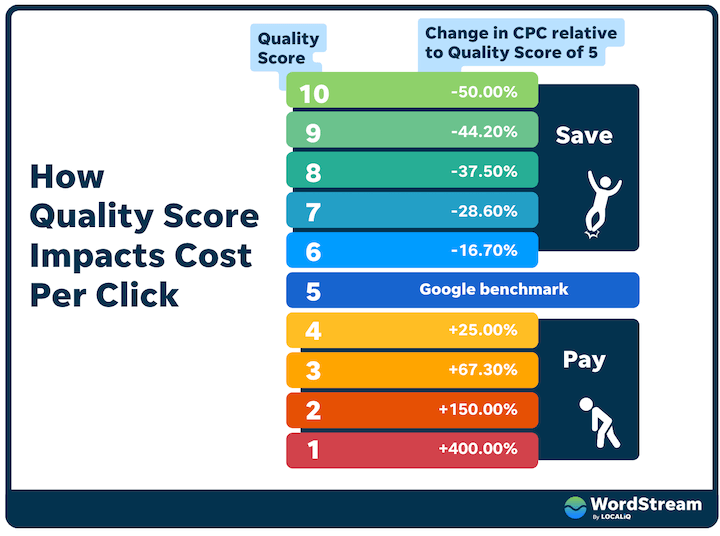
Quality Score is Google's rating of the relevance of your keywords and ads to your target audience. It is calculated from four factors: click-through rate, keyword-to-ad relevance, landing page quality, and historical account performance.
A low Quality Score is expensive in two ways: it increases your cost-per-click and reduces your ad's position in the auction. The combined effect means you can be paying 30–50% more per click than a competitor with a better Quality Score, for a lower ad position. Addressing Quality Score is one of the fastest ways to reduce CPC without changing your budget.
8. Manual campaign management at scale
Manual bid adjustments, budget reallocation decisions, and negative keyword reviews done on a weekly spreadsheet cycle are too slow for today's SaaS PPC environment. By the time a human reviewer identifies an inefficiency and acts on it, thousands of dollars have been wasted on the wrong keywords or audiences.
The campaigns in our portfolio that outperform consistently have automated bid management, real-time budget reallocation between campaigns, and continuous negative keyword mining — all handled by AI agents that operate 24/7. Teams freed from spreadsheet management focus on messaging, positioning, and strategy.
How to Create a Winning SaaS PPC Campaign
SaaS PPC yields an average ROI of $2 for every $1 invested, rising to $8 ROI with Google Ads. [WordStream, 2024] Getting there requires disciplined setup across seven stages. Here is the framework we use at TripleDart.
Step 1: Define your goals and attach specific KPIs
"Get more leads" is not a goal. A goal is: "Increase CRM free trial sign-ups by 20% in 90 days, maintaining CPA below $50." Vague goals produce vague campaigns. Specific goals produce specific targeting, specific bidding strategies, and specific creative briefs.
Structure every campaign goal using SMART criteria:
- Specific: What exactly are you trying to achieve? (Trial activations, demo bookings, MQL volume)
- Measurable: What number defines success? (CPA below $X, ROAS above X:1)
- Achievable: Is the target realistic given your budget and competitive landscape?
- Relevant: Does this campaign goal directly support pipeline or revenue targets?
- Time-bound: What is the evaluation window? (30 days, 90 days, one quarter)
Pair each goal with the right KPIs. For trial sign-ups, track CPA and conversion rate. For pipeline, track CPL, MQL-to-SQL rate, and closed deal value from PPC sources.
Step 2: Define your ICP and build audience personas
In SaaS, you are not selling to companies — you are selling to the people inside those companies: decision-makers, buying committees, and internal champions. These are distinct audiences requiring distinct messages.
Build your targeting by:
- Identifying every company type that could benefit from your solution, then narrowing to the best-fit 2–3 segments
- Finding the decision-makers within those companies — titles, functions, seniority levels
- Researching where those buyers spend time online and what triggers a purchase decision for them
- Building detailed buyer personas with demographics, psychographics, pain points, and buying triggers
Divide your audience into three tiers by buying readiness:
- Hot leads (BOFU) — actively evaluating vendors, budget approved, decision imminent
- Warm prospects (MOFU) — aware of the problem, researching solutions, 30–90 days from decision
- Long shots (TOFU) — adjacent audience, not yet actively searching, requires nurturing
Each tier requires different bid strategies, different creative angles, and different landing page experiences. A single blanket campaign targeting all three will underperform across all three.
Case Study: SingleStore — Targeting Transformation
The challenge
SingleStore was running LinkedIn Ads and generating clicks but not conversations. Their targeting was simultaneously too narrow in some segments and too broad in others.
Step 1 — Audit and ICP refinement: We analysed who was engaging and who was converting. Campaigns targeted engineering leaders broadly. Some were too senior to care; others were the wrong function entirely. We mapped a precise ICP: Hi-Tech companies using functional databases critical to their operations, specifically VP/Director/Head of Engineering at mid-market (250–1,000 employees) and enterprise (1,000–10,000 employees) companies.
Step 2 — Persona build and audience sizing: We built personas around two pain points — traditional SQL tools slowing query performance, and the business impact of that slowdown. We then forecasted audience size to confirm it was large enough to scale but specific enough to drive quality.
Step 3 — Funnel structure: TOFU for brand awareness, MOFU retargeting for product messaging, BOFU push campaigns for high-intent demo requests. Budget was reallocated dynamically toward traction.
Result
Over three months: 20–30% decrease in cost per MQL.
Step 3: Conduct strategic keyword research
Keyword research for SaaS PPC is not the same as for SEO. You are not looking for high-volume terms — you are looking for high-intent terms that indicate a buyer, not a researcher.
Use Ahrefs, SEMrush, or Google Keyword Planner. Start with your primary category keyword (e.g., "CRM" for Salesforce) and map outward to:
- High-intent, lower-volume terms: "CRM for sales teams" vs "what is CRM"
- Competitor and alternative terms: "[Competitor] alternative", "[Competitor] vs [Your Product]"
- Use-case terms: "CRM for real estate agencies", "CRM for financial advisors"
- Long-tail terms: These perform 2.5x better than head terms in our B2B SEO and PPC data combined. Lower CPC, higher relevance, better conversion rate.
Also mine Quora, Reddit, and Google's "People Also Asked" for the exact language your buyers use when describing their problems — then match that language in your ad copy.
Step 4: Choose the right channel and understand CPC by platform
Google Ads is the dominant PPC platform — and the right default starting point for most SaaS companies targeting buyers with active search intent. But the best SaaS campaigns are increasingly multi-channel.
Start with one channel, build a robust strategy, then expand. Most leading SaaS companies use at least three — typically Google, LinkedIn, and either Meta or Bing — but only after proving the model on a primary channel first.
Step 5: Set your bidding strategy and baseline CPC
Bidding strategy should follow campaign goal and funnel stage:
- TOFU (awareness): CPC bidding gives you cost control while building data. Prioritise impressions and clicks to drive traffic and gather signals.
- MOFU (consideration): Blend CPC and conversion-focused bidding depending on the offer. Retargeting audiences here can use ROAS targets effectively once you have conversion data.
- BOFU (decision): Aggressive CPA or ROAS bidding on high-intent keywords. These campaigns can absorb higher CPCs because the buyer intent quality justifies the cost.
Before launching, set an explicit CPC range — a lower limit, an upper limit, and a tolerance for fluctuation. Without this baseline, the learning phase feels like failure when it is actually the algorithm calibrating.
Step 6: Build ad copy and creatives that earn the click
Your ad copy is the first impression of your brand to a buyer who has never heard of you. Every line must communicate your value proposition specifically and differentiate you from the 4–8 other ads competing for the same click.
What effective SaaS ad copy must do:
- Reflect your brand's core identity — tone, promise, and positioning must be consistent
- Speak to the buyer's specific pain point, not your product's features
- Include a clear CTA that matches where the buyer is in the funnel (Book a demo / Start free trial / See pricing)
- Be consistent with the landing page — the promise in the ad must be fulfilled on the page the buyer lands on
Invest in human copywriters for your most important campaigns. AI tools accelerate production — they do not replace the nuance, emotional intelligence, and persuasion of a skilled writer, especially for high-value B2B buyers.
Step 7: Build a high-converting landing page
The click is the beginning, not the conversion. Your landing page is where PPC ROI is won or lost. Poor mobile responsiveness, slow load speed, cluttered layout, or a mismatched message from the ad will cause immediate bounce.
A high-converting SaaS landing page must include:
- A clear headline that matches the promise of the ad exactly
- Fast load speed — every second of delay costs roughly 7% in conversion rate
- Benefit-oriented copy written for the customer, not the product team
- A prominent, single call-to-action — one page, one goal
- Social proof: testimonials, review counts (Clutch/G2), named client logos
- Trust signals: security certifications, compliance badges, guarantees
- Mobile-first design — over 60% of B2B research happens on mobile
Create distinct landing pages for distinct campaign types — your brand campaign landing page should look different from your competitor campaign landing page, which should look different from your category page.
Introduce negative keywords before launch
Before going live, build your negative keyword list. This filters out irrelevant traffic — job seekers, students, competitors doing research — and prevents your budget from being consumed by clicks that will never convert. Negative keywords are one of the highest-ROI, lowest-effort optimisations in SaaS PPC.
Track, measure, and optimise continuously
After launch, resist the urge to intervene immediately. Give campaigns at least 1–2 weeks to gather data before optimising. Then review:
- High CPC with low conversions → likely targeting or Quality Score issue
- Low CTR → ad copy or audience mismatch
- Good CTR but low conversion → landing page problem
- High conversion rate but unprofitable CPA → bidding strategy or keyword cost issue
Advanced SaaS PPC Strategies for Scale
Once the basics are working, here’s how to level up.
1. Competitor Conquesting (The Right Way)
Bidding on competitor keywords works—but only if you’re strategic.
The framework:
Tier 1 competitors (direct alternatives): Aggressive bidding, dedicated comparison pages
Tier 2 competitors (similar but different): Moderate bidding, highlight your differentiators
Tier 3 competitors (adjacent categories): Low bidding, educational content
Real data from 2025:
- Tier 1: $89 CPL, 6.2% conversion
- Tier 2: $104 CPL, 4.1% conversion
- Tier 3: $127 CPL, 2.8% conversion
2. Retargeting for Long Sales Cycles
B2B SaaS sales run 60-180 days. Retargeting keeps you top-of-mind.
The sequence:
- Days 1-14: Educational content (blog posts, guides)
- Days 15-30: Social proof (case studies, reviews)
- Days 31-60: Product demos, feature comparisons
- Days 61+: Aggressive offers (extended trials, discounts)
Retargeting generates MQLs at 45% lower CPL than cold campaigns. Conversion rate: 7.8% vs 3.2%.⁴
3. AI Agents for the Heavy Lifting
We covered the AI budget agent earlier. Here’s what else gets automated:
- Keyword mining: Spots high-potential keywords in search term reports
- Bid adjustments: Real-time changes based on conversion likelihood
- Ad copy testing: Generates and tests variants automatically
- Audience segmentation: Finds patterns humans miss
Results: 22% higher ROAS, 18% lower CPL, 95% less manual time.⁴
4. Signal-based marketing
This is the biggest shift we’ve made.
Instead of waiting for form fills, we identify buying signals across platforms—website visits, content downloads, pricing page views, competitor research. Then we kick off sales outreach immediately.
One client cut their sales cycle from 87 days to 52 days with this approach. That’s a 40% reduction.
Case Study: SingleStore's Targeting Transformation
SingleStore was running LinkedIn Ads. They were getting clicks, but the engagement wasn't turning into leads and eventually into real conversations. The problem was that their targeting was too narrow in some cases and too broad in others which prevented them fromreaching the right people.
Step 1: Digging Into LinkedIn Ads & Refining the ICP
The first thing we did was audit their LinkedIn Ads. Who was engaging? Who was converting? And more importantly, who wasn't? Their campaigns targeted engineering leaders, but some were too senior to care, while others weren't the right fit.
We mapped out an Ideal Customer Profile (ICP) and narrowed it down to Hi-Tech Companies using functional databases critical to their business. These were people who actively needed better product storytelling. From there, we adjusted our targeting to focus on native LinkedIn functions and job titles that matched this persona.
Step 2: Creating Personas and Forecasting Audience Size
With a refined ICP, we built detailed personas:
Role:
- VP/Directors/Head of Engineering and IT
- Managers, Senior Engineers, and IT functions
Company Size:
- Mid-Market: 250-1000 Employees
- Enterprise: 1000-10000 Employees
Pain Points:
- Using traditional SQL tools slows down query time and affects database performance. This impacts customer experience as well as business operations
- SingleStore replaces this with high-performance query speeds
Buying Triggers:
- Traditional Query Tools slow down the performance at scale, hence, adopt SingleStore
We then forecasted the audience size to ensure it was large enough to scale and specific enough to drive quality leads. This helped us chalk out a demo account list.
Step 3: Structuring the Funnel
We set up a structured ad funnel:
- TOFU (Awareness): Broad ads to introduce the brand
- MOFU (Consideration): Retargeting engaged users with product messaging
- BOFU (Decision): Push campaigns driving demos for high-intent leads
We adjusted the budget dynamically, pushing harder where we saw traction and pulling back on underperforming segments.
Results
Over three months, we fine-tuned audience mapping, ad creatives, and budget allocation. This led to a 20-30% decrease in cost per MQL.
Challenges in SaaS PPC and How to Overcome Them
Running SaaS PPC isn't exactly a walk in the park. Here are the most common hurdles and how to get past them.
Challenge 1: Lack of experienced in-house PPC talent
Many SaaS founders hire one generalist to handle strategy, copy, design, analytics, and optimisation simultaneously. SaaS PPC demands specialists: one person for campaign strategy, one for creative, one for data analysis. A generalist covering all four functions will underperform in each one.
The practical solution for most SaaS companies is an agency partnership rather than building a full in-house team. Consider the true cost of building in-house: a mid-level PPC specialist costs roughly $64,000 per year in salary, a copywriter another $71,000, and a designer and analyst on top of that. A full-stack in-house team frequently exceeds $250,000 in annual cost before you account for tools, benefits, or management overhead.
A PPC agency provides ready-made specialists, battle-tested strategies, access to premium tools, and experience across dozens of SaaS verticals — for a fraction of the all-in cost of an equivalent in-house team.
Challenge 2: The SaaS market is more crowded than ever
AI tools have dramatically lowered the barrier to building SaaS products. More companies now target the same buyers with increasingly similar products, which means your ads are competing against more entrants in the same auction, for buyers who are more sceptical and more informed than ever.
The answer is not to spend more — it is to be more specific. Generic category ads lose to specific, value-differentiated ads every time. The SaaS companies winning in paid search in 2026 are the ones whose ads speak to a specific pain point for a specific buyer, not the ones with the largest budgets.
Challenge 3: Budget constraints vs what PPC actually requires
SaaS PPC is not a channel where you can test with $500/month and draw meaningful conclusions. Most B2B SaaS categories require a minimum test budget of $3,000–$5,000/month to generate enough data for the algorithm to optimise effectively. Below this threshold, campaigns stay in a perpetual learning phase and never reach efficiency.
If budget is constrained, prioritise a narrow, high-intent campaign on one channel over a broad, low-budget campaign across multiple channels. A focused $5,000/month Google Ads campaign targeting BOFU competitor and category terms will outperform a $5,000/month spread thinly across Google, LinkedIn, and Meta.
When to Bring in Experts vs. Do It In-House
Here’s the honest math.
In-House Team Costs
Year one:
- PPC specialist: $64,000
- Copywriter: $71,000
- Designer: $68,000
- Analyst: $72,000
- Tools: $12,000
Total: $287,000
Average first-year results: $142 CPL, 3.1% conversion, 2.1x ROAS.³
Agency Partnership Costs
Typical retainer: $8K-$15K/month = $96K-$180K/year
What you get:
- Full team (strategist, copywriter, designer, analyst)
- Proven playbooks
- Advanced tools and platforms
- Experience from 100+ accounts
The breakeven: If an agency improves your ROAS by 30%, the cost pays for itself.
Average results after 6 months with us: 47% lower CPL, 68% higher MQL volume, 2.9x ROAS.⁴
When In-House Makes Sense
Build in-house when:
- Monthly ad spend >$100K (can support a full team)
- You have existing marketing leadership
- Your product needs deep technical knowledge
- You’re hiring senior specialists, not generalists
When Agency Makes Sense
Deciding between building an in-house PPC team and partnering with an agency is one of the first strategic choices you’ll make, and the answer isn’t always obvious. An agency makes the most sense when your monthly ad spend is under $100K, because you’re still testing whether PPC can generate the pipeline your business needs. At that stage, you don’t yet have the conversion data or performance history to justify hiring a dedicated team, which can easily cost $250K+ annually when you factor in salaries, benefits, tools, and training.
You should also consider an agency if you need results quickly. Building an in-house PPC function from scratch takes 12 to 18 months—time spent recruiting, onboarding, training, and building institutional knowledge. An agency, by contrast, brings proven playbooks and can start driving results within 3 to 6 months. This speed matters especially for growth-stage SaaS companies where hitting pipeline targets determines your next funding round.
Another strong signal that you should work with an agency is when you lack internal PPC expertise. If your marketing team doesn’t have deep experience with Google Ads, LinkedIn Campaign Manager, or Meta Ads Manager, the learning curve is steep. PPC platforms change constantly, and mistakes can burn through budget fast. Agencies already know what works, what doesn’t, and how to avoid expensive missteps.
Finally, if you want to test PPC before committing to permanent hires, an agency gives you that flexibility. You can run campaigns for 6 to 12 months, measure the ROI, and then decide whether to bring the function in-house once you have enough data to justify it.
Most companies follow a hybrid path. They start with an agency, scale to $100K+ per month in ad spend, then bring PPC in-house once they have enough volume and complexity to support a full team. At that point, the agency might stay on as a strategic partner for advanced tactics like programmatic buying or creative production, while the in-house team handles day-to-day campaign management.
Here’s how different-sized SaaS companies typically decide:
Small SaaS (early-stage): A company with under $100K per month in ad spend usually prefers an agency because they don’t yet have the budget or performance data to justify hiring a full-time PPC specialist. For example, a Series A SaaS company spending $15K/month on Google Ads might work with an agency to test different keyword strategies, build out landing page variants, and determine which campaigns generate the highest-quality pipeline before committing to permanent hires.
Mid-sized SaaS (growth-stage): A company with $100K to $500K per month in ad spend often tries a hybrid model, where they have one or two in-house PPC specialists who manage day-to-day campaign operations, while the agency handles specialized work like programmatic buying, creative production, or advanced analytics. This gives them the control and institutional knowledge of an in-house team, plus the specialized expertise and cross-client insights that agencies bring.
Large SaaS (enterprise): A company with over $500K per month in ad spend typically builds a full in-house PPC team with dedicated specialists for Google Ads, LinkedIn, Meta, creative production, and analytics. At this scale, they have enough volume and complexity to justify the investment in full-time hires. The agency, if they’re still involved, becomes a strategic partner who provides high-level consulting, advanced reporting, or overflow support during peak campaign periods like product launches or major industry events.
SaaS PPC Trends in 2026
The SaaS PPC landscape is shifting faster than most marketers realize, and if you’re still running campaigns the way you did in 2023, you’re already behind. Three major trends are reshaping how high-performing teams buy ads, create content, and measure success. Understanding these trends isn’t just about staying current—it’s about maintaining competitive advantage in an increasingly automated, creative-driven, and data-saturated advertising environment.
1. Programmatic advertising
Programmatic advertising uses digital automation to buy and sell ad space, enabling hyper-targeted campaigns and more efficient budget allocation through advanced audience data. The global market value for programmatic ads topped $200 billion in 2023 and is projected to reach $300 billion by 2026.
As AI and automation become more accessible, programmatic is moving from optional to essential for SaaS companies managing multi-channel campaigns at scale. If you are not running programmatic retargeting today, you are manually doing work that competitors are automating.
2. Ad retargeting as a longer-term nurture tool
Not every prospect will click your ad the first time — and in B2B SaaS, that is the norm rather than the exception. Sales cycles for SaaS products are longer than B2C, and most buyers require multiple touchpoints before committing. Retargeting keeps your brand present through that evaluation period.
Retargeting audiences that have visited your pricing page, viewed your demo video, or downloaded a case study convert at dramatically higher rates than cold audiences — and at a fraction of the CPC. Separating retargeting campaigns from prospecting campaigns is one of the simplest structural improvements available to most SaaS accounts.
3. Non-branded and UGC-style creatives
Non-branded creatives — screenshots, reviews, product demos, and user quotes that feel organic rather than polished — consistently outperform branded studio-quality ads in terms of click-through rate and lead quality for SaaS. They feel authentic to buyers who have been trained by years of ad exposure to ignore polished brand advertising.
The best performing creative in our portfolio for 2025 was not a professionally produced brand video — it was a screen-recorded product demo with a narrated voiceover showing exactly how a specific feature solved a specific problem. Zero production budget. Top-performing CTR across the account.
4. AR and VR as emerging SaaS advertising channels
AR lets users visualise your product in real-world settings. VR provides immersive demos or training environments that deepen product understanding. These are not mainstream SaaS PPC channels yet, but they are no longer fringe. VR advertising generated $166 million in revenue in 2023, with projections pointing to $174 million by end of 2025. SaaS companies that begin experimenting now will have an advantage as adoption grows.
The AI Agent Revolution in SaaS PPC
In 2025, TripleDart moved from manual campaign management to a hybrid of human expertise and AI agents. This has fundamentally changed how we manage PPC campaigns — and how our clients' campaigns perform.
What AI agents do in a PPC context
AI agents are specialised tools that handle repetitive tasks, identify patterns in data, and make adjustments faster than any human team can. Unlike basic automation rules, they learn from data and improve over time. The key functions where AI agents now operate across our portfolio:
- Dynamic keyword management: Automatically sourcing new keywords, analysing performance, and classifying them into high-performing or negative lists — without waiting for weekly reviews
- Budget optimisation: Tracking performance throughout the day and shifting budget between campaigns in real time based on what is working
- Ad copy generation and testing: Creating multiple variants based on proven frameworks, then prioritising the variants showing the strongest response — removing guesswork from the creative testing process
- Audience segmentation: Uncovering new customer segments by identifying conversion patterns that manual analysis would miss or identify too slowly
- Competitor intelligence: Tracking competitor ads, detecting new entrants in the auction, and flagging significant changes in competitor strategy before they affect your own performance
- Omnichannel attribution: Building a complete picture of the customer journey across touchpoints and assigning credit accurately — resolving the attribution mess that typically plagues multi-channel SaaS campaigns
Why this approach wins: speed and scale
The biggest advantage of AI agents in PPC is speed. They adapt to real-time market changes — CPC spikes, competitor bid changes, performance drops — far faster than any human team operating on weekly review cycles. They make thousands of micro-adjustments, 24/7, freeing PPC specialists to focus on high-level strategy: messaging, positioning, channel expansion.
Important caveat
AI agents excel at pattern recognition and data-driven execution. They lack brand context, emotional nuance, and strategic intuition. The highest-performing campaigns combine AI agents for execution with human expertise for strategy. We treat this as a partnership — not a handoff.
Results across 47 client accounts:
- 22% ROAS improvement
- 18% CPL reduction
- 34 hours/month saved
Case Study: AI Agent for Budget Optimisation
The challenge: SaaS campaigns often run across multiple platforms, each with varying performance. Manual budget reallocation — done weekly or even daily by a human — is always lagging behind actual performance. The goal: ensure every dollar flows to the campaigns driving the most value, in real time.
The process:
- Aggregate campaign data: Pull real-time performance data from all active campaigns across platforms
- Normalise via Python: Clean, standardise, and structure the data for analysis
- Analyse with LLM-powered AI agent: Evaluate daily spend and ROI trends, pinpoint high-performing campaigns to scale, flag low performers for budget cuts, and generate reallocation recommendations
- Generate executive summary: Produce a digestible report with performance shifts, budget recommendations, and actionable insights for both the internal team and the client
What makes this system powerful is adaptive thinking. It does not just pause underperformers — it actively reinvests that budget into better-performing campaigns.
Results
Faster budget decisions, higher return on ad spend, and greater client visibility through simple, data-driven reports. Budget decisions guided by the latest performance data — not guesswork or lagging weekly metrics.
Before AI:
- Manual budget reviews: Weekly
- Reallocation speed: 3–5 days
- ROAS: 2.1x
After AI:
- Automated reviews: Every 6 hours
- Reallocation speed: Real-time
- ROAS: 2.7x (+28%)
Data Methodology
Everything in this guide comes from our portfolio of 84 actively managed B2B SaaS Google Ads accounts (January 1 - December 31, 2025).
Portfolio breakdown:
- 10 accounts analyzed in depth (the CPC benchmarks table)
- 74 accounts included in aggregate metrics
- Combined ad spend: $60M+
- Industries: FinTech, MarTech, HR Tech, Sales Tech, Document Management, Customer Support
Case study results (Plivo, CleverTap, DocketAI) = actual client outcomes during stated periods. Data’s been anonymized. Published with client permission.
Statistical significance: All reported improvements (conversion rates, cost reductions) come from campaigns with 1,000+ clicks and 50+ conversions minimum. 95% confidence level.
TripleDart: Certified Partner Network
We’re certified partners with: - Google Ads (Premier Partner since 2021) - Meta Business Partner (Advanced tier) - LinkedIn Marketing Solutions Partner - HubSpot Elite Partner
Find us in Google’s Partner Directory
Ready to See What Your PPC Could Be?
Look, most in-house teams burn budget with scattered campaigns, mismatched messaging, and “experts” who deliver activity reports instead of results.
SaaS PPC delivers 2.8x ROAS median when you optimize for revenue, not clicks.
Why Work With Us?
We’ve done this before. $60M+ managed across 84 SaaS companies in 2025.
Real results. Our clients see 47% lower CPL and 68% higher MQL volume within 6 months on average.
Full team, not one person. Strategists, copywriters, designers, analysts—not a generalist trying to do everything.
AI-powered workflows. Our agents handle optimization 24/7 while our team focuses on strategy.
Recent wins:
- Plivo: 78% MQL increase, 2x pipeline, 10% CPL reduction (6 months)
- CleverTap: 40% MQL-to-SAL improvement, 20% cost per SAL reduction
- DocketAI: 1:18 spend-to-pipeline ratio via LinkedIn ABM
"TripleDart has been a dream partner. The team is intelligent and responsive and delivers what they promised. We have made huge progress in our growth marketing efforts with TripleDart." — Drew Wallace, Head Performance Marketing at SpotDraft
Want to see what we can do for you?
Get a free PPC audit → We’ll show you exactly where you’re leaving money on the table.
FAQ
What is SaaS PPC?
SaaS PPC (Software-as-a-Service Pay-Per-Click) is a digital advertising model in which SaaS companies bid on keywords and pay only when their ads receive a click. These ads appear on search engines, social media platforms, and other digital channels, targeted at potential buyers of the software.
Why is PPC important for SaaS companies?
SaaS has a longer sales cycle than most categories, higher customer lifetime values, and buyers who research extensively before committing. PPC gives you control over exactly when, where, and to whom your product appears — independently of organic ranking. It also generates 2.3x more leads than SEO in our portfolio and closes leads at a 12% rate compared to 8% for organic.
What are the best PPC platforms for SaaS?
Google Ads is the primary platform for capturing active search intent. LinkedIn Ads are uniquely effective for account-based targeting by function, seniority, and company size. Facebook and Meta Ads work well for retargeting and awareness-stage campaigns. Bing Ads is often overlooked but delivers lower CPCs for similar intent. Most mature SaaS PPC programmes use at least three platforms, starting with Google and layering in LinkedIn once the primary channel is optimised.
What are the key metrics to track in SaaS PPC?
Track these:
- Cost per click (CPC)
- Cost per lead (CPL)
- Conversion rate by funnel stage
- Return on ad spend (ROAS)
- Customer acquisition cost (CAC)
- Cost per customer
- Quality Score (Google Ads)
But optimize for pipeline contribution and revenue impact, not just lead volume. MQLs that never convert waste budget.
How long does it take to see results from SaaS PPC?
First clicks can appear within hours of launch. Reliable performance data typically requires 2–4 weeks, allowing the platform algorithm to optimise delivery. Most SaaS accounts reach stable, repeatable performance by week 8–12. Treat month one as a data-collection period and budget accordingly — campaigns that are paused too early during the learning phase never reach the efficiency that justified the investment.
What’s the minimum budget to start SaaS PPC?
$7,500-$10,000/month minimum.
Why? It covers the platform learning period (2-3 weeks of higher CPCs) and generates enough conversion data to make smart decisions. Anything less rarely produces actionable insights.
How do I know if my agency is doing a good job?
Track these:
- CPL trending down month-over-month
- MQL volume stable or increasing
- ROAS improving quarter-over-quarter
- Regular reporting with actionable insights (not just data dumps)
- Proactive recommendations based on performance
- Transparent communication about what’s working and what’s not
If your agency only reports metrics without explaining why performance changed, that’s a red flag.
Why use an agency instead of building in-house?
Better results at lower total cost.
Cost comparison:
- In-house team: $250K+/year
- Agency: $96K–$180K/year
Performance comparison:
- Agency average: $118 CPL, 4.8% conversion, 3.2x ROAS
- In-house average (year one): $142 CPL, 3.1% conversion, 2.1x ROAS
Agencies bring proven playbooks, advanced tools, multi-client experience, and specialized expertise. Building that in-house costs 2-3x more.
Why should I use a PPC agency for my SaaS company?
SaaS PPC requires specialised expertise, strategic planning, keyword research, ad creation, and performance analysis tailored to your business needs. A specialised agency provides the resources to manage your campaigns for better ROI -and helps you redirect your time to core business activities.
What makes SaaS PPC different from regular PPC?
Several things:
Longer sales cycles: B2B SaaS takes 60-180 days vs days/weeks for e-commerce
Higher deal values: $10K-$500K+ ACV vs $50-$500 for most products
Multiple decision-makers: 6-10 stakeholders vs individual buyers
Complex attribution: Multi-touch across months vs last-click
Funnel stage segmentation: TOFU/MOFU/BOFU campaigns required vs single conversion goal
These differences demand specialized strategies like competitor conquesting, signal-based engagement, and long-term retargeting.

Related Posts



%20(1).png)


.webp)
.webp)
.webp)



%20Ads%20for%20SaaS%202026_%20Types%2C%20Strategies%20%26%20Best%20Practices%20(1).webp)

We'd Love to Work with You!
Join 70+ successful B2B SaaS companies on the path to achieving T2D3 with our SaaS marketing services.