

.png)


Key Takeaways
- International SEO is not translated SEO. Domain structure, hreflang, content localization, and regional authority all need to move together. Miss one piece, and traffic leaks in every market you enter.
- Start with market signal, not ambition. Your Google Analytics geo report and competitor rank data tell you which locales deserve budget before a single landing page gets translated.
- Subfolders are the default for most B2B SaaS. ccTLDs win on local trust but cost you domain authority split five ways; subdomains are almost never the right answer.
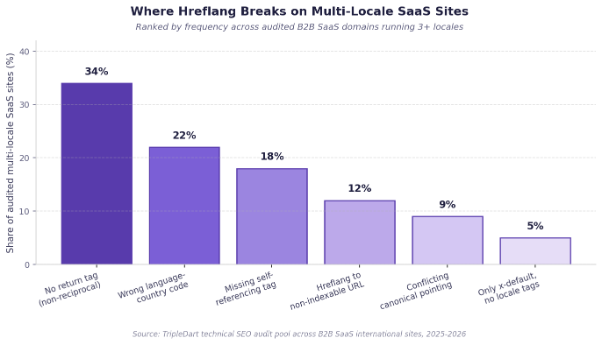
- Hreflang is where most international SaaS sites break silently. Missing return tags, wrong language-country codes, and canonical conflicts are the top three errors we find in audits.
- AI Overviews already ship answers in German, Portuguese, Japanese, and more. If your locale pages aren't cited, a competitor's are. Your pipeline feels it before your dashboard does.
- Long-tail keywords now generate 68% of SaaS organic traffic, up from 58% in 2023, driven by more specific, intent-driven search behavior across locales.
- TripleDart, an AI-native SaaS marketing agency, runs international SEO for B2B SaaS from seed to enterprise. Book a strategy call to map your multi-market rollout.
You've spent months building a product that works beautifully in English. Now leadership wants to "go global," and someone suggests translating the blog into four languages over a weekend.
That's not international SEO. That's a recipe for leaking traffic in every market you enter.
International SEO for SaaS is a distinct discipline. Domain structure, hreflang implementation, content localization, and regional authority building all need to move in lockstep. Miss one, and the others can't compensate.
The global SEO market crossed $100 billion in 2025 and is tracking toward $143.9 billion by 2030. For B2B SaaS companies, that growth curve means massive headroom to reach untapped international markets and grow your user base before competitors claim the category keyword in each locale.
This guide covers the full playbook. From picking your first locale to earning AI Overview citations in German, Portuguese, and Japanese, so your SaaS product ranks, gets cited, and converts across every market that matters.
Let's get started.
What Is International SEO and How Does It Differ From Traditional SEO?
International SEO is the process of optimizing your website so search engines know which countries and languages you target, while making sure your content matches how locals actually search. Our SaaS SEO playbook treats it as two moves stacked: signal your locale intent to crawlers, then deliver content that answers the way each audience asks.
Consider a project management SaaS trying to tap into the German market. Optimizing with German keywords and creating localized content addressing time-tracking and efficiency (key concerns for German professionals) opens the door. Without international SEO, the product stays invisible to German users actively searching for those exact features.
Why Do SaaS Companies Need International SEO?
SaaS products are inherently borderless. Search engines are not. International SEO bridges that gap, letting you reach customers across the globe regardless of their language or location.
Attracting Diverse Customer Bases
With international SEO, SaaS companies target new regions and tap into customer bases eager for local-language options. Your product goes beyond your home country and into untapped global markets. CSA Research found 76% of global consumers prefer buying products with information in their native language, and 40% won't buy from sites that skip it.
That's not a preference. That's a dealbreaker.
Staying Competitive in Emerging Markets
Emerging markets like Southeast Asia, Latin America, and Africa are adopting SaaS fast. By optimizing for these regions early, your SaaS company can establish dominance before competitors even notice the search volume moving.
The teams that localize content for international markets early own the category keyword in each locale before a local competitor has a chance to claim it.
Achieving Higher Search Rankings Across Locales
International SEO takes the primary goal of traditional SEO and amplifies it for global markets. By tailoring keywords, meta tags, and content for specific languages and regions, your SaaS brand is more likely to rank higher in local search engines. That drives visibility and credibility among local audiences.
How Should SaaS Companies Get Started With International SEO?
The difference between SaaS teams that compound internationally and those that stall comes down to sequencing. Here's the step-by-step approach we run across our portfolio.
1. Define the Business Case for International SEO
Building a data-driven case for going global means linking it to your goals, identifying market opportunities, and proving ROI. Without this, leadership will dismiss international SEO as an unnecessary cost.
Align with leadership. Schedule a strategy meeting and present clear examples: "Our competitor increased revenue by 30% in Europe after investing in localized content. Let's aim for the same." Define goals like "Increase website traffic by 50% from APAC regions in the next six months."
Identify your target markets. Check your Google Analytics geo report via Audience > Geo > Location. If 20% of your traffic is from Germany but you never targeted it, that's a goldmine. Use Statista for SaaS adoption rates in specific countries. Map where your competitors are ranking. If they're dominating in the UK, it's time to give them real competition.
2. Create a Regional SEO Strategy
A one-size-fits-all approach won't work. Each market needs unique tactics based on local preferences, search behavior, and cultural nuances.
- Define target audience personas that reflect local demographics, interests, and search behaviors. In the US, your persona might be tech-savvy professionals. In Brazil, it could be small business owners seeking affordable options.
- Set specific goals for each market. Not "more traffic" but "increase organic traffic from the UK by 40% in six months" or "generate 200 qualified leads per month in the US."
- Allocate budget wisely. Focus on high-traffic regions like the US, UK, and India first, then allocate a more modest budget to emerging markets based on growth prospects.
3. Choose the Right Domain Strategy
Your domain strategy affects search engine authority, user experience, and SEO scalability. This is one of the most important SEO considerations for SaaS international markets.
For most B2B SaaS, subdirectories are the right default because they inherit the root domain's authority. ccTLDs are better when local brand trust is critical or when you're large enough to compound authority on five separate domains.
Implement a consistent URL structure. If you're targeting the UK and France with subdirectories, use example.com/uk/ and example.com/fr/. Adding example.com/de/ for Germany later doesn't require overhauling the system.
4. Conduct Comprehensive Keyword Research Per Locale
This is like learning regional slang: you need to understand your audience's language, intent, and vibe. Our keyword research playbook shows how to rebuild the map per market rather than translate an English list.
Use the right tools. Enter general terms like "HR software" into Ahrefs, SEMrush, or Google Keyword Planner and narrow to specific countries. In the UK, "payroll software" captures local intent better than "HR software."
Factor in local language and intent. In the UK, people search for "invoice software," while in Australia they might use "billing software." Use Google Trends to see how SaaS SEO funnel keywords fluctuate by region.
Analyze competitor keyword gaps. Check which high-intent keywords your competitor ranks for in India versus Australia. Pay attention to featured snippets and top-ranking pages. They reveal the search intent and content types that resonate locally.
This is a common question on Reddit too. One thread in r/SEO asked about implementing international SEO for a SaaS website, and the consensus was clear: keyword research per locale is non-negotiable, and machine-translated keyword lists consistently underperform native research.
5. Localize Content Beyond Translation
Localization is about making your content feel like it was created in the local market, not adapted for it. If you're launching in European Spanish, for example:
- Translate app or website content accurately
- Use visuals that resonate with the target audience
- Display prices in Euros for regional relevance
- Adapt forms to accommodate two surnames (common in Spain)
- Ensure GDPR compliance with a legal review
- Offer local payment methods like SEPA or PayPal
Hire a native speaker. These experts can rewrite your product descriptions in a way that clicks with your target audience. Avoid machine translations. Tools like Google Translate miss the nuance.
Adapt imagery, tone, and CTAs. In Japan, go for minimalist designs and professional tones. In Brazil, use vibrant visuals and playful language. Our SaaS content strategy framework has the full map.
Solve local pain points. If your US customers care about scalability but your Indian audience prioritizes affordability, tailor your messaging to match. This is how you build a strong content diversification strategy across locales.
6. Implement Technical SEO for International Audiences
Technical SEO ensures search engines understand your site's structure, while users experience fast, optimized performance regardless of their location. Our technical SEO guide walks through the fuller audit flow.
Use hreflang tags correctly. Hreflang tags help search engines understand which version of your site to show based on language and region:
\<link rel="alternate" hreflang="en-us" href="https://example.com/us/">
\<link rel="alternate" hreflang="fr-fr" href="https://example.com/fr/">
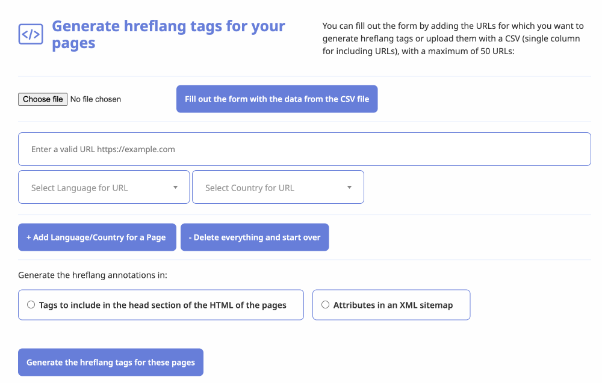
Use Aleyda Solis' Hreflang Tags Generator to create tags quickly, then run a check with SEMrush's International SEO report to fix issues.
Optimize page speed and mobile experience. Use Google PageSpeed Insights to identify speed issues per region. If your SaaS site is slow in India, PageSpeed Insights might flag large images as the cause.
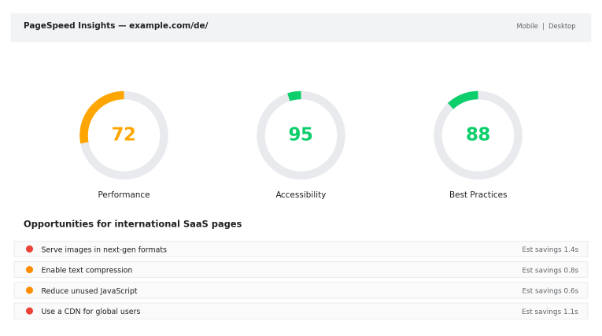
Implement a CDN. A CDN like Cloudflare or Akamai caches content on servers closer to your audience. If your primary server is in the US but you're targeting Southeast Asia, a CDN drastically improves load times.
Set geo-targeting in Google Search Console. If you're using subdirectories or subdomains, go to Google Search Console and configure geo-targeting to align with your regional focus.
7. Build a Backlink Strategy for Each Market
What works in one market won't always work in another.
In the UK, links from .uk domains or respected sources like BBC carry more authority. In France, backlinks from Le Monde or Le Figaro and industry-specific French blogs carry high authority. Our SaaS link building playbook shows how to scope this per market.
- Research high-authority websites, blogs, and forums popular in your target markets. For Germany, identify industry-specific sites like t3n.de for SaaS-related topics.
- Partner with local influencers who can share your content and link back to your website.
- Sponsor events or trade shows in your target country and get backlinks from their websites.
Building backlinks in non-English markets is one of the most discussed challenges in the SaaS community. A recent thread in r/SaaS on international markets and AI search highlighted that small SaaS startups can now appear alongside global incumbents in AI answers without years of link-building. But only if their locale content is structured correctly.
8. Optimize Analytics for International SEO
Analytics help you see what's working and where to adjust.
- Set up region-specific views in Google Analytics to monitor localized traffic and conversions.
- Build custom dashboards in Google Looker Studio to visualize performance across markets. Include metrics like regional bounce rates and conversion rates.
- Focus on localized KPIs: organic traffic by region, bounce rates per locale, and regional keyword rankings. Our SEO tracking guide has a full dashboard template.
9. Monitor Competitors in Each Market
Understanding what your competitors are doing in each region lets you find areas where they're weak. Our competitor comparison landing pages guide shows one high-converting angle.
Identify top-ranking SaaS competitors in your target regions. Study their rankings, popular features, and pricing plans. In Japan, a competitor might emphasize step-by-step tutorials and free trials because users there value detailed information before purchase.
Use SEMrush or Ahrefs to check which keywords competitors rank for in different countries. Monitor which content types perform best in specific regions. If competitors in Italy lack comprehensive mobile apps, highlight your mobile-first features in that market.
10. Scale Incrementally and Refine
Expanding into international markets is a marathon, not a sprint. The teams that compound pick two or three locales, go deep (20-40 long-form pages per locale), earn local backlinks, and only then expand. Our SaaS SEO strategy guide covers the sequencing.
- Invest more in markets that show positive ROI. Track ROI on two to three high-potential regions, then expand based on performance.
- Try A/B testing. Test different headlines, CTAs, and content formats for each region. In Germany, "Free Trial" may perform better than "Get Started Now."
- Collect user feedback. Use surveys, interviews, or support interactions to gather feedback, then refine your content and messaging for cultural relevance.
11. Invest in the Right Tools and Resources
Tools provide a solid foundation for handling international SEO. Our SaaS SEO tools roundup has the wider stack.
SaaS companies that offer free tools like ROI calculators increase the number of keywords ranking in Google's top 10 by 24.7% on average. That lift compounds when you localize those tools per market.
How Do AI Overviews Change International SEO for SaaS?
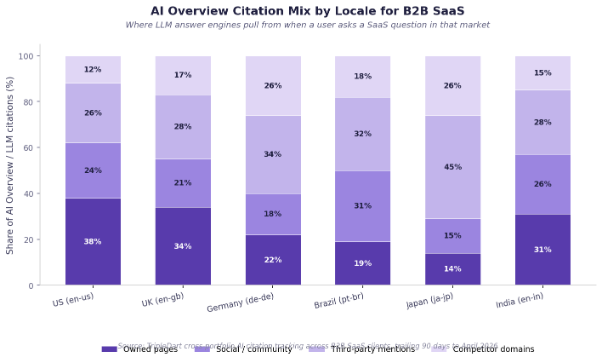
AI Overviews and LLM answer engines now ship in German, French, Portuguese, Japanese, Hindi, and more. Your locale pages aren't just fighting for the classic ten blue links anymore. They're fighting to be cited inside the answer box that sits above them.
Our answer engine optimization playbook is the deeper read.
How AI Overviews Decide What to Cite Per Locale
The ranking logic for citations in AI Overviews is not identical to organic SERPs. Answer engines pull from a mix of owned pages, social or community discussion, third-party mentions, and sometimes competitor domains.
The mix varies by locale.
What SaaS Teams Should Add Per Locale for AI Overviews
- Locale-specific schema markup: Organization, Product, and FAQ schema with locale-correct language tags and currency.
- Native-language FAQ blocks: AI Overviews love FAQ schema in the user's language. A US FAQ translated to German via a machine tool won't get cited, because the question phrasing won't match how Germans search.
- Locale-tagged statistics: Cite regional sources (t3n.de, Le Figaro, Nikkei) inside your content. Answer engines weight local proof heavier than global proof when answering a locale query.
- Render-stable pages: If your locale page hydrates client-side, the crawler may miss half the content. Use server-side rendering for every locale.
Which Keywords Get Answer-Engine Traffic First?
In our audits, long-tail "how," "why," and "should I" questions in the target language pick up AI citation traffic ahead of head terms. This matches Backlinko's analysis showing AI Overviews trigger more often on question-style and informational queries than on navigational ones.
For more on the mechanics, our guide on how to rank in AI Overviews covers the broader playbook.
What International SEO Mistakes Do SaaS Teams Keep Repeating?
The mistakes are predictable. They're also expensive, because each one silently leaks traffic from a locale you already paid to launch.
Shipping Hreflang Without Reciprocity
The single most common failure in our technical audits: non-reciprocal hreflang tags. Page A declares a German counterpart, but page B doesn't declare page A back. Search engines then treat the pair as broken and fall back to their own language-detection guess.
That guess usually gets it wrong.
Canonicalizing Every Locale Back to the English Page
Teams set rel="canonical" on every locale page pointing to the English source page, thinking it deduplicates content. It doesn't. It tells Google to ignore every locale page entirely.
Every locale needs a self-referencing canonical.
Machine-Translating the Body but Localizing Only the CTA
The reverse mistake also appears: a team spends on CTA localization and leaves the body as a machine translation. Conversion lifts cap out because the trust signal breaks mid-page. Machine translation alone underperforms in every market we've tested.
Launching Five Locales Before Earning One
The teams that stall tend to launch five locales at once with shallow content in each. The teams that compound pick two or three locales, go deep, earn local backlinks, and only then expand.
Forgetting the Local Search Engine
If you're targeting China without indexing on Baidu, Russia without Yandex, or Korea without Naver, you've written off the majority of that market's search traffic. Search Engine Journal's analysis on regional engines is a good starting point.
The top 10 pages on an average SaaS site account for nearly 45% of all organic sessions. If those pages aren't indexed on the right engine, you're invisible.
What Are the Biggest Challenges and How Can You Overcome Them?
International SEO has real challenges. But the right strategies and tools make them solvable.
Duplicate Content Issues
Identical product descriptions on the US, UK, or Australian sites can trigger duplicate content issues. Add canonical tags to indicate the original content, and customize product descriptions for each market to highlight features relevant to each location (local regulations, delivery options, regional compliance).
Managing Multiple Languages and Regions
Managing content in English, Spanish, French, and German can be overwhelming. Use tools like Weglot or Lokalise to ensure content is accurately translated and adapted to cultural context. Choose CMS tools that support multilingual and multi-regional SEO, like WordPress with WPML or Shopify's localization features.
Cultural Nuances and Preferences
In Japan, users prefer a cleaner, minimalist design with fewer on-screen elements. In the US, a more detailed, data-heavy dashboard may resonate better.
Conduct market research to understand local behaviors and search intent. Customize your content to address these preferences. Offer a product demo in markets that prefer hands-on experiences, or adapt your CTA tone to suit the local communication style.
Communicating ROI Internally
To keep stakeholders engaged, communicate the ROI clearly and regularly. Create detailed reports showcasing growth in traffic, leads, and conversions by region. Highlight successful examples: "Our localized landing pages in Brazil increased lead generation by 25% in six months."
Companies that offer original research increased organic traffic on average by 18.7% versus 11.2% for those that didn't. That stat resonates with leadership when justifying locale investment.
How Can You Measure ROI From International SEO Campaigns?
Measuring ROI from international SEO campaigns requires isolating locale-specific performance from your overall organic metrics. Without this separation, you can't tell whether Germany is compounding or stalling.
Set up region-specific segments in Google Analytics 4. Filter by country, language, and landing page subfolder to track organic sessions, conversions, and revenue per locale independently. Build a custom dashboard in Google Looker Studio that visualizes performance across all active markets side by side.
Track these KPIs per locale:
- Organic traffic growth rate month-over-month per subfolder
- Keyword rankings for your top 20 target terms in each language
- Conversion rate from organic traffic to demo request or signup
- Cost per locale (content creation + translation + link building) versus pipeline generated
- AI citation share - how often your brand appears in AI Overviews for locale queries versus competitors
The teams that report these numbers quarterly to leadership keep budget flowing. The teams that report only aggregate organic traffic lose funding because nobody can see which locale is working.
A thread in r/SaaS on whether SEO actually works for SaaS reinforced this point: SEO works for B2B SaaS but takes time, and most founders give up before seeing results. The ones who persist with clear locale-level reporting are the ones who scale.
How Can You Build Your International SEO Engine With TripleDart?
TripleDart is an AI-native SaaS marketing agency with experience serving 250+ brands across the full B2B SaaS lifecycle, from bootstrapped founders to global enterprise SaaS. As a specialized SEO agency, we build global strategies tailored to SaaS companies.
Our team crafts customized SEO strategies that account for regional behaviors, cultural adaptation in SaaS SEO strategies abroad, and global audience preferences. We map your product in depth to position it in target markets, and we handle the full stack: market signal, domain architecture, hreflang, localized content, regional link building, and AI Overview optimization.
Want to make your SaaS the next global success story? Book a strategy call with our team today.
Frequently Asked Questions
How Long Does International SEO Take to Show Results?
For most B2B SaaS launches, the first locale shows meaningful traffic signal in four to six months and measurable pipeline signal in seven to nine months. Additional locales compound faster because the technical and content patterns are already built.
Should a SaaS Company Choose Subdirectories or ccTLDs?
Subdirectories (example.com/de/) are the right default for most B2B SaaS because they inherit the root domain's authority. ccTLDs (example.de) are better when local brand trust is critical or when you're large enough to compound authority on five separate domains.
How Is International SEO Different From Answer Engine Optimization?
International SEO targets classic organic rankings per locale. Answer Engine Optimization targets citations inside AI Overviews and LLM responses. In 2026, the two overlap more each quarter. Our AEO guide covers the overlap.
Do I Need Separate Content for Every Locale, or Can I Translate?
Machine translation alone underperforms in every market we've tested. Human rewrite or heavy human editing of a machine draft is the floor for anything that's meant to rank or get cited. Translate UI strings, rewrite marketing and SEO content.
How Do AI Overviews Handle Multilingual SaaS Content?
AI Overviews ship answers in the user's language and pull from a mix of owned pages, mentions, and competitor content in that language. If your locale page is a shallow machine translation, it won't be cited. A local publisher or competitor will be instead.
Which Regional Search Engines Should a SaaS Company Care About?
For China, Baidu. For Russia, Yandex. For South Korea, Naver. For Japan, Google dominates but Yahoo Japan still matters. For most Western markets, Google is the primary engine.
How Does TripleDart Help With International SEO for SaaS?
TripleDart is an AI-native SaaS marketing agency that runs international SEO for B2B SaaS companies from seed-stage through global enterprise. We handle market selection, domain architecture, hreflang, localized content strategy, regional link building, technical SEO, and AI Overview optimization across every locale that matters. Book a strategy call to scope your multi-market rollout.



.webp)
.webp)

.png)


.png)




.webp)





.webp)


.webp)







%20(1).png)


.webp)
.webp)
.webp)





%20Ads%20for%20SaaS%202026_%20Types%2C%20Strategies%20%26%20Best%20Practices%20(1).webp)








.png)


.png)





.webp)


![Creating an Enterprise SaaS Marketing Strategy [Based on Industry Insights and Trends in 2026]](https://cdn.prod.website-files.com/632b673b055f4310bdb8637d/6965f37b67d3956f981e65fe_66a22273de11b68303bdd3c7_Creating%2520an%2520Enterprise%2520SaaS%2520Marketing%2520Strategy%2520%255BBased%2520on%2520Industry%2520Insights%2520and%2520Trends%2520in%25202023%255D.png)




.png)
















.webp)








%20Agencies%20for%20B2B%20SaaS%20Compared%20(2026).webp)

.webp)

%20with%20Hubspot.webp)








.png)


.png)

.png)
.png)
.png)
.png)


















.webp)

.webp)
.png)
.png)



.webp)


.png)



















.webp)

![How to Measure AEO Success: 12 Metrics Beyond Clicks [2026 Framework]](https://cdn.prod.website-files.com/632b673b055f4310bdb8637d/6a0d664b326187e99b3d5960_6%20-%20The%20Ultimate%20Guide%20to%20Measuring%20AEO%20Success%20in%202026.png)
![7-Step Workflow for AEO-Ready Content [2026 Framework]](https://cdn.prod.website-files.com/632b673b055f4310bdb8637d/6a0d55ea88913ede1d3a7123_5%20-%20Workflows%20for%20Optimized%20AEO-Ready%20Content%20Creation.png)
.png)

![How to Structure Content for AEO and GEO [With Templates]](https://cdn.prod.website-files.com/632b673b055f4310bdb8637d/6a0c6a56eb700472e635ff33_1%20-%20How%20to%20Structure%20%20Content%20for%20AEO%20and%20GEO%20%20Summaries%20(2026).png)


.png)
.png)









.png)


.png)





%2520Agencies%2520(2025).png)

![Top 9 AI SEO Content Generators for 2026 [Ranked & Reviewed]](https://cdn.prod.website-files.com/632b673b055f4310bdb8637d/6858e2c2d1f91a0c0a48811a_ai%20seo%20content%20generator.webp)




.webp)
.webp)














.webp)














.avif)