Google Ads for SaaS: The Winning Strategies for 2026
Key Takeaways
- Google Ads delivers up to 8:1 return on ad spend for SaaS companies that optimize campaigns around pipeline, not just clicks. Median CPC ranges from $0.25 (Customer Support) to $10.40 (HR Tech) depending on vertical.
- Defining clear campaign objectives, building audience personas, and conducting thorough keyword research are critical for an effective Google Ads strategy.
- Structuring campaigns with proper campaigns, ad groups, keywords, landing pages, and negative keywords ensures better control and higher conversions.
- Split your initial budget across Brand (15%), Competitor (45%), and Generic (40%) campaigns. Track CAC, CLV, CPC, and ROAS to optimize spend by channel.
- Remarketing cuts cost per lead by 45% compared to cold campaigns, with conversion rates of 7.8% vs. 3.2%. Pair it with CRM-connected offline conversion tracking for full-funnel visibility.
The Power of Google Ads for SaaS
Google Ads remains the highest-intent paid channel for SaaS. While the SaaS industry is flourishing, so is the saturation level in this ever-competitive landscape.
SaaS PPC gives you direct access to buyers actively searching for your solution, and the data backs it up: PPC leads close at 12% compared to 8% for organic, and PPC generates 2.3x more leads on average.
The good news is that Google Ads lets you quickly reach potential buyers and convert them into paying customers. This guide breaks down the campaign frameworks, budget splits, and optimization playbooks we use across accounts.
Why Google Ads Works Differently for SaaS
Google Ads for SaaS isn’t Google Ads for e-commerce with different keywords. The mechanics are fundamentally different.
Long sales cycles change everything. The average SaaS CAC payback period is 23 months. A click today might not become revenue for 6–12 months. Multi-touch attribution isn’t optional — it’s survival.
LTV matters more than CPA. A $500 CPA looks terrible for a $50/month product until you factor in 36-month average retention. That’s $1,800 in lifetime value against a $500 acquisition cost — a 3.6:1 ratio. Measure by LTV:CAC ratio, not first-touch ROAS.
Lead quality variance is extreme. Two form fills from the same keyword can be worth $0 and $50,000. Your conversion tracking must go beyond form submissions to track MQLs, SQLs, and closed-won revenue.
SaaS companies are betting big on Google Ads. Enterprise players like IBM, Adobe, and Salesforce collectively spend tens of millions annually on Google search ads, and Google holds 91.4% of the search engine market share worldwide.
Do you wish to be left behind? No, right? Here are more reasons why Google Ads is a significant growth marketing channel for your SaaS business. Google allows you to run ad campaigns based on different audience parameters such as demographics, location, and search terms. Therefore, it's an excellent platform to sell to your ideal customers with targeted messages.
- Start small and scale when you see returns. Google Ads is a low-risk, low-investment channel that helps you fight it out with bigger competitors.
- Enjoy the flexibility to run multiple campaigns and optimise outcomes.
- Measure campaign results with ease and accuracy.
- Get deeper insights into your customers' likes and dislikes.
- Experiment with varying ad formats to reach prospects cost-efficiently.
What you'll actually pay depends on your vertical. Here's what we see across our portfolio:
Scale Your Business with TripleDart's High-Impact PPC Strategies — Book a Call
Crafting a Winning Google Ads Strategy for SaaS
The best way to start building a Google Ads strategy is to understand your SaaS business. Here are some steps to get right first:
Define Your Campaign Objectives
Start by documenting what you wish to accomplish from a Google Ad campaign.
- What key success metrics are you tracking: demo bookings, free trials, sign-ups, MQLs, etc.?
- Now, determine how much you can spend acquiring each lead or customer.
- Estimate the total lifetime revenue you can expect from each new customer.
Develop Audience Personas
Building ideal buyer personas is essential to building your Google Ads strategy. It helps you customise campaign messages to your audience's needs. For instance, if you're selling a billing tool, you must target accounting professionals, freelancers, and small business owners. But if it's for a B2C SaaS company like Airbnb, you must think in an all-new direction. Research your industry and study your most potential buyers. Then, document prospect details, such as age, location, profession, goals, interests, and preferences.
ICP Analysis & Deep Product Knowledge
Before you spend a single dollar on Google Ads, you need to define your Ideal Customer Profile (ICP), the specific type of business most likely to buy your product and benefit from it.
What is an Ideal Customer Profile (ICP)?
For B2B SaaS businesses, your ICP is a business (not a person) with the exact problem you solve. Think of it as a buyer persona at the company level, who they are, what they need, and why they'd choose you.
Classifications
Identify which business type is most suitable to target:
- Startups (early stage, 11-50 employees)
- SMBs / Mid-Market (51-5,000 employees)
- Enterprise (5,000+ employees)
Goals: What Problem Are You Solving?
Document the specific goals for each customer type. For example, startups and SMBs often need to be made aware that the solution you offer even exists, so your messaging should lead with education and problem awareness.
Pain Points
List the pain points to highlight in your ad copy and landing pages:
- Affordable pricing vs. enterprise alternatives
- Lack of in-house expertise
- Access to specialized skill sets at lower cost
- Time lost on non-core business activities
Decision-Maker Designations
Target the right job titles by classification.
For Startups:
- Business Owners, CEO (High priority)
- Head of IT and HR
- VP & Directors of HR
- Senior-Level HR & IT Managers
What Does Your Ideal Customer NOT Look Like?
Define negative ICP characteristics to avoid wasted ad spend.
For Startups:
- HR managers without decision-making authority
- Teams looking for local-only hiring solutions
- Leaders not open to outsourcing or expansion
Company Size & Experience
- Startups: 11-50 employees, 5-8+ years in operation
- Mid-Market: 51-5,000 employees, 8-12+ years
- Enterprise: 5,000+ employees, 10-12+ years
Primary Industries to Target
- Computer Software
- Internet
- Information Technology & Services
- Finance
- Computer & Network Security
Messaging by Segment
Each ICP segment needs distinct messaging across your ad copy, landing pages, and sales materials.
For Startups:
- "Build talented remote teams at affordable costs"
- "Building global teams made faster and easier"
Use this ICP work to create a Glossary of Verbiage, Jargon, and Niche-Specific Language for each target audience group. It will keep all your campaign messaging tight and consistent.
Conduct Keyword Research
Effective keyword research is another cornerstone for a successful SaaS Google Ads strategy.
- The first step is brainstorming niche topics and popping niche search terms in a tool like the Google Keyword Planner.
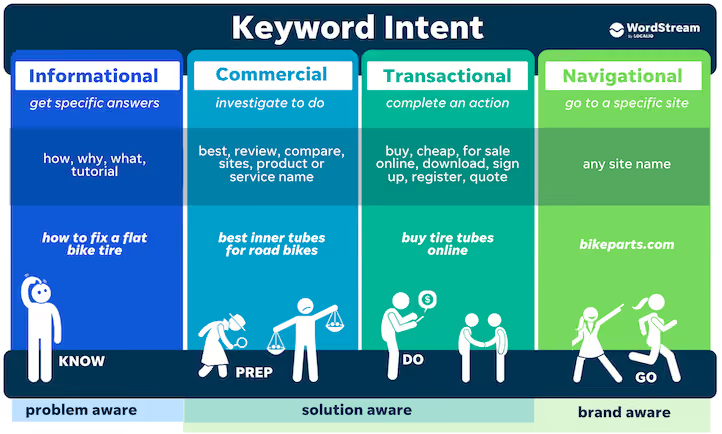
- Enlist and segment keywords based on search intent and audience personas.
- Look for commercial and transactional keywords with a high search volume and low CPC/CPA. Here are excellent examples of high-intent keywords: "buy invoicing software," "best invoicing software for small business."
Keyword Category Framework
Structure your keyword research across four categories to ensure comprehensive coverage:
- Generic keywords: Directly relate to the product or service your business offers (e.g., International Payroll, PEO/EOR, Global Employment)
- Related keywords: Adjacent searches your audience makes but don't directly point to your product (e.g., Overseas Employment, Hiring in Singapore, Contractors in Australia)
- Brand keywords: Contain your own brand or product name and variants
- Competitor keywords: Include names of competing tools or platforms (e.g., Remote.com, Deel)
Map these four categories to funnel stages for smarter budget allocation. BOFU keywords (like "best [tool] for [use case]") convert at 6.2x the rate of TOFU terms, but cost 2.3x more per click. The sweet spot is MOFU: 3.4x better conversion at only 1.5x the CPC.
Expanding Your Keyword List with Google
After your initial list, use Google itself to surface additional keyword opportunities for each of your 15-20 seed terms:
- Autocomplete / Drop-down: Type each keyword into the Google search bar and note the suggested completions
- People Also Ask: Review the related questions Google surfaces in the results
- "Searches related to X": Scroll to the bottom of the SERP to find short-tail and long-tail variants
Search Strategy Best Practices
Before scaling spend, make sure you have the following foundations in place:
- Define campaign goals and budget parameters
- Analyse the competitive keyword landscape
- Complete full keyword research across all four category types
- Define your account structure before building campaigns
- Write effective ad text with a clear value proposition
- Optimise landing pages before driving paid traffic
- Build your negative keyword list to avoid irrelevant spend
- Set up measurement and reporting from day one
Write Compelling Copy
Craft concise titles and descriptions to showcase your product USP. Don't forget to include an irresistible call-to-action that gets prospects to click on your ad. Take a look at this example:
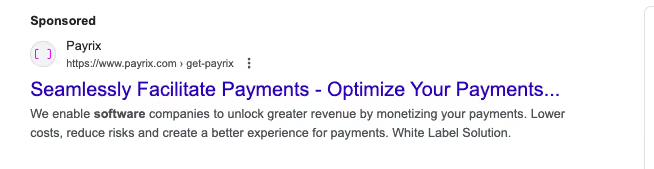
Specificity wins. In our audits, ad copy that names a concrete outcome ("Cut Sales Cycle by 40%") outperforms generic value props by 2.3x in CTR. Pin your strongest headline to position one and test three to four description variations per ad group.
Set up Conversion Tracking for Measuring Success
A conversion tracking mechanism helps SaaS marketers to observe and analyse key campaign metrics. Here are common data points to measure:
- A phone call that generates from your Google ad
- A website action such as a purchase, a button click, or a form-fill
- App downloads and app installs
Once you know what matters most, track it with the following process:
- Create a conversion action that defines the key metric
- Add the relevant tracking tag to your website
- Go back to your Google Ads account to check your tracking tag
Go beyond on-site conversions. Connect your CRM (HubSpot, Salesforce, or Pipedrive) to Google Ads using offline conversion imports. This feeds MQL, SQL, and pipeline data back into Google's bidding algorithms, so Smart Bidding optimizes for revenue, not just form fills. We've seen this single change reduce CAC by 20-30% across accounts.
Set up Enhanced Conversions alongside your standard tracking. It hashes first-party data like email and phone number to match conversions back to Google accounts, improving match rates by 15–20%.
Structuring Your Google Ads Campaigns
Creating a SaaS Google Ads campaign structure can seem daunting. But it's not. A Google Ads framework helps you control how each ad triggers and appears in the search engines. The exciting part is that Google's ML allows you to create complex ad structures that align campaign results with business goals.
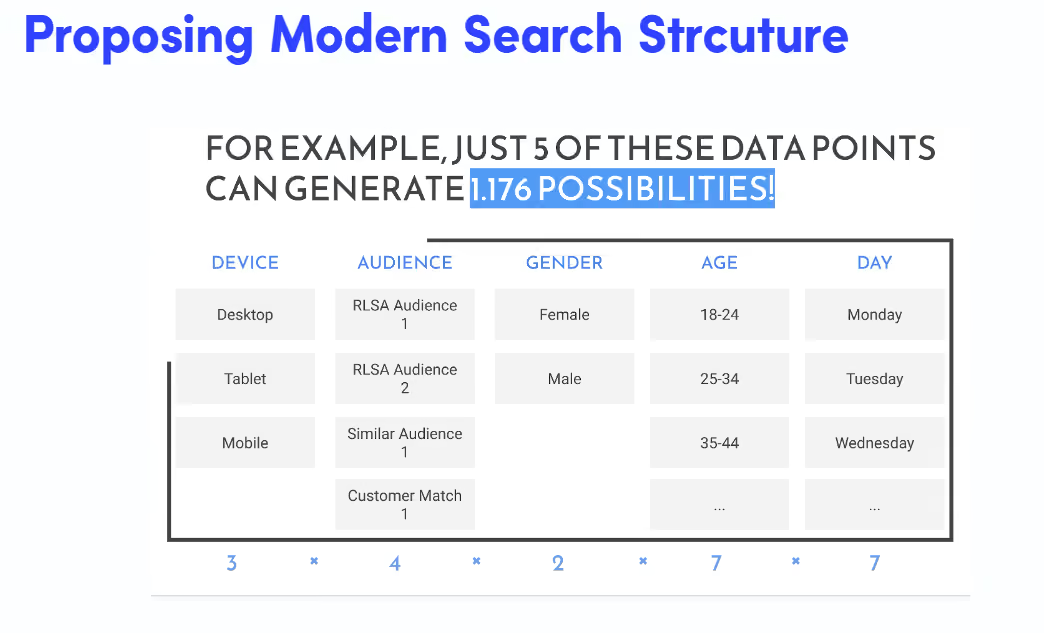
Here are the critical elements of a Google Ads account structure:
- Campaigns: Every Google Ads campaign structure has a few campaigns around your main topics and keywords. Hence, campaigns are at the top of your Google Ads pyramid.
- Ad Groups: Ad groups help you to divide your campaigns into specific topics. Each ad group has about 10-20 keywords.
- Keywords: Keywords are critical to your campaign structure. They fall under different ad groups. Every keyword has parameters like Match Type, CPC, and quality score.
- Landing Pages: Landing pages carry a core offer or message that helps convert prospects into leads or customers. A click directs the user to a landing page where they can see the offer benefits and take an action.
- Negative Keywords: This list helps you to weed out all the irrelevant keywords from your campaigns. For instance, "free invoicing software" is a negative keyword if your invoicing software is paid. Therefore, running an ad on such a keyword is wasteful.
- Ad Text: Ad copy is integral to your campaign structure. Each ad group has 2-3 ads and texts that direct the user to a single landing page. You must follow Google's Adwords policies while writing your ad text.
Organising Your Google Ads SaaS Campaign
There are various interesting ways to organise your ad campaigns. But you have to choose one that suits your SaaS business.
- Product Offerings: When you have multiple products, promoting them using different campaigns or ad groups is ideal. But if you have one product with varying price points, you can divide your ad groups based on price points.
- Location: If you're targeting product buyers in different locations, cater to each segment with a separate ad group.
- Target Audience: It's best to create unique campaigns for different audience segments, such as small business owners, freelancers, accountants, etc.
For your first week live, split budget across three campaign types: Brand (15%), Competitor (45%), and Generic (40%). Competitor campaigns cost more per click ($22.21 avg vs. $6.27 generic), but they deliver 39% lower MQL cost because the buyers already understand the category. Review our full SaaS PPC strategy guide for the three-tier competitor conquesting framework.
Performance Max (Pmax)
Pmax runs across Search, YouTube, Display, Discover, and Gmail from a single campaign. It works best for SaaS accounts generating 100+ conversions per month.
The critical requirement: you must feed offline conversion data from your CRM. Without it, Pmax optimizes for the cheapest form fills — which are almost never your best pipeline sources.
Demand Gen Campaigns
Google reduced the audience minimum for Demand Gen campaigns to just 100 users in January 2026 — a game-changer for SaaS companies with smaller CRM lists. Use these for mid-funnel content: webinars, case studies, and explainer videos.
YouTube Campaigns
In-stream skippable ads on YouTube cost $0.03–$0.10 per view — significantly cheaper than LinkedIn or Facebook video. For SaaS, YouTube works best for brand awareness with custom intent audiences and retargeting with product demos.
Building a Global Campaign Structure
When running Google Ads across multiple regions, start by grounding your campaign planning in your SaaS metrics, expected spend, conversion benchmarks, and pipeline targets. This creates a data-driven forecasting foundation before you touch a single campaign setting
Step 1: Define Your Target Geographies
Plan which regions you're targeting and group them logically:
- NAM: United States, Canada
- APAC: India, Singapore, Australia, and others
- EMEA: UK, Ireland, Netherlands, and others
Step 2: Build Your Keyword Framework by Category
For each region, map keywords across four categories:
- Generic keywords: Directly describe your product/service (e.g., International Payroll, Global Employment)
- Related keywords: Adjacent searches your audience makes (e.g., Hiring in Singapore, Overseas Contractors)
- Brand keywords: Your own brand name and variants
- Competitor keywords: Names of competing products (e.g., Remote.com, Deel)
Step 3: Cross-Reference Keywords + GEOs for Volume Planning
Use Google Keyword Planner to combine your keyword categories with your geographic targets and calculate estimated volume. This bottom-up planning approach tells you whether the available search demand is sufficient to hit your pipeline goals, before you commit budget.
Step 4: Segment Campaigns by GEO
Once volume is validated, create separate campaigns per region. This gives you granular control over budgets, bidding, and ad messaging by geography, and makes reporting cleaner when your performance varies across markets.
2026 Campaign Structure: Consolidation Over Fragmentation
Google’s algorithm in 2026 rewards fewer, larger campaigns with more conversion data. Here’s the budget framework we use across 84+ SaaS accounts:
Brand campaigns: exact match, tCPA bidding, 10–15% of budget. Competitor campaigns: exact + phrase match, tCPA, 15–20%. Category High Intent: phrase + broad match, tCPA or tROAS, 30–40%. Category Mid Intent: broad match, tCPA, 15–20%. Demand Gen / YouTube: audience-based, maximize conversions, 10–15%. Pmax: tROAS with offline conversions, 0–15% (only at 100+ monthly conversions).
Google now supports campaign-level negative keywords — up to 10,000 per campaign, launched in 2025. Essential for broad match strategies.
Budgeting and Bidding Strategies
The right budgeting strategies help you control how much you're spending on your SaaS Google Ads. And just like in an auction, bidding allows you to tell Google how much you're willing to pay for a click or an acquisition. Here's how to make the most of these two strategies to squeeze the most out of your Google Ad campaigns.
Budget Allocation
Just like budgeting for household expenditure, you can cap how much you wish to spend on your Google Ad campaigns. Here are some budget types you need to know:
- Daily Budgets: Google allows you to set a daily budget for each campaign. But there's a catch. Google can spend less or more of this budget each day depending on the search traffic on a particular day. So, your spending will average out over the month.
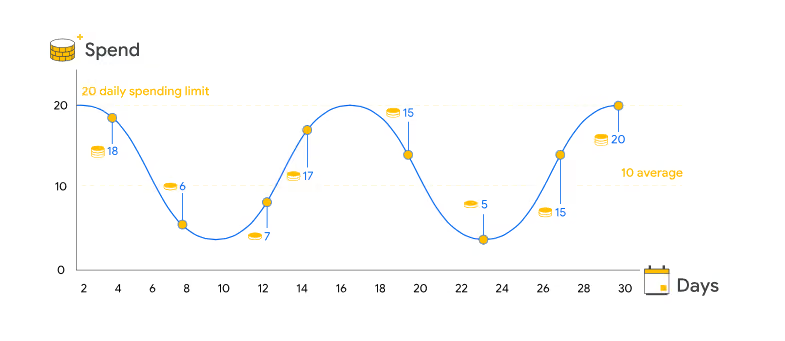
- Shared Budgets: This strategy allows you to allocate a single budget across many campaigns.
- Campaign Total Budgets: Helps you to set a cap on the total lifetime spend of a Google Ad campaign.
- Automated Rules: Automate your Google Ads account spending based on preset conditions. For instance, you can enable campaigns, pause campaigns, or change budgets depending on each campaign's performance.
- Monthly Limits: Set a monthly spending limit on your Google Ads account.
Bidding Strategies and Optimization
You can use manual or automated bidding strategies to achieve specific goals with your SaaS Google Ads campaigns.
- Target CPM: This strategy lets you bid the maximum you're willing to pay for every thousand impressions. Target CPM is helpful when your goal is to maximise brand awareness.
- Manual CPC (Cost Per Click): Set a maximum bid for each click on your ad.
- Maximise (Cost Per View): Bid for the most 30-second views on your video ads.
- Target CPA (Cost Per Acquisition): It automatically sets bids for the maximum possible conversions at a pre-set target CPA.
- Maximise Conversion Value: Set a maximum target return on ad spend, and Google will automatically help you get the highest possible conversion value.
- Target ROAS (Return On Ad Spend): This strategy uses Google's machine learning algorithms to adjust and optimise return on ad spend.
A note on Smart Bidding: Target CPA and Target ROAS work best with 30+ conversions per month per campaign. If you're below that threshold, start with Maximize Conversions to build data, then switch once you hit the volume floor. We've seen Quality Score improvements from 5 to 8 cut CPC by 28%, so invest in ad relevance and landing page experience before throwing more budget at bidding.
Once your CRM data flows back to Google Ads, you unlock value-based bidding — the single biggest lever for SaaS accounts in 2026. You assign conversion values by deal stage. An SQL is worth more than an MQL. A closed-won deal is worth the actual contract value.
Target ROAS with offline conversion imports is the gold standard for SaaS bidding right now. It teaches Google’s algorithm to optimize for pipeline and revenue, not just form fills.
As you can see, Google gives you many bidding strategy options. Pick the ones or use a combination that aligns with your business objectives.
Know Your KPIs
Knowing your Google Ad campaigns' key performance indicators (KPIs) helps you monitor campaign performance and tweak strategies for optimum results. Important KPIs include Conversion Rate, Click Through Rate, Cost Per Click (CPC), Customer Acquisition Cost (CAC), Customer Lifetime Value (CLV), Monthly Recurring Revenue (MRR), and Return on Ad Spend (ROAS).
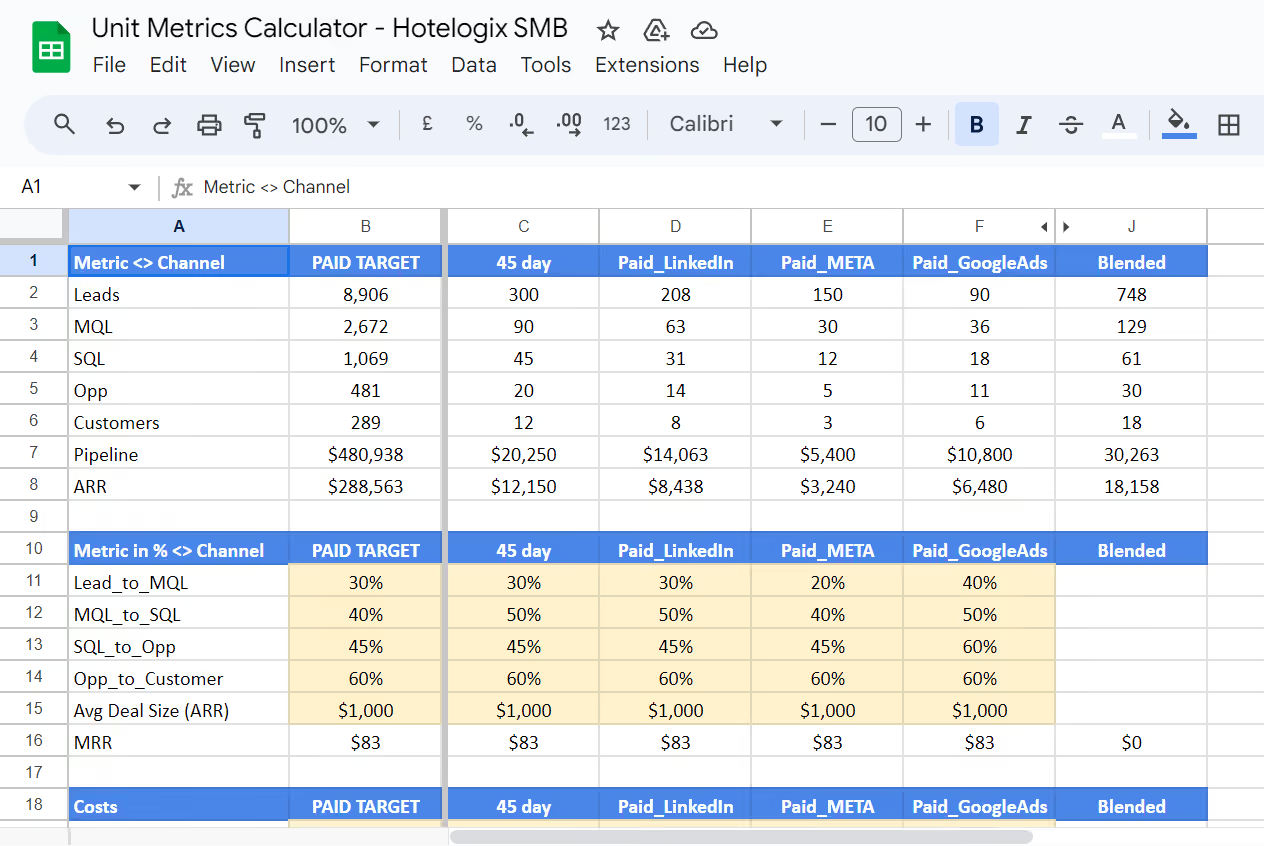
At TripleDart, we use a combination of tools such as Growthnirvana, Google Ads, and Looker Studio to generate comprehensive reports for our clients. For an in-depth analysis, we create end-to-end reports with metrics at all levels, including campaign, location, ad group, pipeline, and channel.
Google Ads Benchmarks for SaaS in 2026
CPC (non-brand): Median $8.50–$14.00. Top quartile $5.00–$8.00. Enterprise SaaS $12.00–$20.00.
CPC (brand): Median $1.00–$3.00. Top quartile $0.50–$1.50. Enterprise SaaS $2.00–$5.00.
CTR: Median 3–5%. Top quartile 5–8%. Enterprise SaaS 2–4%.
Landing page conversion rate: Median 2.5–4%. Top quartile 5–8%. Enterprise SaaS 1.5–3%.
Cost per MQL: Median $150–$400. Top quartile $80–$150. Enterprise SaaS $300–$800.
Cost per SQL: Median $800–$2,500. Top quartile $400–$1,000. Enterprise SaaS $1,500–$5,000.
MQL-to-SQL rate: Median 15–25%. Top quartile 25–40%. Enterprise SaaS 10–20%.
Non-brand CPCs have risen 15–18% year-over-year. The antidote isn’t more budget — it’s better efficiency.
Remarketing in SaaS
Remarketing is a powerful Google Ads feature that lets you connect with prospects who have already shown interest in your business. With the help of remarketing, a SaaS marketer can tag website visitors and show them relevant ads on different web platforms. By showing your campaign messages to "warm" prospects, you can multiply the chances of getting conversions from your Google Ads.
The numbers are clear: remarketing campaigns deliver 45% lower cost per lead and convert at 7.8% compared to 3.2% for cold campaigns. The key is sequencing your ads by recency:
- Days 1-14: Serve educational content (blogs, guides)
- Days 15-30: Show social proof (case studies, reviews)
- Days 31-60: Push product demos and feature comparisons
- Days 61+: Offer extended trials or discounts
Here are simple steps to set up and run a successful SaaS remarketing campaign:
- Install the Google Ads tag on your website and track visitors to create your remarketing list.
- Customise your audience to target those who visited specific pages or performed certain actions.
- Create an exciting offer that'll trigger an action or a purchase.
Google Ads for SaaS: Insights from r/SaaS
Exploring community discussions on platforms like Reddit provides valuable insights into real-world experiences and strategies. Here's a summary of a major discussion regarding the effectiveness of Google Ads for SaaS products:
1. Mixed Results: Users have varied experiences with Google Ads. Some find it ineffective due to high costs and poor traffic quality.
2. Preferred Alternatives: Platforms like LinkedIn, Capterra, G2, Twitter, and Facebook are often preferred for better targeting and higher conversion rates.
3. Strategic Use: Success with Google Ads requires thorough keyword research, competitor analysis, and effective remarketing strategies.
4. Expert Management: Effective management of Google Ads demands expertise in data tracking, CRM integration, and sales funnel optimization.
5. High Costs: Rising costs necessitate careful tracking of lifetime value (LTV) and customer acquisition costs (CAC) to ensure profitability.
6. Innovative Products: Traditional Google Ads may not be suitable for highly innovative products. Instead, video and display ads might be more effective for raising awareness.
7. Data-Driven Approach: A robust, data-driven approach, including continuous optimization and testing, is important for improving return on investment (ROI).
In summary, while Google Ads can be a useful tool for SaaS businesses, its success depends on strategic management and expertise. Many users find better results using alternative advertising platforms, highlighting the importance of choosing the right channel for your specific needs.
7 Common Mistakes SaaS Companies Make With Google Ads
1. Measuring by lead volume, not pipeline. The campaign with the most form fills is rarely the one driving the most revenue. Track cost per SQL and pipeline value, not just CPL.
2. Running broad match without negative keywords. Broad match without a robust negative keyword list is like leaving your front door open.
3. Ignoring competitor campaigns. Your competitors are bidding on your brand name right now. Return the favor.
4. Sending all traffic to the homepage. Build dedicated landing pages that match search intent, and watch conversion rates double.
5. Not importing offline conversions. Without CRM data flowing back to Google, your smart bidding optimizes for the cheapest clicks, not the best pipeline sources.
6. Over-fragmenting campaign structure. SKAGs are dead. Google’s algorithm needs data volume to optimize. Consolidate into fewer, larger campaigns.
7. Set-and-forget management. Google Ads campaigns untouched for two to three weeks typically see CPA increase by 20–30%.
Scaling and Evolving Your SaaS Google Ads Strategy
Scaling your SaaS Google Ads strategy is about making wise investment decisions. Monitor your campaigns to learn which keywords and campaigns are fetching the highest ROI in terms of net revenue.
- Conduct an ongoing opportunity analysis to put money into high-intent keywords.
- Expand to high-return geographical markets and audience segments.
4 Checks to Ensure You're Always Performing Well
Beyond scaling spend, these operational habits will protect campaign performance as you grow:
- Connect your CRM to Google Ads and optimise campaigns based on MQL, SQL, and Pipeline data, not just clicks and conversions. Feeding downstream revenue signals back into Google's algorithms significantly improves bid optimisation.
- Review search terms at least twice a week. Hygiene on search terms is ongoing work. Irrelevant queries will accumulate quickly, and catching them early prevents budget waste before it compounds.
- Continuously optimise your landing pages. Run messaging and CTA experiments regularly to improve conversion rate. Reducing form fields from seven to four lifts conversions by 34%. Adding customer logos above the fold adds another 22%. Don't set landing pages and forget them.
- Use multichannel audience segments in your search campaigns. Layer in audience signals from display and video to enrich your search targeting, which lets you adjust bids or tailor messaging based on prior engagement.
One more thing: if you're spending $10K+/month and not using AI-powered workflows for budget reallocation, you're leaving money on the table. Across 47 accounts, our AI agent workflows delivered a 22% ROAS improvement, 18% CPL reduction, and saved 34 hours per month in manual optimization.
That's the difference between 2.1x ROAS (manual) and 2.7x ROAS (AI-assisted). See how we build these AI-powered workflows into every engagement.
Final Thoughts
A strong Google Ads strategy turns paid search into a predictable pipeline engine for your SaaS business. And it could become the go-to strategy to drive consistent revenue for your SaaS business. But it takes an arm and a leg to set up and implement a successful SaaS Google Ad strategy.
But don't worry, at TripleDart, we've got you covered. As a trusted SaaS PPC agency managing $150M+ in ad spend across 250+ B2B SaaS accounts, we offer complete, end-to-end PPC solutions. Get in touch with us today.
Frequently Asked Questions
How Much Should a SaaS Company Spend on Google Ads?
Start with at least $5,000-$10,000/month to generate enough data for Smart Bidding to optimize. Split it across Brand (15%), Competitor (45%), and Generic (40%) campaigns. Scale once your ROAS exceeds 2x and your Quality Score averages above seven.
Is Google Ads or LinkedIn Ads Better for B2B SaaS?
PPC strategies and trends guideThey serve different roles. Google Ads captures high-intent search demand at a $127 average CPL with 4.2% conversion rates. LinkedIn excels at ABM and enterprise targeting at $213 CPL with 2.8% conversion. Most SaaS companies running both see 43% less revenue volatility quarter over quarter. Read our for the full platform comparison.
How Long Does It Take for Google Ads to Work for SaaS?
Expect a 14-day learning period before Google's algorithms stabilize. You should see directional data by Day 30 and meaningful optimization signals by Day 60-90. Our three-phase launch framework (Pre-Flight, First 30 Days, Days 31-90) is designed around these milestones.
What Is a Good ROAS for SaaS Google Ads?
SaaS PPC delivers approximately 2:1 ROAS on average, scaling to 8:1 with optimized campaigns. Anything above 3:1 is strong for most B2B SaaS verticals. If you're below 2:1 after 90 days, audit your campaign structure, conversion tracking, and landing page experience before increasing budget.
What’s a Good CPA for SaaS Google Ads?
Target 10–20% of your first-year ACV for self-serve products, and 5–10% for sales-assisted deals. If your ACV is $10K, aim for a CPA between $500 and $1,000.
Should SaaS Companies Use Performance Max?
Only after you’re generating 100+ monthly conversions and have offline conversion imports running from your CRM. When properly configured, Pmax can deliver 20–30% more pipeline at similar CPAs.
How Do I Compete With Bigger SaaS Companies on Google Ads?
Focus on long-tail keywords, bid on competitor brand names, use every ad extension available, and optimize landing pages relentlessly. A 5% conversion rate beats a 2% rate at any CPC.
Is Broad Match Safe for SaaS Google Ads?
Yes — with guardrails. Build a robust negative keyword list, use campaign-level negatives (up to 10,000 per campaign), review search terms weekly, and always pair broad match with smart bidding (tCPA or tROAS).
Should I Hire a SaaS PPC Agency or Build an In-House Team?
Year-one cost for in-house is approximately $287,000 (specialist + copywriter + designer + analyst + tools). An agency runs $96,000-$180,000/year and typically delivers results in three to six months vs. 12-18 months in-house. The breakpoint is around $100,000/month in ad spend. Below that, an agency is usually more cost-effective. Compare your options across top SaaS PPC agencies.

summarize with ai


