

.png)

Key Takeaways
- Broad match paired with Smart Bidding delivers more conversions at lower CPA than exact or phrase match.
- Your campaigns need at least 15 conversions per month for Smart Bidding to optimize broad match effectively.
- Negative keywords are non-negotiable: review search terms daily for the first two weeks, then move to weekly.
- Our $40K, six-month test showed broad match delivered 81% of conversions on just 53% of the budget.
- Broad match taps signals like landing page content and user search history that other match types can't access.
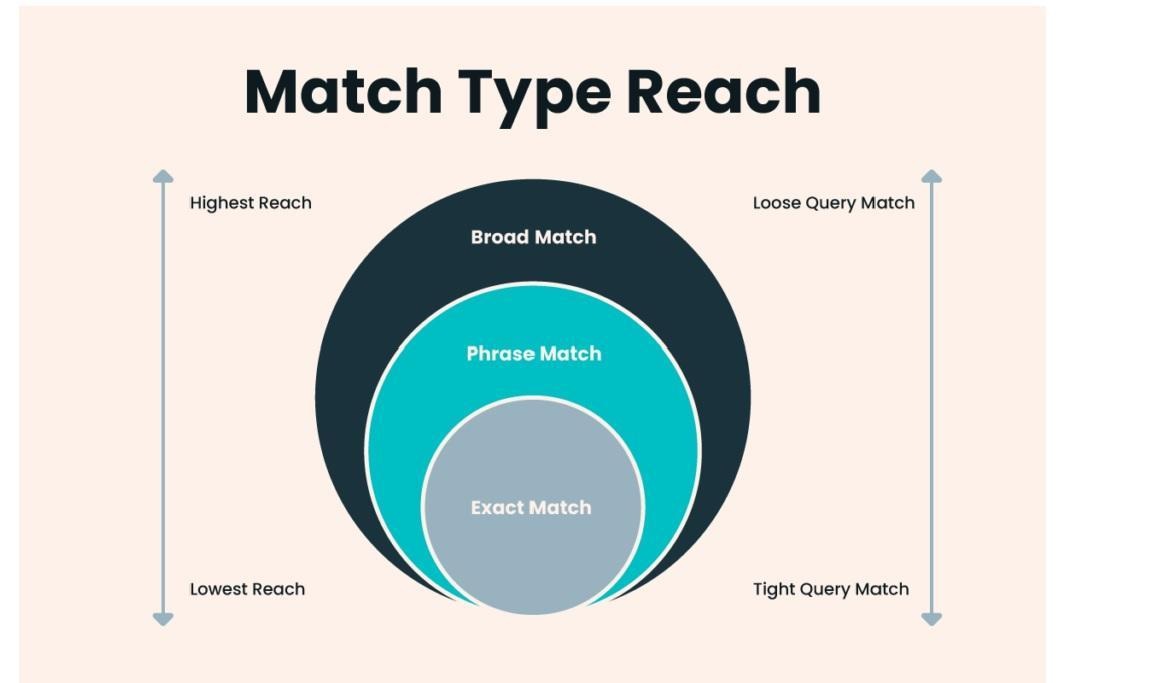
Broad match, Google's most flexible keyword match type, has been around for a while. When Broad Match is used, advertising may appear on searches that are connected to the keyword but do not contain the phrase itself. Because of its adaptability, Broad Match is classified as a "loose" match type.
Managing search queries and ensuring everything is relevant and working efficiently has always been difficult when the match type used is broad. However, as automation capabilities become increasingly important in a successful Google Ads account, we find ourselves revisiting the broad match and how it might be tested strategically in 2026.
Broad match doesn't exist in isolation - it works best as part of a well-structured SaaS PPC program. Our SaaS PPC strategy guide covers how to build that structure from scratch, including which campaign types to launch first and how to set bidding strategy by funnel stage.
When creating a Google search ad campaign, choosing the right keywords is essential for ensuring that your ad is seen by the right audience. One option to consider is using broad keywords, which are less specific and have a higher search volume.
Broad keywords can be a great way to increase visibility and reach a larger audience, but it's important to use them strategically to maximize their effectiveness.
Scale Your Business with TripleDart's High-Impact PPC Strategies — Book a Call
Consider broad match keywords through the search engine's lens:
In the past, search engines have been more rigid in how they understand a user's needs and the content of a website. SEO practices have changed from a greater focus on keyword stuffing to needing to provide more useful content to the person searching. The updates Google has made to its language processing algorithm, BERT, have made these changes possible. This means the engine has a better understanding of intent.
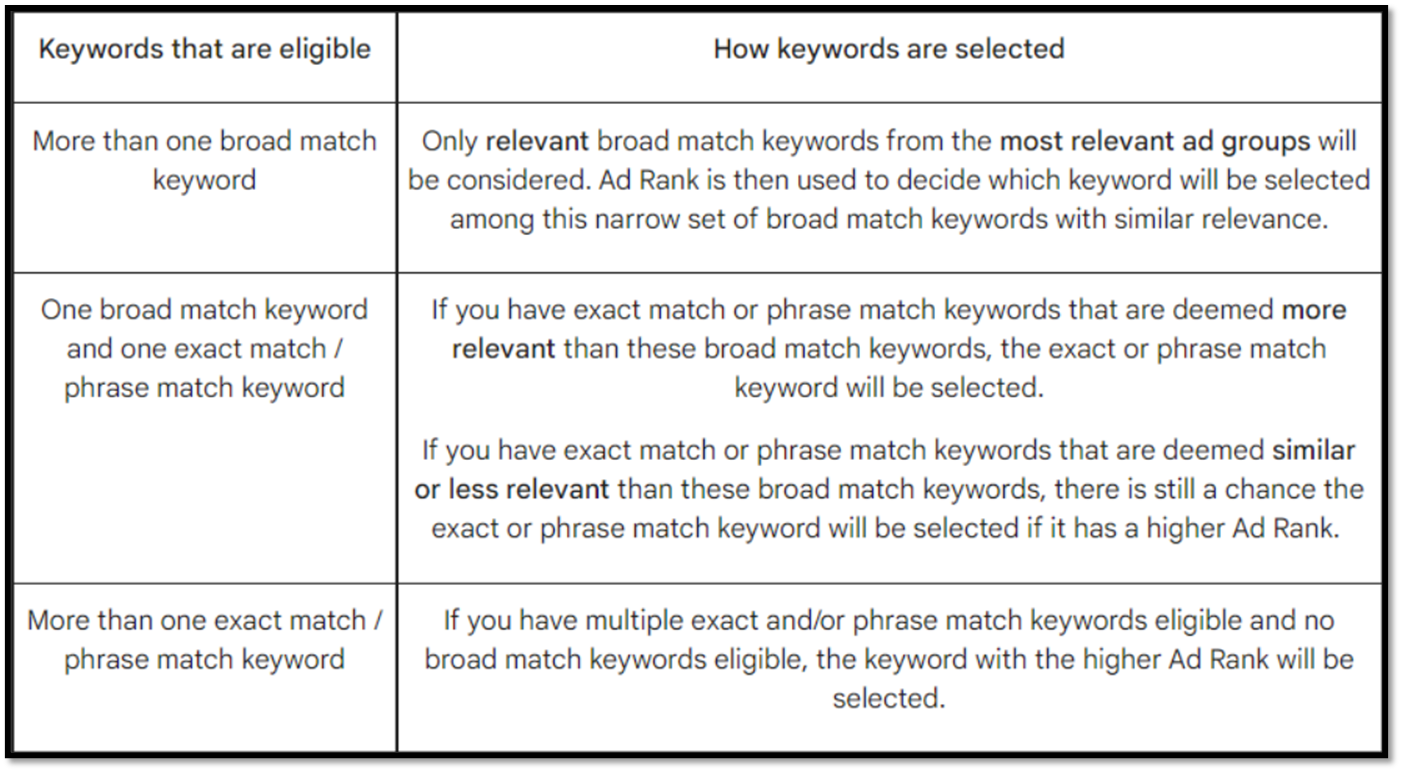
Google even provided this detailed look at how different keyword match types will impact keyword selection:
Benefits of Using Broad Keywords:
- Increased visibility: Broad keywords have a higher search volume, which means they are more likely to be used by people searching for products or services similar to yours. This can increase the visibility of your ad and bring in more potential customers.
- Lower cost-per-click: Because broad keywords are less specific, they are often less competitive and therefore have a lower cost-per-click. This can help you save money on your ad campaign while reaching a large audience.
- Greater flexibility: Using broad keywords allows you to target a wider range of search terms, giving you more flexibility in your ad campaign. This can be especially useful if you offer a wide range of products or services.
- Use an automated bid strategy: Over the years, Google has worked hard to improve its ability to forecast user behavior based on historical user data. Because this is a top-of-funnel strategy, you'll want to make sure you're using automation to help boost the quality of traffic you're driving to the website.
For this to work, your campaign needs at least 15 conversions per month. Below that threshold, the algorithm can't bid accurately on broad terms. Target CPA and Maximize Conversions are the strongest pairings. Google reports that switching from exact to broad match with target CPA delivers 35% more conversions on average.
Set your tCPA 20–30% below what you’d accept for exact match when launching broad match. This forces the algorithm to be selective about which queries it bids on. You can loosen the target as the algorithm learns, typically after 2–3 weeks.
- Broad match is able to use unique signals not available in other Match Types:
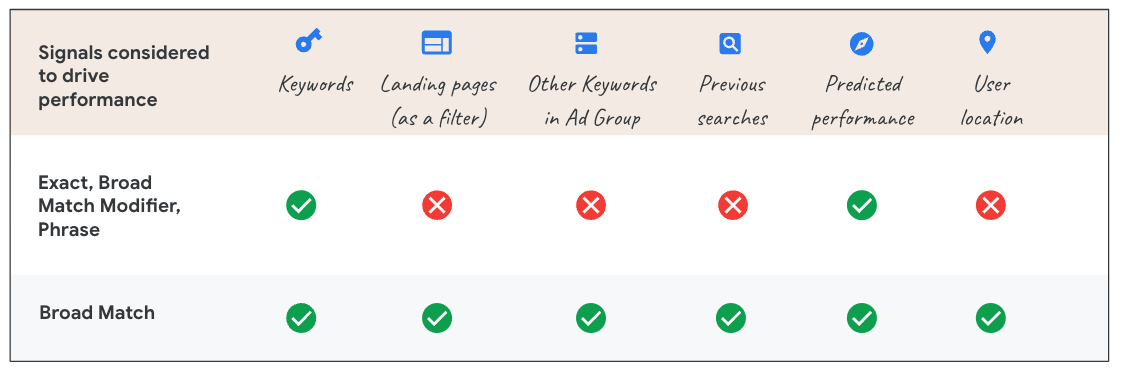
These signals include your landing page content, other keywords in your ad group, the user's recent search history, their location, and device type. No other match type factors in this full context at auction time.
In 2026, increasing the usage of broad match keywords in your Google Ads campaigns may help you reach a broader audience, increase the performance of your ads, and save time and effort in managing your campaigns.
Broad match and Smart Bidding now sit at the center of most SaaS PPC strategies for 2026, especially for teams scaling spend past $20K per month.
Best Practices for Using Broad Keywords:
- Use negative keywords: To avoid attracting irrelevant traffic, use negative keywords to exclude search terms that are not relevant to your business from your ad campaign. In the beginning, I would recommend performing daily SQR for a few days and then moving it to weekly.
Google now supports up to 10,000 campaign-level negative keywords — a feature launched in 2025 that changes the game for broad match management. Use these for universal exclusions: job seekers (“careers,” “salary,” “jobs”), students (“free,” “tutorial,” “course”), and irrelevant industries.
Don’t launch brand-new keywords in broad match. Take your best-performing exact and phrase match keywords — the ones with proven conversion data — and create broad match versions in a separate ad group or campaign. This gives the algorithm a head start on what “good” looks like.
- Monitor your search terms: Keep an eye on the search terms that trigger your ad and make adjustments as necessary to exclude irrelevant terms and optimize for relevant ones.
Check the Search Term Insights report too — it’s separate from the standard search terms report. It groups your queries into themes, showing you clusters of related searches rather than individual terms. Use it to spot new keyword themes worth targeting and broad categories worth excluding entirely.
- Use long-tail keywords: In addition to broad keywords, use long-tail keywords that are more specific to your business to attract a more targeted audience.
- Use ad groups: Organize your keywords into ad groups based on themes or product/service offerings to help increase the relevance of your ads to the right audience.
- Test and optimize: Use A/B testing to optimize your ad copy and landing pages for the broad keywords you're targeting and monitor your metrics like click through rate (CTR), conversion rate, bounce rate, and cost per conversion.
When Broad Match Isn't the Right Call
Skip broad match for branded keywords where exact match gives you tighter control and lower CPCs. Also avoid it if your campaign generates fewer than 15 conversions per month or your budget is too tight to absorb the learning period. In those cases, start with phrase match and graduate to broad once conversion volume builds.
Also skip broad match if you’re in a highly regulated industry where query control is critical — healthcare, legal, and financial services teams with strict compliance requirements can’t afford their ads showing up on unexpected search terms.
Broad Match Pitfalls Every SaaS Team Should Know
Broad match has SaaS-specific failure modes that generic advice doesn’t cover. Here are the three that burn the most budget.
Adjacent industry queries are the silent budget killer. “Project management software” will trigger ads for construction project management, event project management, and every other vertical that uses the same words. Fix this by adding industry-specific negatives from day one.
Informational queries like “what is project management” attract researchers with near-zero buying intent. These clicks are cheap, which makes your metrics look healthy while your pipeline stays empty. Exclude question modifiers or bid them down aggressively.
Feature-specific queries pull in free tool seekers instead of buyers. “Gantt chart” and “time tracking” sound relevant, but the people searching those terms usually want a free standalone tool. Pair feature keywords with commercial modifiers and always add “free” as a negative.
Broad Match vs. Phrase Match vs. Exact Match in 2026
Reach — Broad: widest. Phrase: moderate. Exact: narrowest.
Control — Exact: highest. Phrase: moderate. Broad: lowest — you’re trusting the algorithm.
Data needed — Broad: 30+ conversions/month. Phrase: 15+. Exact: any volume.
Best bidding — Broad: tCPA or tROAS. Phrase: tCPA. Exact: manual CPC or tCPA.
Query relevance — Exact: highest. Phrase: moderate-to-high. Broad: variable.
Discovery potential — Broad: highest. Phrase: moderate. Exact: none.
Ideal use — Broad: scaling and discovery. Phrase: core category terms. Exact: brand and highest-value keywords.
Most mature SaaS accounts run all three simultaneously.
Still Not Convinced? I'll Share Some Data With You That Will Blow Your Mind.

We spent $40K on this test to put the final nail in the coffin on this discussion, it lasted 6 months, and the target country is the United States.
In these three campaigns, we began with a similar set of keywords and kept a close eye on the search terms on a regular basis to eliminate any irrelevant ones.
CPCs were more than four times higher on exact and phrase keywords, allowing broad to serve four times as many clicks with the same budget.
There was no significant difference in CTR, but the overall Conv rate was lower than the other two match types, which is somewhat evident, but when we look at overall level statistics, that CVR difference doesn't matter.
The overall CPA is 6X higher in the exact campaign and roughly 3X higher in the phrase campaign, there were a few leads that were irrelevant, but even after removing them, the overall CPA is still significantly lower than the exact and phrase campaigns.
We spent 53% of the budget on broad campaign and received 81% of the conversions, which is substantially better than other campaigns.
Scale Your Business with TripleDart's High-Impact PPC Strategies — Know More
Wrap Up
Broad match works when you pair it with Smart Bidding, tight negative keyword lists, and themed ad groups. Start with 20-30% of your search budget on broad, review search terms daily for the first two weeks, and scale once CPA stabilizes.
The data from our $40K test speaks for itself: broad match captures more conversions at lower cost. The only question is whether your account has the conversion volume to let Smart Bidding do its job.
Frequently Asked Questions
Should I use broad match with Smart Bidding?
Yes. Broad match gives Smart Bidding more auctions to optimize against. Google reports 35% more conversions when pairing broad match with target CPA bidding. You need at least 15 conversions per month per campaign for reliable results.
What signals does broad match use?
Broad match factors in your landing page content, other keywords in your ad group, the user's recent search activity, their physical location, and device type.
When should I avoid broad match?
Avoid it for branded keywords (exact match gives better control), campaigns with fewer than 15 monthly conversions, and accounts with limited budgets. If you're unsure whether your account is ready, a specialized SaaS PPC agency can audit your setup.
Is broad match modifier still available?
No. Google retired broad match modifier in July 2021. Its functionality was merged into phrase match, which now covers both exact phrases and close variations. Use broad match with Smart Bidding for the widest reach.



.webp)
.webp)
.png)


.png)



.webp)




.webp)

.webp)






%20(1).png)


.webp)
.webp)
.webp)





%20Ads%20for%20SaaS%202026_%20Types%2C%20Strategies%20%26%20Best%20Practices%20(1).webp)







.png)


.png)





.webp)


![Creating an Enterprise SaaS Marketing Strategy [Based on Industry Insights and Trends in 2026]](https://cdn.prod.website-files.com/632b673b055f4310bdb8637d/6965f37b67d3956f981e65fe_66a22273de11b68303bdd3c7_Creating%2520an%2520Enterprise%2520SaaS%2520Marketing%2520Strategy%2520%255BBased%2520on%2520Industry%2520Insights%2520and%2520Trends%2520in%25202023%255D.png)




.png)















.webp)




%20Agencies%20for%20B2B%20SaaS%20Compared%20(2026).webp)

.webp)
%20with%20Hubspot.webp)







.png)


.png)

.png)
.png)
.png)
.png)
















.webp)

.webp)
.png)
.png)



.webp)


.png)



















.webp)

![How to Measure AEO Success: 12 Metrics Beyond Clicks [2026 Framework]](https://cdn.prod.website-files.com/632b673b055f4310bdb8637d/6a0d664b326187e99b3d5960_6%20-%20The%20Ultimate%20Guide%20to%20Measuring%20AEO%20Success%20in%202026.png)
![7-Step Workflow for AEO-Ready Content [2026 Framework]](https://cdn.prod.website-files.com/632b673b055f4310bdb8637d/6a0d55ea88913ede1d3a7123_5%20-%20Workflows%20for%20Optimized%20AEO-Ready%20Content%20Creation.png)
.png)
![How to Structure Content for AEO and GEO [With Templates]](https://cdn.prod.website-files.com/632b673b055f4310bdb8637d/6a0c6a56eb700472e635ff33_1%20-%20How%20to%20Structure%20%20Content%20for%20AEO%20and%20GEO%20%20Summaries%20(2026).png)


.png)
.png)








.png)

.png)




%2520Agencies%2520(2025).png)

![Top 9 AI SEO Content Generators for 2026 [Ranked & Reviewed]](https://cdn.prod.website-files.com/632b673b055f4310bdb8637d/6858e2c2d1f91a0c0a48811a_ai%20seo%20content%20generator.webp)



.webp)
.webp)









.webp)














.avif)