.png)


Key Takeaways
- Content format is the highest-leverage decision: tool pages earn 51+ citations per page on average while standard blog posts earn under 10.
- Answer-first structure (core answer in the first 100 words) is the single most impactful structural change, driving 30-66 citations vs. under 10 for buried-answer pages.
- Schema markup correlates with appearance on 5-6 AI platforms vs. 1-2 without, a 3x-5x distribution difference from a single technical implementation.
- Named authorship with verifiable credentials significantly boosts Claude citation rates compared to anonymous or team-attributed content.
- Organizing content into topic clusters of 5+ interlinked pages signals topical authority that standalone pages cannot match.
Research shows that optimized content achieves up to 40% higher visibility in AI-generated responses compared to unoptimized content.
The gap between brands that show up in Claude and brands that do not is not about budget or publishing volume. It is about structure, format, and specificity.
This is the exact 7-step framework we use with clients across email security, cloud infrastructure, enterprise payments, and vertical SaaS. It is built from URL-level citation data. And it is designed so you can hand it to your team Monday morning.
Content Audit Scorecard
Before diving into the steps, run every page on your site through this scorecard. It tells you where to start and what to fix first.
Scoring: 0-4 = full restructure needed. 5-8 = targeted fixes. 9-12 = minor optimization.
Your fastest path is not creating 50 new pages. It is auditing the 200 you already have, scoring each one, and restructuring the highest-intent URLs first. Most teams find that 60-70% of their existing pages score below 5. That is the opportunity.
Step 1: Map Your Citation Hierarchy by URL Type
Why It Matters
Your content calendar is lying to you. The pages your team pours the most effort into are probably standard blog posts. And blog posts earn the fewest AI citations. Meanwhile, a single diagnostic tool page can outperform fifty blog posts combined. Before you create anything new, you need to know what is already working and why.
What to Do
Pull every URL on your domain that earns AI citations and sort them by format type. When we did this for a mid-market email security platform, the hierarchy was immediate and stark:
- Their homepage led with over 200 citations across every major AI platform
- A free diagnostic tool earned 78 citations across five platforms
- An error-fix guide on a specific protocol error earned 77
- Comparison pages and how-to guides came in at 66 each, appearing across five platforms
- Standard blog posts? Consistently below 10, showing up on just one or two platforms
The pattern held across every brand we tracked. Utility pages, diagnostic tools, error-fix content, and comparison pages dominate. Standard blog posts barely register.
Before and After
Before: A cloud infrastructure company's content calendar allocated 80% of output to weekly blog posts on industry trends. Total AI citations across 120 blog posts: fewer than 200 combined.
After: The same team reclassified their URLs by type, identified that their uptime calculator and region comparison page already earned 60+ citations each, and shifted resources toward those formats. Within one quarter, their high-utility pages outnumbered their blog posts in total citations by 4x.
Benchmark
Your first action: classify every URL on your site by format type. If 80% of your content calendar is blog posts, you have found the problem. Target a format mix where tool pages, comparison content, and error-fix guides make up at least 40% of new production.
Your content calendar now reflects reality. But knowing which formats win is not the same as building them. The highest-performing format across every brand we have tracked is the tool page. That is Step 2.
Step 2: Build Free Tool Pages and Interactive Utilities
Why It Matters
Tool pages sit at the top of the citation hierarchy for a reason. They answer questions with outputs, not opinions. When someone runs a domain through a security scanner, checks a configuration against best practices, or calculates pricing for a specific use case, they get a concrete, verifiable result. AI platforms love to reference verifiable information. That is why tool and checker pages earn 35 to 78 citations across five platforms, while thought-leadership blogs struggle to break 10.
What to Do
Identify every place your product can generate a scan, a score, a calculation, or a comparison output. Build a public-facing page for each one. These are not traditional content pages. They are data-rich utility pages that answer buyer questions with numbers, not narratives.
For one enterprise payments company we tracked, the numbers were dramatic. Their pricing page alone earned over 2,600 citations because it contains specific fee breakdowns that AI platforms can cite with precision. Their payment gateway overview earned over 2,000 citations. The common thread: specificity that an AI can extract and present as a direct answer.
Before and After
Before: A B2B project management platform published a blog post titled "How to Choose Project Management Software" with 1,500 words of general advice. It earned 4 citations on one platform.
After: The same team built a free "Team Size Calculator" that recommends a plan tier based on inputs like team size, number of projects, and integration needs. The calculator page earned 45 citations across four platforms within 60 days. Same topic, different format, 10x the visibility.
Benchmark
If your product can generate a diagnostic, a benchmark, or a personalized recommendation, build a public-facing page for it. It will outperform every blog post you publish this quarter. Target at least 3 tool/utility pages in your first 30 days.
Your site now has tool pages generating verifiable outputs. But a useful answer from an anonymous source carries less weight than one from a recognized authority. That is Step 3.
Step 3: Create Error-Fix and Troubleshooting Content
Why It Matters
This is the most underrated format in AI optimization. When someone hits a cryptic error message at 2 AM, they need a fix. Not a blog post about best practices. AI platforms surface error-fix content because the answer is precise, actionable, and verifiable. One email security brand's guide for a specific SMTP error code earned 77 citations across three AI platforms. Their "policy not enabled" fix guide earned 49 citations across four platforms.
What to Do
Think about the error messages, configuration failures, integration breakdowns, and troubleshooting scenarios your customers face. Each one is a citation opportunity.
For every error, build a dedicated page with this structure:
- Name the exact error in the H1 and first sentence (e.g., the specific error code or message)
- State the cause in one sentence
- Provide the fix as numbered steps
- Add context on prevention only after the fix is delivered
The more specific the error, the less competition you face and the more likely AI platforms are to cite your fix.
Before and After
Before: A cloud monitoring SaaS had a single "Troubleshooting FAQ" page covering 30 different error states in a long accordion. It earned 6 citations.
After: They broke it into 30 individual error-fix pages, each targeting one specific failure mode with the error code in the title and the fix in the first 100 words. The top 5 individual pages each earned 25-50 citations. Total citations for the error-fix library: over 400.
Benchmark
Audit your support tickets and documentation for the top 20 error states your customers encounter. Each one should become its own page. Target pages where the fix can be stated in under 50 words for maximum citability.
You now have tool pages and error-fix content that deliver precise answers. But even precise answers get overlooked if they are buried under three paragraphs of preamble. How you structure the page matters as much as what is on it. That is Step 4.
Step 4: Lead With the Answer, Not the Context
Why It Matters
This is where structure meets citation performance. The Princeton GEO research is clear: front-loading your core answer in the first 100-150 words significantly improves AI visibility. Comparison pages that open with a direct recommendation earn 30 to 66 citations. Pages that open with two paragraphs of background context earn fewer than 10. We have seen this pattern across every category we have studied.
What to Do
Apply this rule to every page: the core recommendation or answer must appear in the first 100 words. No warmup. No "in today's rapidly evolving landscape" preamble. Answer first, explain second.
Content Refresh Protocol for Existing Pages
This step is your fastest win because it does not require new content. It requires restructuring what you already have.
- Pull your top 50 pages by organic traffic
- Check the first 150 words of each. Does the core answer appear? Or do you lead with context?
- Restructure: Move the conclusion or recommendation to the opening paragraph. Keep the supporting detail below.
- Resubmit to search engines via sitemap update after restructuring
For most teams, this audit-and-restructure pass across existing pages takes 2-3 weeks and delivers measurable citation improvement within 6 weeks.
Before and After
Before: A mid-market HR tech platform's "Best Employee Onboarding Software" page opened with: *"Employee onboarding is a critical process that sets the tone for new hire success. In recent years, the landscape of onboarding tools has evolved significantly..."* The answer (the actual list) started at word 280. Citations: 3.
After: The same page restructured to open with: *"The best employee onboarding platforms in 2026 are [Platform A], [Platform B], and [Platform C], based on ease of setup, integration depth, and time-to-productivity. Here is how they compare."* The list and comparison table followed immediately. Citations: 38 across five platforms.
Benchmark
Audit your top 50 pages. For each one, find the core answer and count where it appears. If it is past word 150, restructure. Target: 100% of comparison, listicle, and how-to pages should deliver the answer in the first 100 words.
Your content now leads with answers. But an answer from an anonymous author carries less weight than one backed by demonstrable expertise. That is Step 5.
Practical Tools for Content Restructuring
When restructuring existing pages to lead with the answer, these tools help your team execute faster:
- Slate: Complete automation of your content engine through workflows
- Hemingway Editor: Tests readability and highlights overly complex sentences. Target Grade 8 or below for maximum AI extractability.
- Clearscope or SurferSEO: Shows where your target terms appear relative to the top of the page. Use these to verify your core answer lands in the first 100 words.
- Google Search Console: Identify your highest-impression queries. These are the pages to restructure first.
- Screaming Frog: Crawl your site to audit schema coverage across all pages.
Step 5: Organize Content Into Topic Clusters
Why It Matters
One brand built nearly a thousand pages that AI platforms reference regularly. Those pages are organized into nine topic clusters, and together they earn thousands of owned citations. Clustering works because AI platforms evaluate topical authority across multiple pages, not just one.
Topical authority signals, where a domain demonstrates depth across related subtopics, correlate with higher visibility in generative engine responses. A standalone blog post, no matter how well written, cannot signal the same depth as a cluster of interlinked pages covering a topic from every angle.
What to Do
Build 5 to 10 clusters. Each cluster needs:
- 1 pillar page covering the broad topic comprehensively
- 4 to 8 supporting pages covering subtopics, comparisons, error fixes, and tool pages
- Aggressive interlinking between every page in the cluster
When Claude encounters a domain with a pillar page on a core topic, plus supporting pages covering implementation guides, provider comparisons, common errors, and enterprise use cases, it recognizes depth. That depth translates into citation confidence.
Before and After
Before: A cybersecurity vendor had 45 blog posts about various aspects of endpoint protection scattered across their blog with no linking structure. Total citations across all 45 posts: under 100.
After: They reorganized into three clusters: "Endpoint Detection and Response," "Threat Intelligence," and "Compliance Automation." Each cluster had a pillar page and 6 supporting pages. They added interlinks and restructured each page to lead with answers. Within 10 weeks, total citations for the same content (reorganized, not rewritten from scratch) tripled to over 300.
Benchmark
Map your existing content into clusters. If you have pages that cover related subtopics but do not link to each other, that is low-hanging fruit. Target 5 clusters in your first 60 days. Each cluster should have a minimum of 5 interlinked pages.
Your content is now clustered, authoritative, and answer-first. But AI platforms do not just read your prose. They parse your page structure. Making that structure machine-readable is Step 6.
Step 6: Implement Schema Markup on Every Page
Why It Matters
Pages with proper schema (Article, FAQ, HowTo) appear on 5 to 6 AI platforms. Pages without schema appear on 1 to 2. That is a 3x to 5x difference in distribution for the same content. Schema is the single highest-leverage technical change you can make.
What to Do
Match your schema to your content format:
- FAQ schema for any page with a Q&A section. Claude extracts FAQ content directly for definitional queries.
- HowTo schema for step-by-step guides. Claude can extract and cite individual steps.
- Article schema (with author, date, publisher) for all thought leadership and analysis.
- Product schema for feature pages. Describes capabilities in a format Claude can parse.
- Person schema on author bio pages. Ties bylines to verifiable credentials, which strengthens authorship signals across every page that author has written.
The correlation is consistent: the highest-cited pages across every brand we track appear on five or more platforms. The lowest-cited standard blogs appear on one to two. Schema is the common differentiator.
Before and After
Before: A supply chain analytics platform had HowTo content formatted as standard blog posts with no structured data. Their "How to Reduce Warehouse Picking Errors" guide appeared on one AI platform with 7 citations.
After: They added HowTo schema with explicit step markup, plus FAQ schema for the three questions answered at the bottom of the page. Same content, same words. The page appeared on five platforms with 41 citations within 8 weeks.
Benchmark
Audit every page for schema coverage. Target: 100% of pages should have at least one schema type. Prioritize FAQ and HowTo schema on your highest-traffic pages first, as these show the fastest citation improvement.
Your pages are structured, schema-marked, and organized into clusters. The final step is knowing whether any of it is working. Without measurement, you are guessing. That is Step 7.
Content Optimization Impact: What Changes Move the Needle
Across the brands we monitor, specific content characteristics correlate with higher AI visibility. Here is what we observe.
Correlation is not causation. But the pattern is consistent: brands implementing multiple content optimization factors cluster at the top of visibility rankings, and brands missing them cluster at the bottom. The gap is not 2x or 3x. It is orders of magnitude.
Step 7: Measure and Iterate
Why It Matters
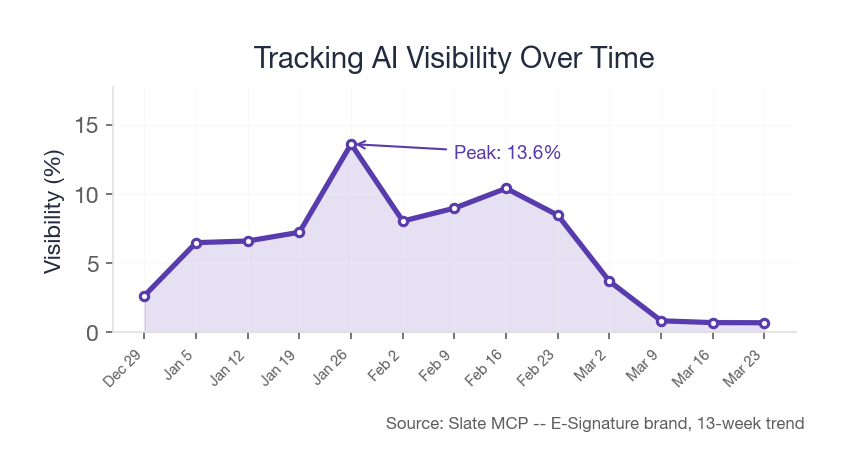
Citation performance follows a power law. Across every brand we have tracked, the top 10 URLs drive a wildly disproportionate share of total owned citations. You need to know which URLs are pulling weight and which are dead weight. Otherwise you are investing in formats and topics blindly.
What to Do
Track four metrics per URL:
- Total citation count across all AI platforms
- Platform breadth: how many platforms cite each URL (target 5+)
- Citation velocity: are new URLs entering the citation set within 30 to 60 days?
- Format correlation: which content formats consistently earn the most citations?
When we run this analysis for clients, the same pattern emerges every time. Product and pricing pages with specific data dominate. Tool pages and comparison content form a strong second tier. Everything else, the weekly blog posts, the generic thought leadership, trails far behind.
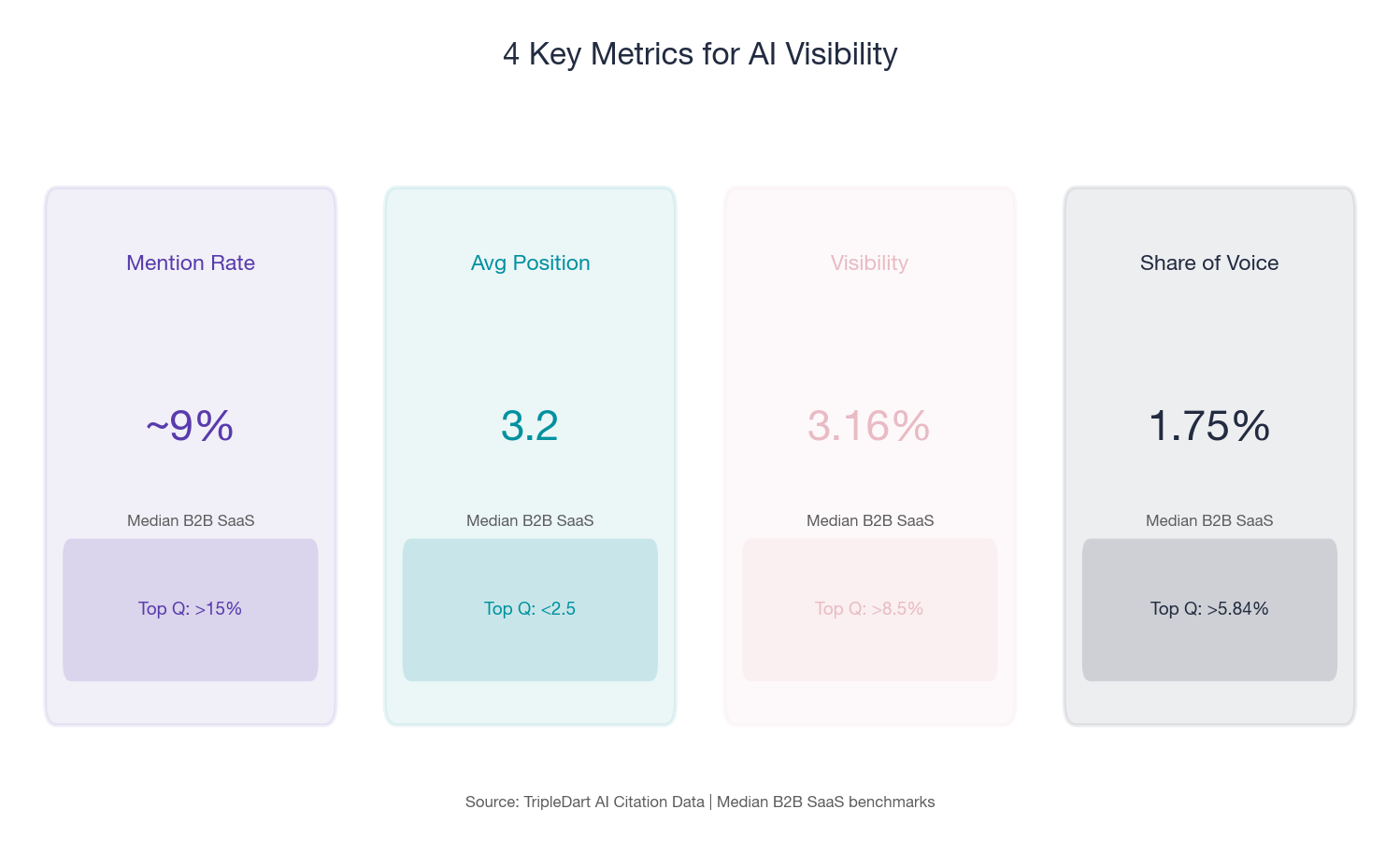
If your AI visibility report is a single number, you do not have a report. You have a feeling with a decimal point.
Before and After
Before: A marketing automation platform tracked "AI mentions" as a single monthly number. They knew they had "about 200 citations" but had no idea which pages drove them or whether the number was growing.
After: They implemented URL-level tracking across six AI platforms. They discovered that 8 of their 180 pages drove 74% of all citations. Three of those 8 were tool pages they had considered deprioritizing. They doubled down on those formats instead. Citation count grew 3x in 90 days because investment followed data, not intuition.
Benchmark
Set up URL-level tracking within your first two weeks. Review the data biweekly. The goal is a feedback loop: measure which formats and topics earn citations, then produce more of what works. Target 30-day review cycles with format-level analysis.
The Compound Effect of Getting This Right
When you combine all seven steps, the results compound. Tool pages earn citations. Those citations build domain authority with AI platforms. That authority makes your next page more likely to get cited. The brands with nearly a thousand cited URLs did not get there overnight. They built a system.
Brands that treat AI citation as a content format problem, not a content volume problem, earn 10x to 30x more citations than those publishing weekly blog posts. The framework is not complicated. The discipline to follow it is what separates the winners.
The Foundation Layer: Build a Brand Vocabulary Document
Every step above assumes your team describes your product the same way every time. In practice, they do not.
Your website says "AI-powered revenue intelligence platform." Your G2 profile says "sales analytics tool." Your CEO's LinkedIn bio says "we help companies close deals faster." Claude reads all of these. And it gets confused.
Brand consistency is not a messaging exercise. It is a Claude SEO tactic.
Create a one-page brand vocabulary document and enforce it across every contributor and platform:
- Your canonical one-sentence brand descriptor. Use it everywhere, verbatim.
- Your category label. Not "sales tool" in one place and "revenue platform" in another. Pick one.
- 3-5 core capability phrases. Standardize them.
- Banned terms that create category confusion.
The brands Claude recommends most confidently are described the same way everywhere it looks.
Key Terms Defined
If your team is new to Claude optimization, here are the terms that matter most in this framework:
- Schema markup: Structured data you add to your page’s code (JSON-LD format) that tells search engines and AI platforms what your content is about. A machine-readable label for every page.
- Topic cluster: A group of 5+ interlinked pages covering one broad topic from multiple angles. A pillar page covers the topic broadly; spoke pages go deep on subtopics.
- Citation hierarchy: The ranking of which content formats earn the most AI citations. Tool pages sit at the top. Standard blog posts sit at the bottom.
- Answer-first structure: Placing your core recommendation or answer in the first 100 words, before any background context.
- Platform breadth: The number of AI platforms that cite a given URL. Higher breadth signals stronger content.
What This Means for Your 90-Day Plan
The seven steps here are not a checklist to run once. They are a compounding system. Each tool page, error-fix article, and schema implementation makes the next citation more likely.
Here is how to sequence the work:
The teams seeing the strongest Claude citation performance are not doing anything exotic. They mapped their URL types, fixed their structure, built a few high-utility pages, and stayed consistent.
If you are not sure where to start, pick your single highest-intent URL and run it through this framework first. One well-optimized page will teach you more than a hundred mediocre ones.
Get Expert Help With Your Claude Optimization Strategy
Building a Claude-visible content system takes discipline, data, and a clear framework. If you want to accelerate the process, TripleDart's team specializes in AI search optimization for B2B SaaS brands. We have built and executed the exact framework described in this article for companies across email security, cloud infrastructure, enterprise payments, and more.
Book a strategy call to get your 90-day Claude optimization plan.
Frequently Asked Questions
What does it mean to optimize content for Claude?
It means organizing your content so it is easy to cite: answer-first structure, named authorship, and utility-first formats over keyword-dense blog posts. The goal is to make your pages the most extractable, verifiable source for the questions your buyers ask.
What page types get cited most by Claude?
Free tool pages, pricing pages, and error-fix content consistently outperform standard blog posts. Tool pages earn 35-78 citations on average, while blog posts typically earn fewer than 10.
How important is schema for Claude citations?
Very. Pages with structured schema show up on 5-6 AI platforms. Pages without schema appear on 1-2. That is a 3x-5x distribution difference for identical content.
How long until I see results?
Most teams see measurable citation movement within 6-10 weeks of structural changes. Tool pages and schema move fastest. Full compound effects typically emerge by week 12.
Is Claude optimization different from ChatGPT optimization?
The principles overlap, but Claude favors owned-domain content at a higher rate than ChatGPT. Optimizing for Claude tends to improve visibility across all AI platforms.
Do I need to rebuild my entire content library?
No. Start with your highest-intent URLs. Map what is already cited, then prioritize structural fixes. Most teams find that restructuring existing pages (not creating new ones) delivers the fastest ROI.
.webp)


.webp)
.webp)

.png)


.png)





.webp)





.webp)


.webp)






%20(1).png)


.webp)
.webp)
.webp)





%20Ads%20for%20SaaS%202026_%20Types%2C%20Strategies%20%26%20Best%20Practices%20(1).webp)







.png)


.png)





.webp)


![Creating an Enterprise SaaS Marketing Strategy [Based on Industry Insights and Trends in 2026]](https://cdn.prod.website-files.com/632b673b055f4310bdb8637d/6965f37b67d3956f981e65fe_66a22273de11b68303bdd3c7_Creating%2520an%2520Enterprise%2520SaaS%2520Marketing%2520Strategy%2520%255BBased%2520on%2520Industry%2520Insights%2520and%2520Trends%2520in%25202023%255D.png)




.png)
















.webp)







%20Agencies%20for%20B2B%20SaaS%20Compared%20(2026).webp)

.webp)
%20with%20Hubspot.webp)








.png)


.png)

.png)
.png)
.png)
.png)


















.webp)

.webp)
.png)
.png)



.webp)


.png)



















.webp)

![How to Measure AEO Success: 12 Metrics Beyond Clicks [2026 Framework]](https://cdn.prod.website-files.com/632b673b055f4310bdb8637d/6a0d664b326187e99b3d5960_6%20-%20The%20Ultimate%20Guide%20to%20Measuring%20AEO%20Success%20in%202026.png)
![7-Step Workflow for AEO-Ready Content [2026 Framework]](https://cdn.prod.website-files.com/632b673b055f4310bdb8637d/6a0d55ea88913ede1d3a7123_5%20-%20Workflows%20for%20Optimized%20AEO-Ready%20Content%20Creation.png)
.png)
![How to Structure Content for AEO and GEO [With Templates]](https://cdn.prod.website-files.com/632b673b055f4310bdb8637d/6a0c6a56eb700472e635ff33_1%20-%20How%20to%20Structure%20%20Content%20for%20AEO%20and%20GEO%20%20Summaries%20(2026).png)


.png)
.png)









.png)


.png)





%2520Agencies%2520(2025).png)

![Top 9 AI SEO Content Generators for 2026 [Ranked & Reviewed]](https://cdn.prod.website-files.com/632b673b055f4310bdb8637d/6858e2c2d1f91a0c0a48811a_ai%20seo%20content%20generator.webp)




.webp)
.webp)














.webp)