.png)

Key Takeaways
- Performance Max, Smart Bidding, Broad Match, and AI Max for Search are the core AI features inside Google Ads today.
- AI-generated ad variations outperform human-designed ads in A/B tests 68% of the time when tested at scale.
- Align your bidding strategy to revenue goals first, then let AI optimize within those guardrails.
- Third-party tools fill gaps Google's native AI doesn't cover, but general LLMs have real limitations for PPC.
- Human oversight on audience signals, creative quality, and negative keywords prevents AI from wasting budget.
- TripleDart Digital combines AI-backed campaigns with hands-on B2B SaaS expertise to convert ad spend into pipeline
Global AI marketing revenues are projected to reach around $47 billion in 2025 and more than $107 billion by 2028. Google has been embedding machine learning into every layer of its advertising platform for years now. Today, 86% of all Google Ads campaigns use some form of automated bidding, and 43% of advertisers already rely on AI-generated ad copy suggestions directly inside the platform.
For B2B SaaS teams, the old playbook of manual bid adjustments and static ad groups doesn't hold anymore. You need to understand how AI for Google Ads works, where it genuinely helps, and where it quietly burns your budget... so you can control spending, improve performance, and reach high-intent buyers at scale.
Let's break it down.
What Is AI in the Context of Google Ads?
Google's AI foundation for advertising goes back to the 2011 Google Brain Project, which developed neural networks to improve search. Over the years, Google trained its systems to recognize patterns, user intent, and keyword context. The BERT update added natural language processing so the platform understands full queries now, not isolated keywords.
Today, AI handles targeting, bidding, creative generation, and performance prediction inside Google Ads. When you run competitive research for Google Ads with AI, you get insights that help you win better placements, improve your copy, and act on data faster.
Every feature you interact with (from automated bidding to responsive search ads) connects back to that AI foundation.
For B2B SaaS marketers, here's what this means in practice: AI-powered Google Ads budget allocation and reallocation happens in real time. It adjusts to signals like device type, location, time of day, and audience behavior. The platform isn't a manual tool anymore; it's an AI-driven system that rewards the teams who know how to guide it.
Which AI features are built into Google Ads?
Google's native AI capabilities now span campaign types, bidding, creative, and measurement. Here are the features that matter most for B2B SaaS advertisers.
Performance Max
Performance Max campaigns use AI to serve ads across Search, YouTube, Display, Discover, Gmail, and Maps from a single campaign. The platform's creative reporting helps you track Ad Strength and gives deeper insights into asset performance. It also includes asset coverage reporting that flags underperforming assets and offers AI-driven suggestions like "add two long headlines" or "add three square images."
These campaigns now account for over 60% of Google Ads spend across advertisers. Google has also added search terms reporting and channel performance diagnostics, giving you more visibility into where AI is putting your budget.
When campaigns miss targets, AI explains why. It flags market fluctuations or budget constraints so you can act fast instead of guessing.
Broad Match
Broad match uses AI to expand your ad reach, showing ads for searches related to your keywords even if they don't match exactly. Say you sell project management software. Broad match might connect you with searches like "team collaboration tool for remote teams" or "task tracking for engineering sprints." Queries you'd never have added manually.
The optimal bid to reach each user varies. Bidding manually for every variation would take too much time and leave gaps. Google's AI solves that through responsive search ads, testing headlines and descriptions to deliver the top-performing combo for each search. This is how AI tools for Google Ads bid optimization strategies work at the keyword level.
Smart Bidding
Smart Bidding optimizes for conversions or conversion value during each auction. This "auction-time bidding" includes strategies like target CPA (tCPA) and target ROAS (tROAS). Machine learning analyzes large volumes of data to predict how different bids affect outcomes, factoring in signals like device type, location, and time of day.
Agency Data Insight
Across our portfolio of 40+ B2B SaaS accounts, AI-optimized Google Ads campaigns using Smart Bidding strategies like Target ROAS consistently deliver 28% lower CPAs compared to manual bidding approaches. This benchmark holds even as impression share increases by 15–20% in high-volume periods.
AI Max for Search campaigns
AI Max for Search is a newer feature that expands reach to AI surfaces with personalized creatives and landing pages. You can activate it in one click to drive performance on relevant queries that your existing keyword lists might miss.
For B2B SaaS teams, this is especially useful when launching new product features or entering adjacent markets where search behavior is still forming.
Automatically generate visual assets
Google's text-to-image feature, powered by conversational AI, lets you turn prompts into visual assets. Provide a prompt that fits your ad context, and the system generates images to match. You can request changes like adjusting the background or isolating an element.

Google has expanded this with Asset Studio, a centralized hub for AI creative generation, and Product Studio, a free suite for merchants to optimize visuals, generate lifestyle scenes, and remove backgrounds. Image-to-video capabilities now use Google's Veo model, and AI outpainting intelligently expands videos beyond their original frames.
Agency Data Insight
In managing diverse PPC portfolios, campaigns incorporating AI-generated creatives via tools like Asset Studio show 35% higher CTRs on Performance Max and Demand Gen formats. Rapid testing of asset combinations reduces creative fatigue, and top-performing visuals are identified in under a week -- boosting overall ROAS.
Brands using AI creative generation report 30-60% higher click-through rates compared to manually designed ads. These tools appear across Search, Performance Max, Demand Gen, App, and Display campaign types.
What are the benefits of AI in campaign management?
AI in campaign management reduces manual work, sharpens targeting, and enables real-time optimization based on data. All of which are critical for B2B SaaS teams running multi-channel campaigns.
Reduced manual workload
You no longer need to manually adjust bids, monitor campaigns around the clock, or analyze data across multiple platforms. With automated Google Ads optimization with machine learning tools, campaigns are optimized based on performance metrics. Your team gets to focus on strategy, messaging, and pipeline alignment instead.
Enhanced targeting precision
AI processes complex variables in real time: user behavior, device preferences, location, time of day, past ad interactions. In Performance Max, AI considers signals like market trends and even weather forecasts to predict user behavior.
Bain & Company reports that retailers using AI-powered targeted campaigns increase return on ad spend by 10% to 25%. For B2B SaaS, this precision means your ads reach decision-makers at the right moment in their buying journey.
Real-time optimization based on data
As campaigns run, AI algorithms continuously monitor CTR, conversion rates, and ROAS to adjust campaigns dynamically. If a campaign underperforms, AI can adjust bidding or targeting instantly. Google Ads AI forecasting for conversion rate prediction helps you anticipate results before they happen, rather than reacting after budget is already spent.
JoinBrands
"JoinBrands achieved a 6x growth in revenue while maintaining the same level of ad spend, and improved their ROAS from 0.6 to 3.7 over a 9-month period."
Read the full JoinBrands case study →
What AI strategies actually work for Google Ads?
Knowing the features is one thing. Applying them to B2B SaaS campaigns requires a different approach than what works for e-commerce or local businesses.
Align bidding strategy with goals
Your revenue goals should shape how you bid. Not the other way around.
- Target CPA - when you want more conversions while stabilizing costs
- Target ROAS - when you care more about revenue than volume
- Maximize Conversions - when you want to capture as many leads as possible within a set budget
- Maximize Conversion Value - when you prioritize revenue over lead count
After selecting your strategy, let AI handle the bidding. Google's Smart Bidding learns how users behave and adjusts bids for every auction. You won't need to guess which keyword will convert next. This is how to use AI for Google Ads campaign automation at the bidding level.
Fuel campaigns with fresh creatives
Google's AI can only test what you give it. No matter how advanced the targeting, the campaign will underperform if your assets look generic or stale.
Upload a mix of short and long headlines, direct CTAs, product benefits, and emotional hooks. For images, choose high-contrast, focused visuals that highlight your product clearly. AI-generated ad variations outperform human-designed ads 68% of the time when tested at scale with more than 50 variations.
Keep checking performance labels: "Low," "Best," and "Learning." Swap out low-performing assets and test fresh variations regularly.
Demand Gen campaigns saw 64% growth in adoption in 2026, focusing on YouTube Shorts and Discover placements. So your creative strategy needs to cover video and visual formats, not just text.
Target better with search themes
Google introduced Search Themes in Performance Max and Demand Gen campaigns to let you steer AI without limiting its reach. Instead of uploading keywords, you enter topics related to your offer, like "employee onboarding software" or "compliance automation for fintech."
Google uses these themes to predict interest, behavior, and purchase readiness across YouTube, Gmail, Discover, and Search. This works well for seasonal campaigns or new products with minimal historical data. Feed the system your audience signals, product feeds, and creatives alongside Search Themes for the strongest results.
A Reddit user in r/PPC noted: "If you are looking to get AI-assisted recommendations, Performance Max and built-in AI are ramping up, but other tools like Adalysis assist you with specific optimizations that Google's native AI doesn't cover."
Which tools and platforms enhance AI for Google Ads?
Google's native AI handles a lot, but third-party tools fill specific gaps, especially for ad copy generation, account auditing, and creative testing. Here are the best AI platforms for Google Ads performance improvement.
Hypotenuse AI
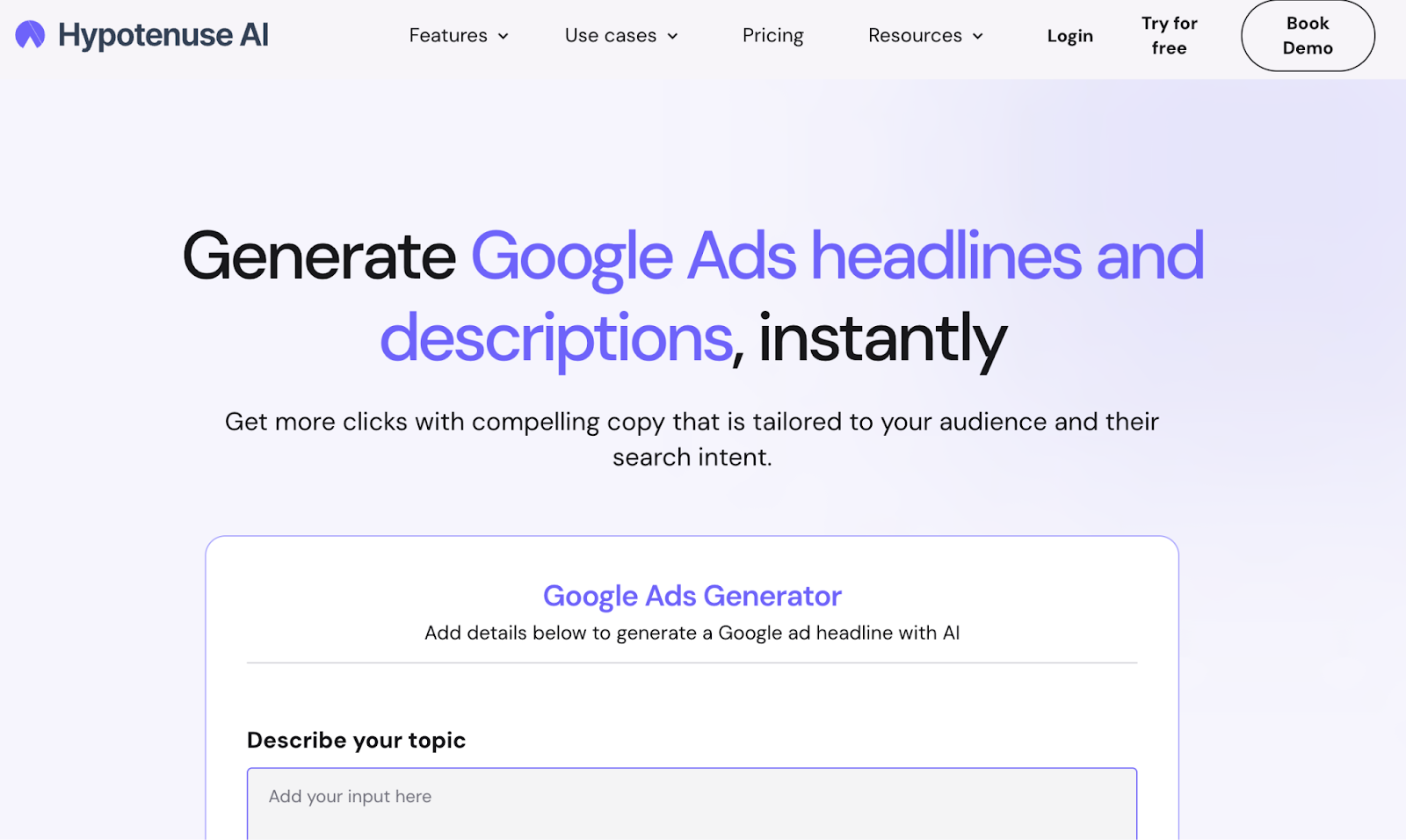
Hypotenuse AI crafts ad copy tailored to your audience and search intent. You get multiple copy variations for every campaign type without writing from scratch. Its Google Ads preview tool lets you visualize how ads will appear, and you control the message, tone, and keywords in every line. That's how AI is changing B2B SEO and PPC: not by replacing writers, but by helping you work smarter.
Key features: Pre-built templates, image generation with Hypo Art, content rewrites. Pricing: Basic at $150/month per seat; Ecommerce Pro and Enterprise at custom pricing. See Hypotenuse AI pricing.
WordStream
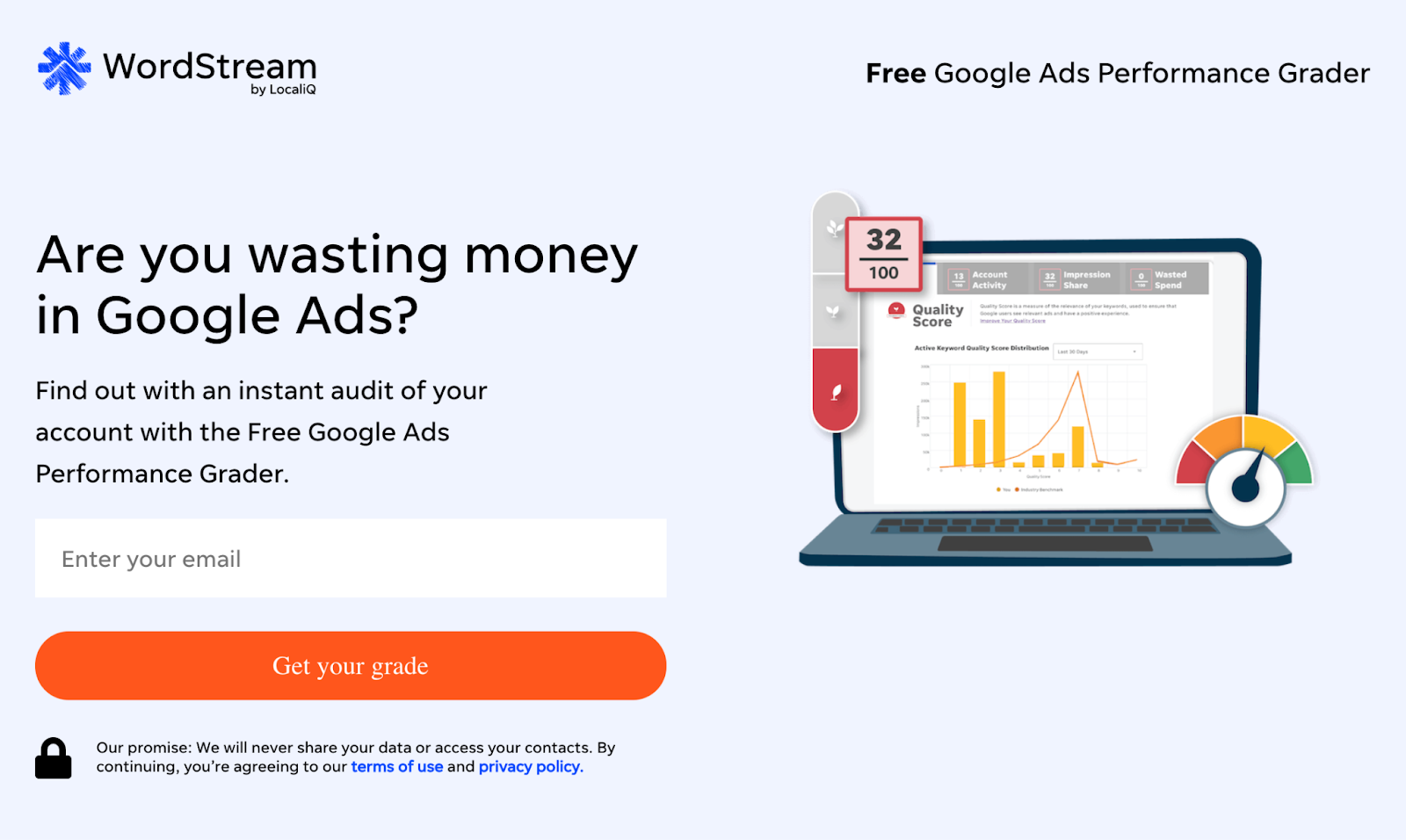
WordStream's free Google Ads Performance Grader checks your account against ten metrics and provides a clear overall score with steps to act on. You can compare ad performance with industry benchmarks and understand if your ads are getting seen. Pricing: Free.
AdCreative.ai
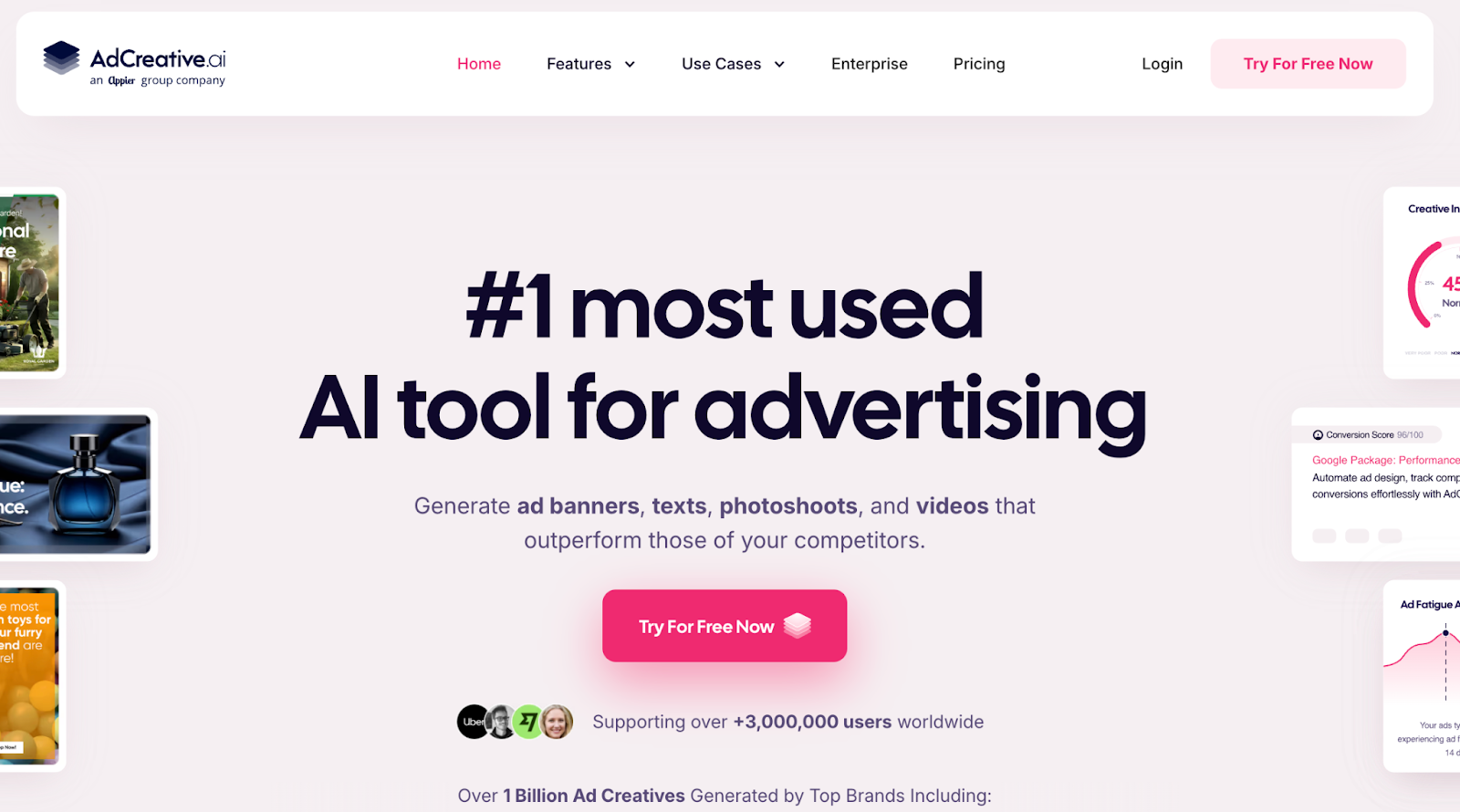
Trusted by three million+ users, AdCreative.ai builds ROI-focused ad creatives, product photoshoots, videos, and ad copy. Its creative scoring AI predicts ad performance by analyzing ad components.
Key features: Product photoshoot AI, AI-driven ad text, creative scoring. Pricing: Starter at $39/month (1 brand); Professional at $249/month (3 brands); Ultimate at $599/month (10 brands); Enterprise at custom pricing. See AdCreative.ai pricing.
Shown
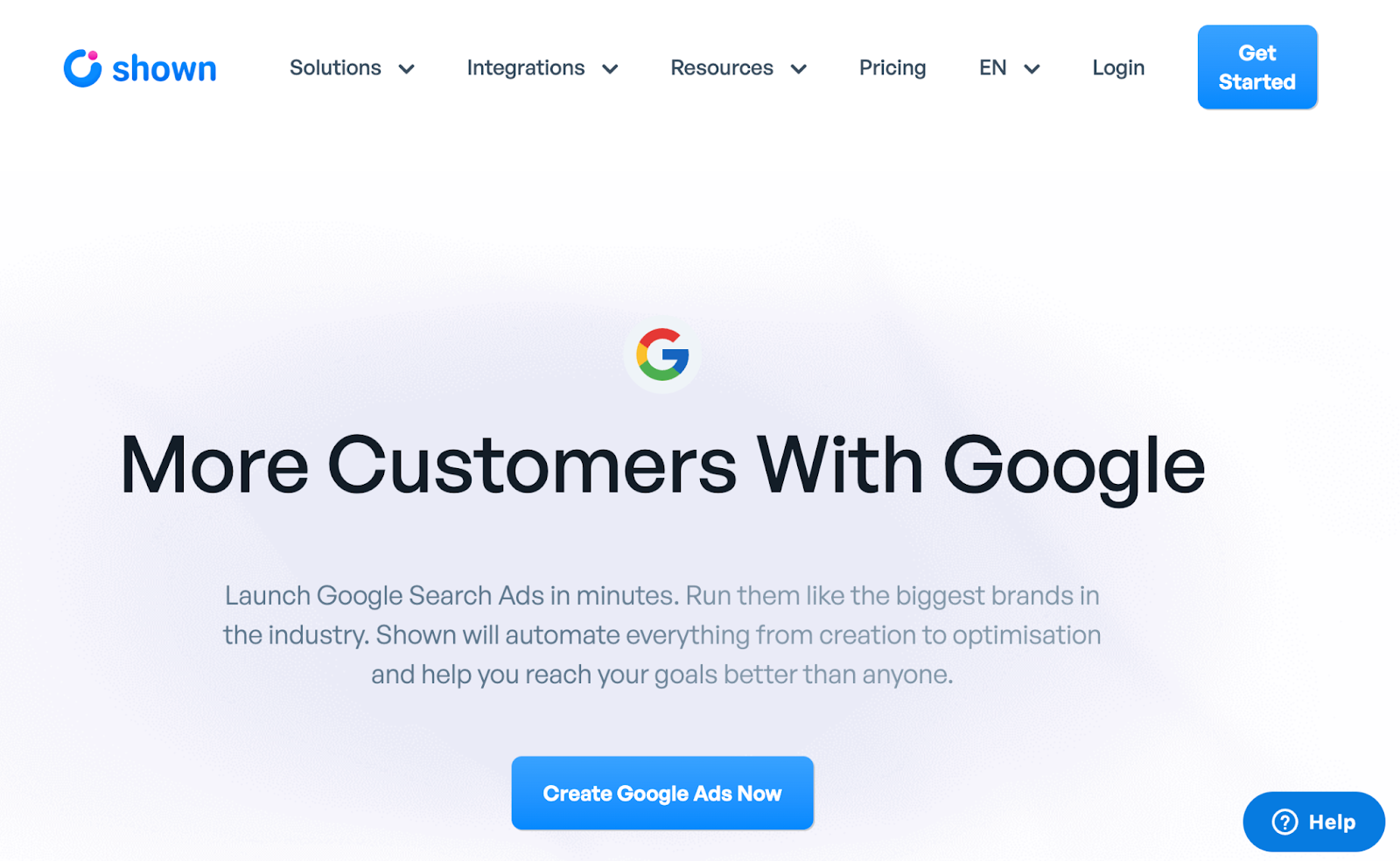
Shown manages and optimizes campaigns across Google, Facebook, Instagram, and Microsoft. For B2B SaaS PPC teams, it's a smarter way to scale ads without overcomplicating the process.
Key features: Ad account selection, automated campaign creation, ongoing campaign optimization. Pricing: Starter at $29/month (2 members); Advanced at $120/month (10 members). See Shown pricing.
Balloonary
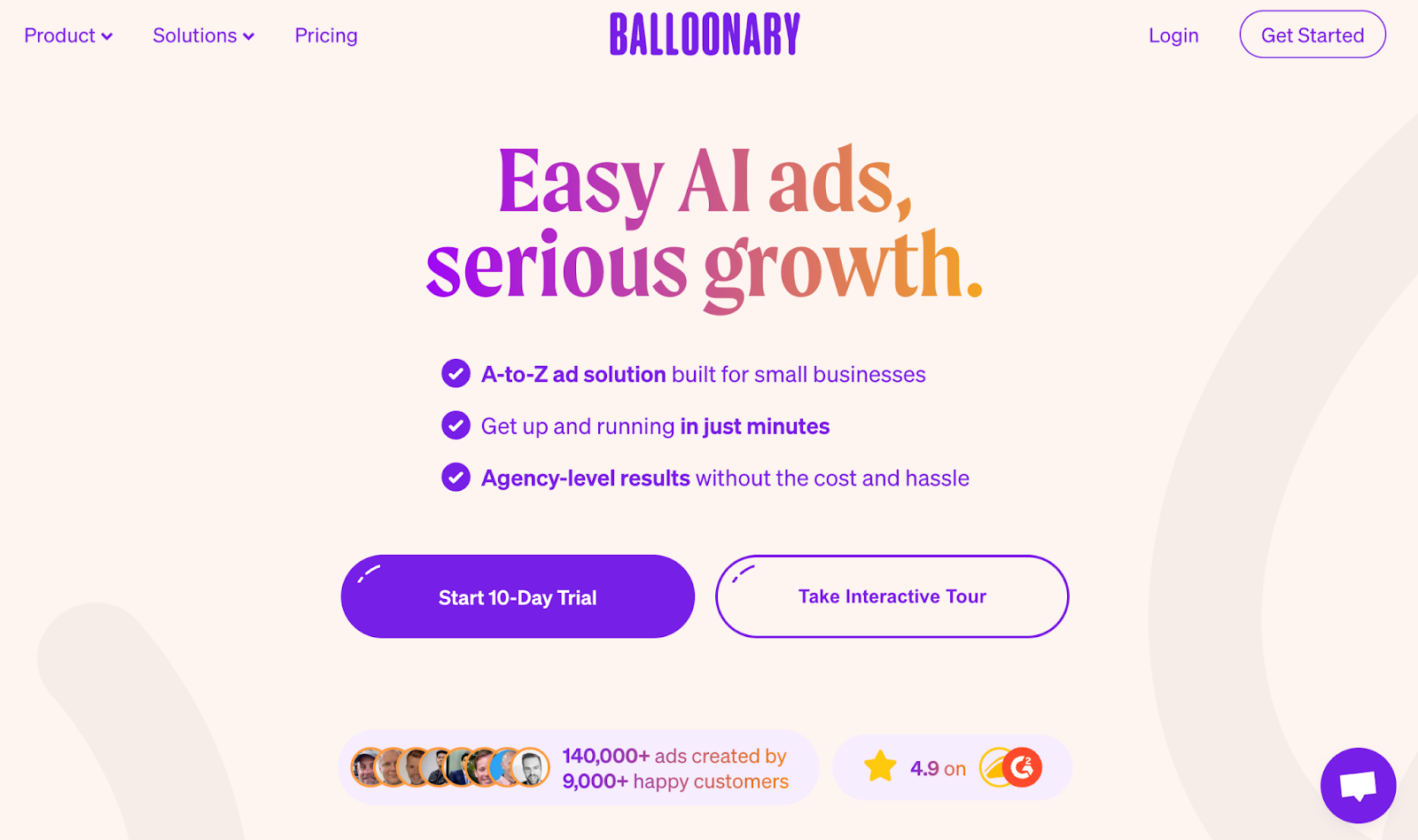
Balloonary simplifies online advertising with AI-driven ad creation, optimization, and tracking across Google, Facebook, and Instagram. It connects to your existing ad accounts and simplifies tracking setup by automatically managing tracking codes and pixels.
Key features: Loona AI Assistant, Autopilot optimization, creative editor, advanced ad templates. Pricing: Basic at $29/month; Grow at $59/month; Expand at $99/month. See Balloonary pricing.
A note on general LLMs for Google Ads
A growing number of advertisers are experimenting with ChatGPT and Claude for ad copy and analysis. But connecting general AI directly to the Google Ads API has real limitations. Outputs can be inconsistent, context is limited, and hallucinations are a risk, especially for bid recommendations or budget decisions.
Agency Data Insight
AI-driven search term analysis across our accounts uncovers 22% more high-intent long-tail queries for negative keyword optimization, cutting wasted spend by an average of 18% while preserving volume on converting traffic. This pattern emerges strongest in broad match campaigns, where human-AI hybrid reviews prevent intent drift.
A Reddit thread in r/googleads summed it up well: "Both Claude and ChatGPT can help with ideas, copy variations, and basic analysis, but they won't replace proper Google Ads data tools and hands-on optimization."
Specialized AI agents built for PPC, with data validation and N-gram pattern recognition, outperform general LLMs for tasks like AI Google Ads tools for reducing wasted ad spend.
What pitfalls should you watch out for?
AI can waste budget, target the wrong users, or harm ad relevance if left unchecked. Here are the most common pitfalls and how to avoid them.
Google's algorithm updates, including the March 2024 Spam Update targeting manipulative ad experiences, reinforce that a basic understanding of how to use AI for Google Ads isn't enough anymore. You need active management.
CleverTap
"CleverTap achieved a 42% reduction in cost per SQL and a 20% reduction in cost per opportunity over 24 months, while also increasing conversion rates by 20–30% after implementing changes."
Read the full CleverTap case study →
Why does human insight still matter in AI-driven advertising?
AI can't understand emotions, break creative boundaries, or adapt to unexpected market conditions. It often misses context, runs on limited data, and carries the risk of bias. Even the most advanced tools won't detect a major industry change unless a human steps in and makes the call.
Real-time Google Ads optimization using artificial intelligence works best when paired with strategic human oversight. That means reviewing search term reports, auditing audience overlap, refreshing creatives before fatigue sets in, and aligning campaigns to pipeline goals, not just platform metrics.
A discussion in r/PPC captured this tension well: "Google Ads definitely faces new challenges in the AI era, but it's still incredibly effective for capturing high-intent traffic at the moment of decision."
The advertisers winning right now are the ones who treat AI as an enabler, not a replacement for strategy.
Partnering with an AI SEO agency like TripleDart Digital makes a real difference here. We combine AI-backed campaigns with hands-on B2B SaaS expertise to help companies grow faster, reduce wasted spending, and convert ad budgets into predictable pipeline and qualified leads. We track behavior, predict search trends, refine ad copy, and optimize bids for actual revenue, not clicks.
If you're ready to scale smarter with precise, performance-driven SaaS PPC, contact TripleDart today and turn that ad spend into profitable results.
FAQs
How does AI improve ad relevance in Google Ads?
AI improves ad relevance by analyzing user behavior, predicting intent, and personalizing ad content in real time. It ensures the right message reaches the right audience by testing headline and description combinations, adjusting bids per auction, and factoring in signals like device, location, and past interactions. This drives higher engagement and better conversion rates.
What are the best AI-powered bidding strategies for B2B SaaS?
The most effective AI-powered bidding strategies for B2B SaaS include Target CPA (for stabilizing cost per lead), Target ROAS (for maximizing revenue from high-value actions), and Maximize Conversion Value (for prioritizing pipeline over lead count). Performance Max and AI Max for Search campaigns layer these strategies across multiple Google surfaces.
How can AI help with audience targeting in a cookieless world?
AI analyzes first-party data, predicts user intent, and segments audiences without relying on cookies. It uses behavioral patterns, contextual signals, and custom audience segments to target relevant users while respecting privacy regulations. Integrating your CRM data with Google Ads strengthens these signals.
What are the limitations of using general AI tools like ChatGPT for Google Ads?
General LLMs like ChatGPT and Claude can help with ad copy ideas and basic analysis, but they lack direct API integration, produce inconsistent outputs for bid recommendations, and can hallucinate data. Specialized PPC AI tools with data validation and N-gram pattern recognition are more reliable for campaign optimization.
How does TripleDart help B2B SaaS companies with AI for Google Ads?
TripleDart Digital combines AI-backed campaign management with deep B2B SaaS expertise across 40+ accounts. We use Smart Bidding, Performance Max, and AI-driven creative testing alongside human-led strategy: reviewing search terms, managing audience signals, and optimizing for pipeline metrics like SQL and opportunity cost. Our approach has delivered results like a 42% reduction in cost per SQL for CleverTap and 6x revenue growth for JoinBrands. Book an intro call to see how we can help your team.
How TripleDart turns AI for Google Ads into pipeline growth
AI for Google Ads isn't optional anymore. It's the default operating system for paid search. The B2B SaaS teams winning today are the ones who pair Google's native AI with strong creative inputs, clear conversion goals, and disciplined human oversight.
At TripleDart Digital, we run AI-backed B2B PPC campaigns that optimize for revenue, not vanity metrics. From Smart Bidding configuration to Performance Max creative testing to negative keyword automation, our team manages every layer so your ad spend converts into qualified pipeline.
Book a call with TripleDart and start scaling smarter.



.webp)
.webp)
.png)


.png)


.webp)




.webp)

.webp)





%20(1).png)


.webp)
.webp)
.webp)




%20Ads%20for%20SaaS%202026_%20Types%2C%20Strategies%20%26%20Best%20Practices%20(1).webp)







.png)


.png)




.webp)


![Creating an Enterprise SaaS Marketing Strategy [Based on Industry Insights and Trends in 2026]](https://cdn.prod.website-files.com/632b673b055f4310bdb8637d/6965f37b67d3956f981e65fe_66a22273de11b68303bdd3c7_Creating%2520an%2520Enterprise%2520SaaS%2520Marketing%2520Strategy%2520%255BBased%2520on%2520Industry%2520Insights%2520and%2520Trends%2520in%25202023%255D.png)



.png)













.webp)

%20Agencies%20for%20B2B%20SaaS%20Compared%20(2026).webp)

.webp)
%20with%20Hubspot.webp)





.png)


.png)

.png)
.png)
.png)
.png)












.webp)

.webp)
.png)
.png)



.webp)


.png)


















.webp)

![How to Measure AEO Success: 12 Metrics Beyond Clicks [2026 Framework]](https://cdn.prod.website-files.com/632b673b055f4310bdb8637d/6a0d664b326187e99b3d5960_6%20-%20The%20Ultimate%20Guide%20to%20Measuring%20AEO%20Success%20in%202026.png)
![7-Step Workflow for AEO-Ready Content [2026 Framework]](https://cdn.prod.website-files.com/632b673b055f4310bdb8637d/6a0d55ea88913ede1d3a7123_5%20-%20Workflows%20for%20Optimized%20AEO-Ready%20Content%20Creation.png)
.png)
![How to Structure Content for AEO and GEO [With Templates]](https://cdn.prod.website-files.com/632b673b055f4310bdb8637d/6a0c6a56eb700472e635ff33_1%20-%20How%20to%20Structure%20%20Content%20for%20AEO%20and%20GEO%20%20Summaries%20(2026).png)


.png)
.png)








.png)

.png)



%2520Agencies%2520(2025).png)

![Top 9 AI SEO Content Generators for 2026 [Ranked & Reviewed]](https://cdn.prod.website-files.com/632b673b055f4310bdb8637d/6858e2c2d1f91a0c0a48811a_ai%20seo%20content%20generator.webp)

.webp)
.webp)








.webp)