.png)

%2520Agencies%2520(2025).png)
Key Takeaways
- AI is eating traditional search: Gartner predicts a 25% drop in traditional search engine volume by 2026 as users move to AI chatbots, making Generative Engine Optimization non-negotiable.
- The top agencies: The major players in the GEO space right now are TripleDart, Omnius, iPullRank, Flow Agency, Growth Plays, First Page Sage, and WebFX.
- SEO is not GEO: Traditional SEO playbooks focused on backlinks and keyword density are falling short. GEO requires technical schema, entity linking, and "citable" content structures.
- Adoption is accelerating: 56% of marketers already use generative AI in their SEO workflows, and 33% of business leaders sought professional GEO support because of competitor pressure.
- The core services: Look for agencies offering AI-optimized content clusters, prompt-level research, LLM visibility monitoring, and citation tracking.
We work with multiple SaaS brands across industries. And this transition from traditional search to AI-driven discovery? It's not something we're bracing for. It's already here.
Search today doesn't just live on Google's blue links. It lives inside ChatGPT answers, Gemini summaries, Perplexity citations, and AI-powered search experiences that don't always send users to a website at all.
That's created a new optimization layer: Generative Engine Optimization (GEO).
Think about how your brand shows up when buyers ask AI tools questions like:
- "What's the best SOC 2 compliance software for startups?"
- "Which B2B marketing agencies specialize in AI search?"
- "Best tools for RevOps teams in SaaS?"
Search Engine Journal's AI Search Behavior Study found that 37% of B2B buyers now begin research with AI tools rather than traditional search engines. That's exactly why companies are actively looking for the best generative engine optimization agencies; teams that understand how AI engines discover, evaluate, and surface information.
Let's break it down.
How did we select the 15 best GEO agencies?
Evaluating GEO expertise is different from evaluating traditional SEO. You can't just look at a backlink profile. You have to assess how an agency handles knowledge graphs, entity linking, and LLM citation architecture.
We used a weighted scoring system across 50+ agencies:
- Client repository (25%): We prioritized agencies with documented GEO-specific case studies and measurable AI citation results.
- Customer reviews (25%): Analysis of feedback on Trustpilot and Clutch regarding their ability to adapt to new search trends.
- Leadership and thought leadership (20%): Does the leadership team actively contribute to the AI SEO conversation with original research?
- Original research (20%): Higher weight went to agencies publishing original data on LLM citation growth and AI visibility benchmarks.
External references (10%): Mention frequency in specialized communities like Reddit (r/SaaS, r/GEO_optimization) and industry publications.
Which are the 15 best generative engine optimization agencies in 2026?
Here's a quick-reference comparison. Detailed breakdowns for each agency follow below.
1. TripleDart: full-funnel GEO for B2B SaaS and tech growth
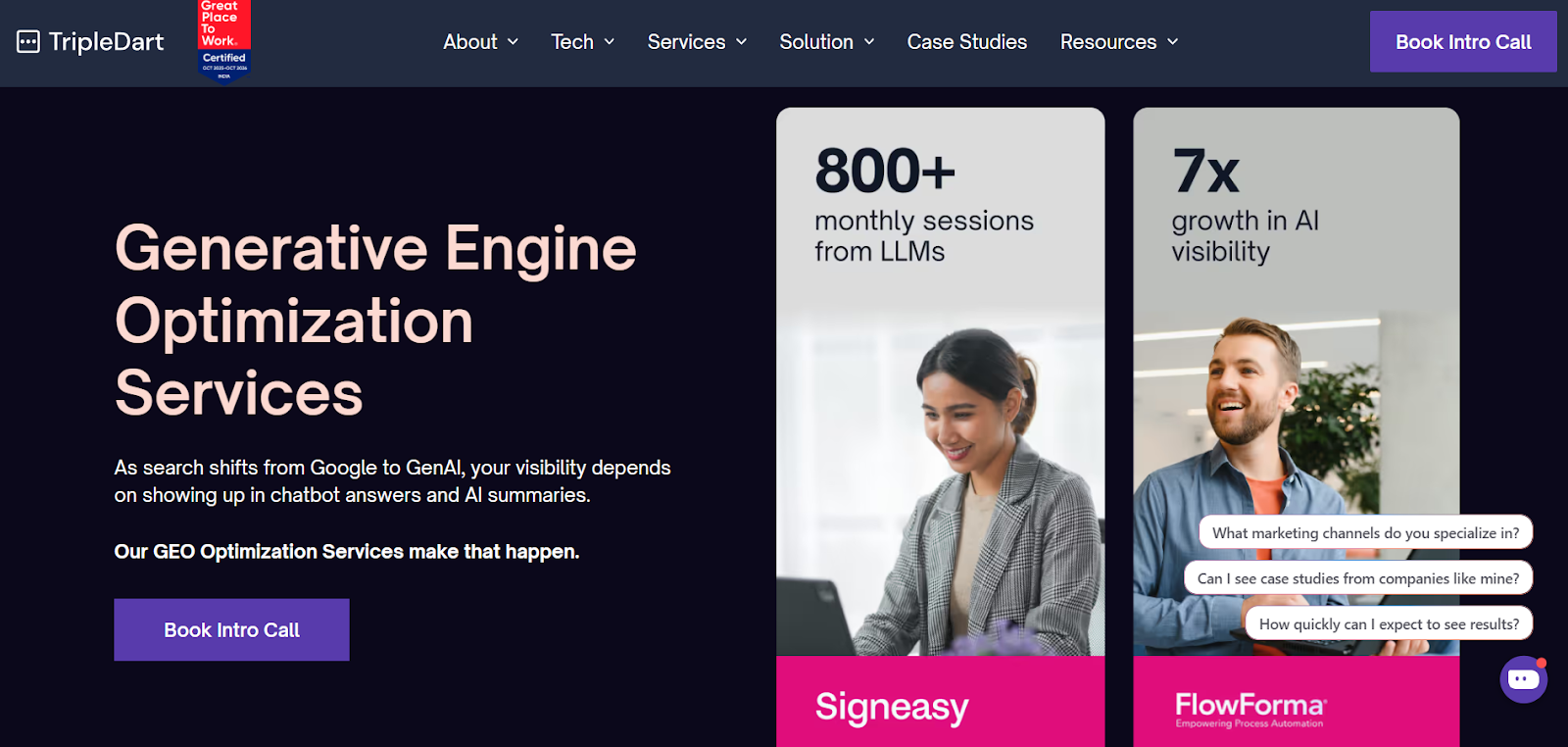
TripleDart is a specialized growth agency that bridges the gap between traditional SEO and Generative Engine Optimization. We don't build links for the sake of it. We build authority that AI engines trust.
So what makes us different? We run deep audits across the funnel, then use conversational query mapping, AI response tracking, and structured content architecture to align your pages with how people actually ask questions on AI platforms.
We use Slate, our proprietary content refresh platform, to make sure your content never goes stale. AI engines prioritize the most current and verified data, and Slate processes hundreds of pages simultaneously to maintain the freshness that triggers AI citations.
Results worth noting:
- Our work with FlowForma resulted in a 5.5x increase in LLM-attributed traffic within nine months. FlowForma now appears consistently in ChatGPT recommendations for "process automation" queries.
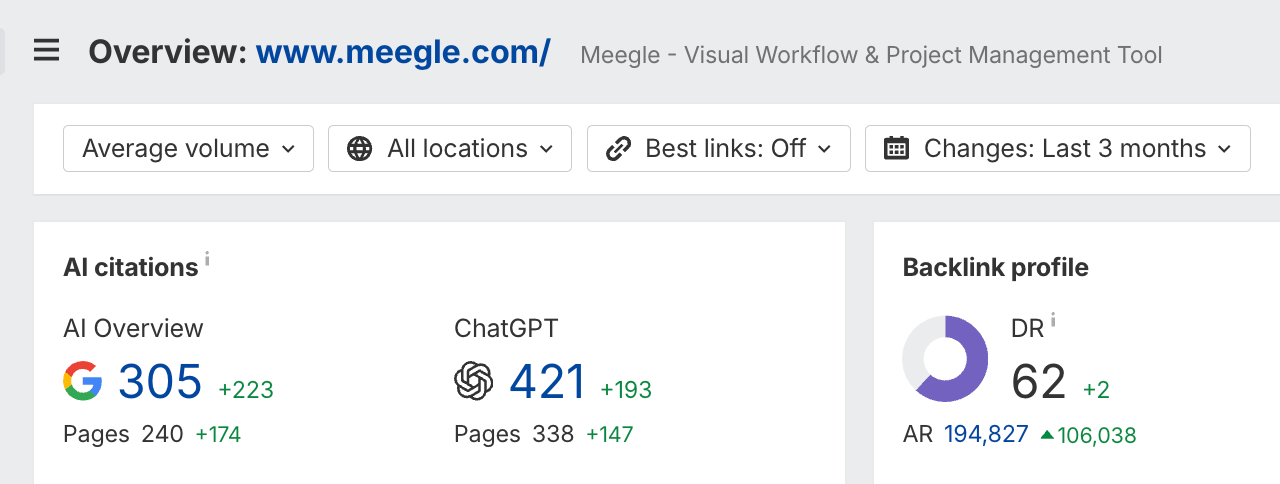
- Meegle achieved a 134% increase in AI citations by restructuring their content into LLM-friendly clusters.
FlowForma — GEO Case Study
FlowForma improved AI-attributed traffic by 5.5x within 9 months through strategic GEO implementation and achieved consistent visibility in process automation recommendations across AI platforms like ChatGPT, Perplexity, and Gemini.
Read the full FlowForma case study →
Services offered:
- AEO (Answer Engine Optimization)
- Conversational query and prompt research
- Automated content refresh via Slate
- Citation tracking across Perplexity, ChatGPT, and Gemini
Pricing: Custom monthly retainers start at $5,000.
2. Omnius: automation-led GEO for scalable AI visibility
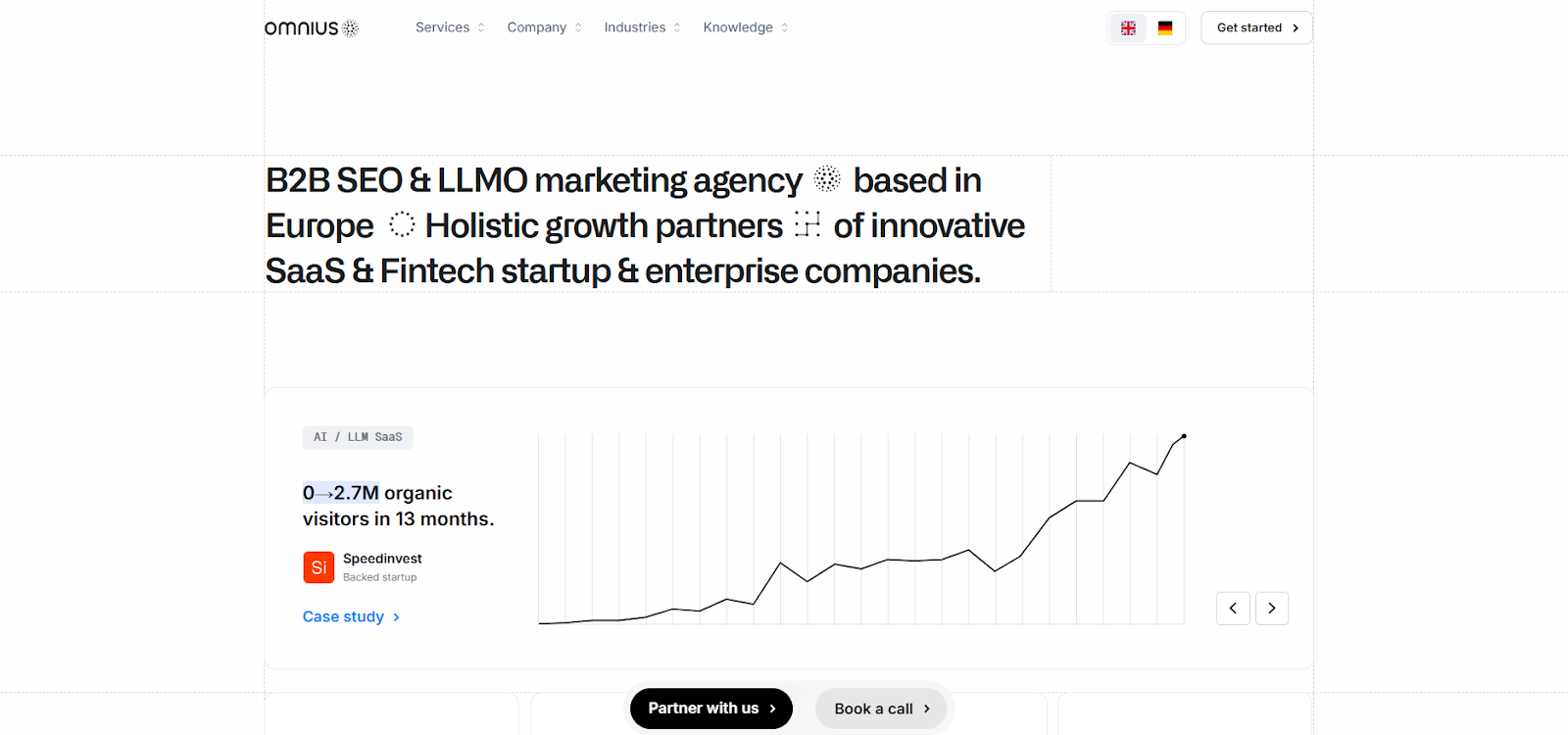
Omnius uses AI to scale semantic depth. Their content frameworks are engineered for how generative engines understand topical authority. If you need to win in highly competitive, category-level searches across hundreds of pages, Omnius brings the structure, speed, and systemization to get there.
Notable clients: Bigcommerce, Payoneer, Databox, Native Teams, Signify
Pricing: Retainers start at $6,000/month
3. iPullRank: technical SEO with GEO precision
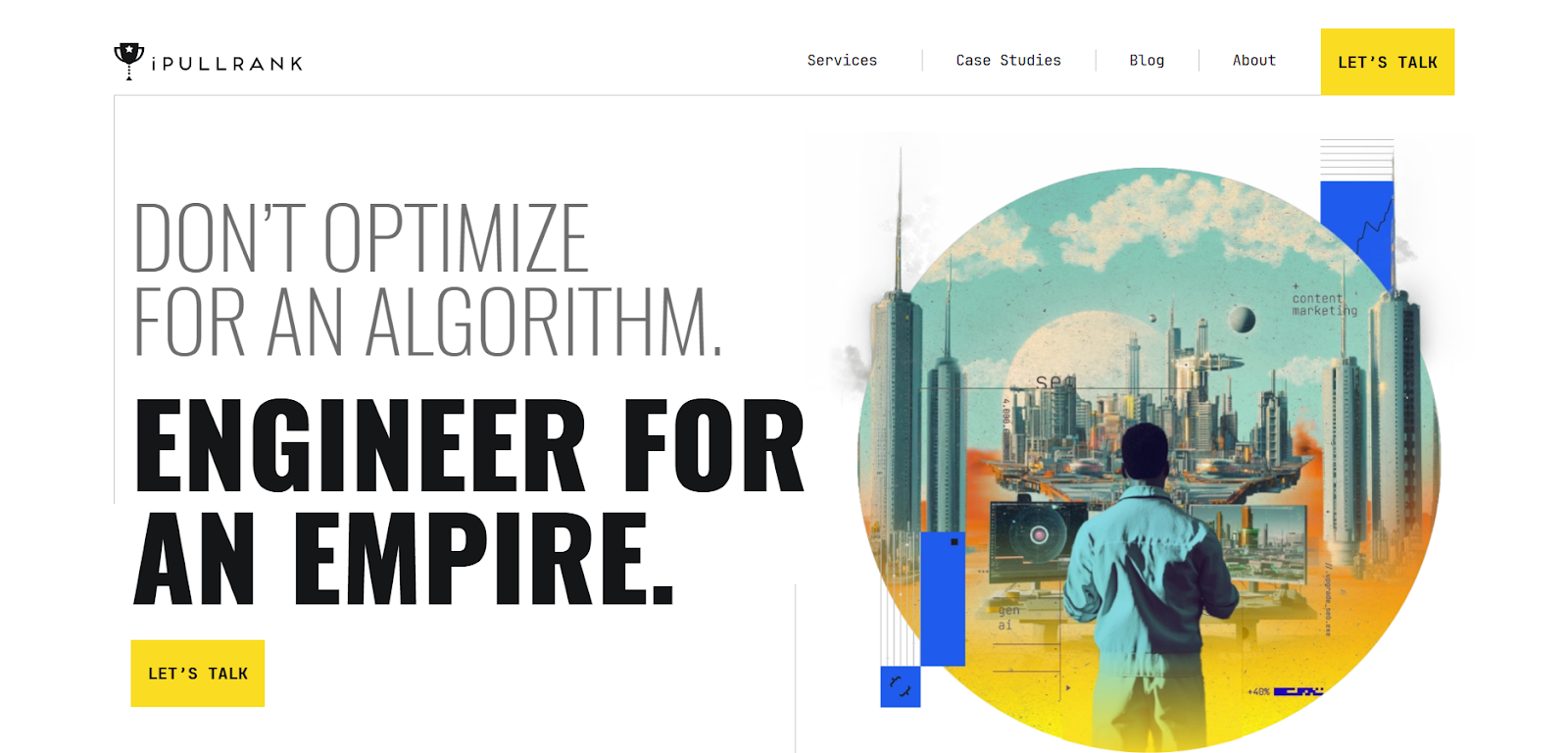
iPullRank dives into the bones of your site. They restructure information architecture, deploy schema at scale, and optimize for how large language models parse and prioritize content. They also emphasize governance, training, and custom prompt libraries that help enterprise teams adopt AI at scale.
Notable clients: Target, CoinDesk, Nordstrom, Adidas, American Express
Pricing: Engagements start around $8,500/month; enterprise retainers up to $30,000/month
4. Flow Agency: UX-led GEO strategy for fast-moving startups
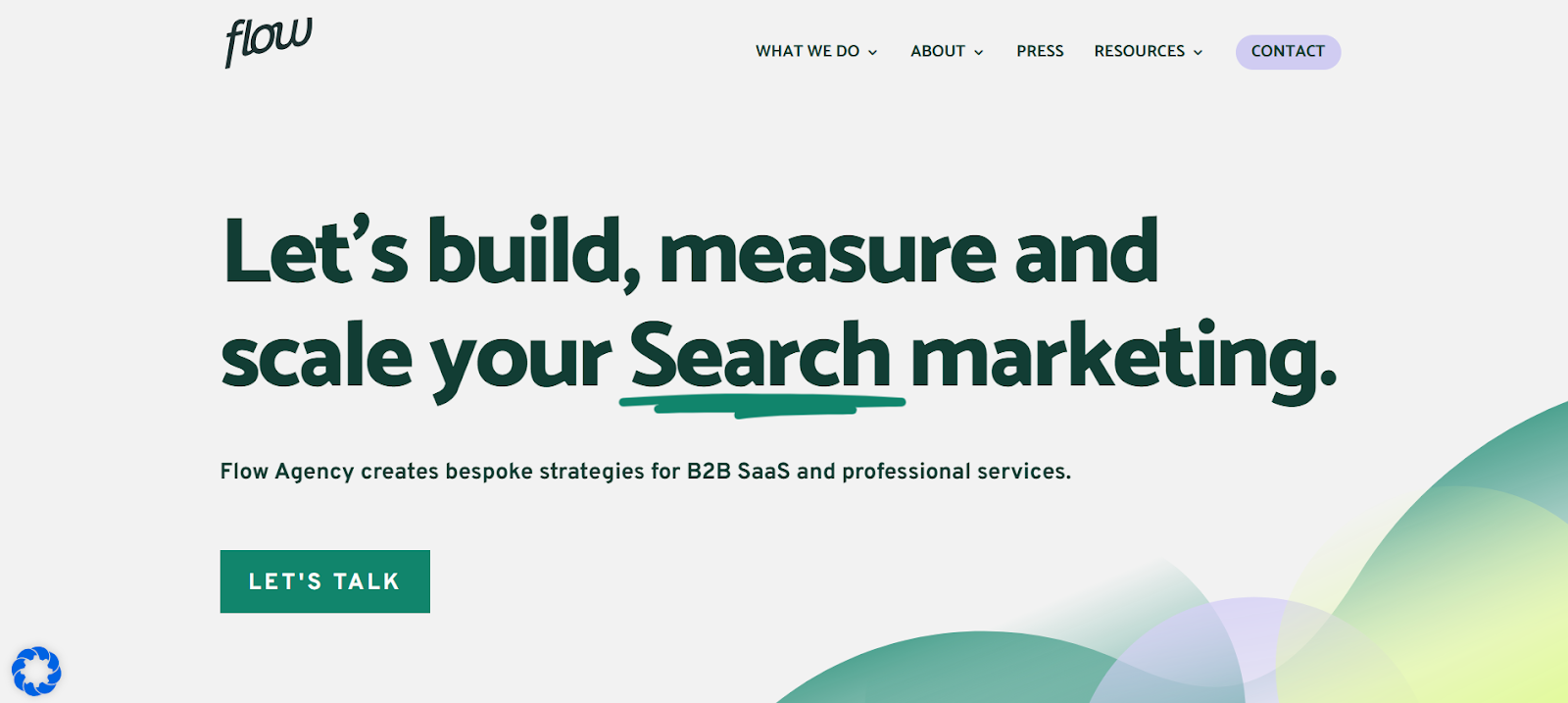
Flow Agency creates content architecture that mirrors how people ask questions and how LLMs return answers. Better content hierarchy, logical site structures, and metadata that speaks the language of both humans and machines. An affordable generative engine optimization agency for startups that need to move fast.
Notable clients: Sharpen, Starmind, Aroflo, Mailbird, Lanes & Planes
Pricing: Start at $4,000/month
5. Growth Plays: revenue-focused GEO content
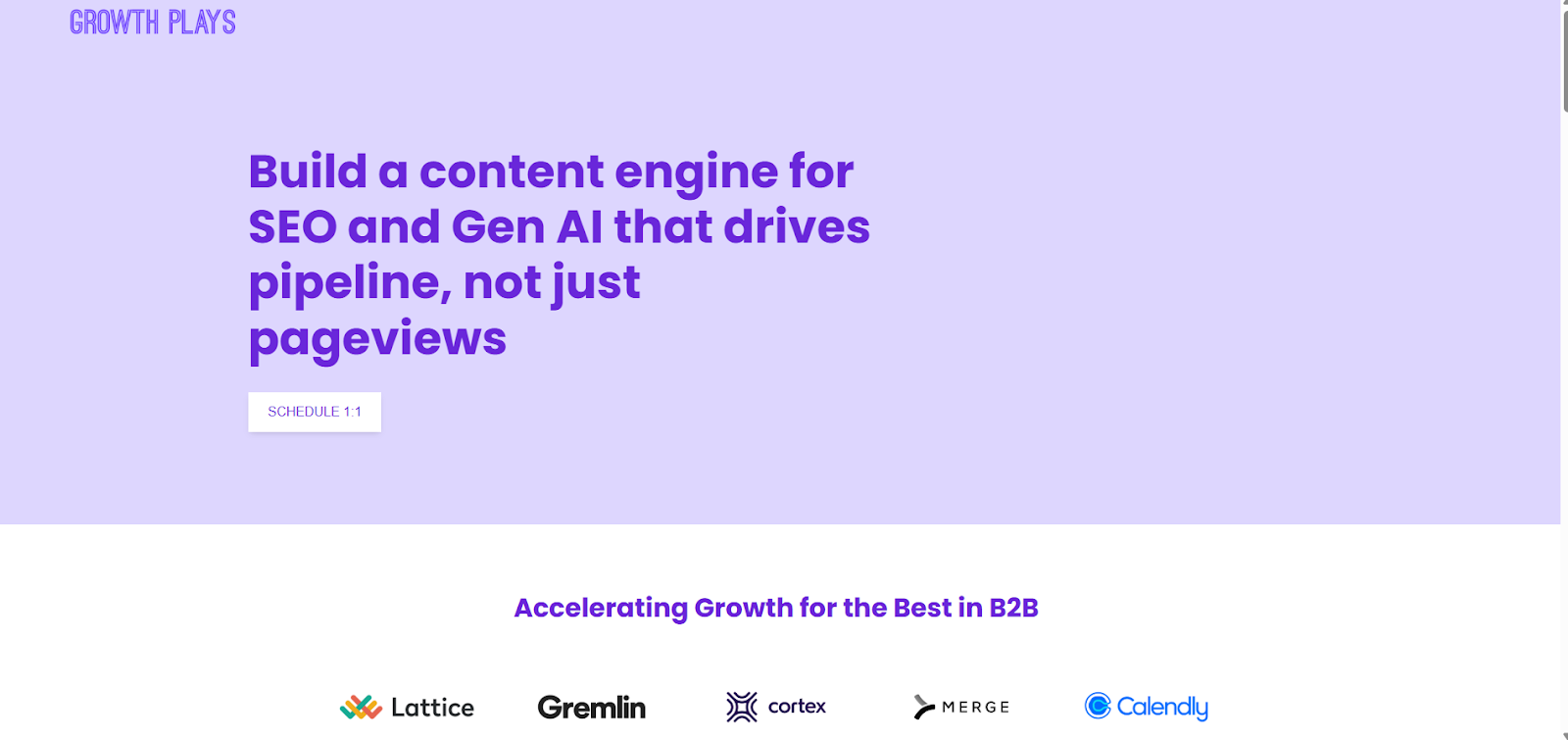
Growth Plays dominate in sales-aligned GEO. Their strength is in prompt-level keyword research, funnel-aware content creation, and CRO-backed analysis that ties every asset to outcomes. A strong pick for B2B SaaS companies where pipeline is the metric that matters.
Notable clients: Lattice, Gremlin, Cortex, Merge, Calendly
Pricing: Start at $6,000/month
6. First Page Sage: thought leadership built for AI search
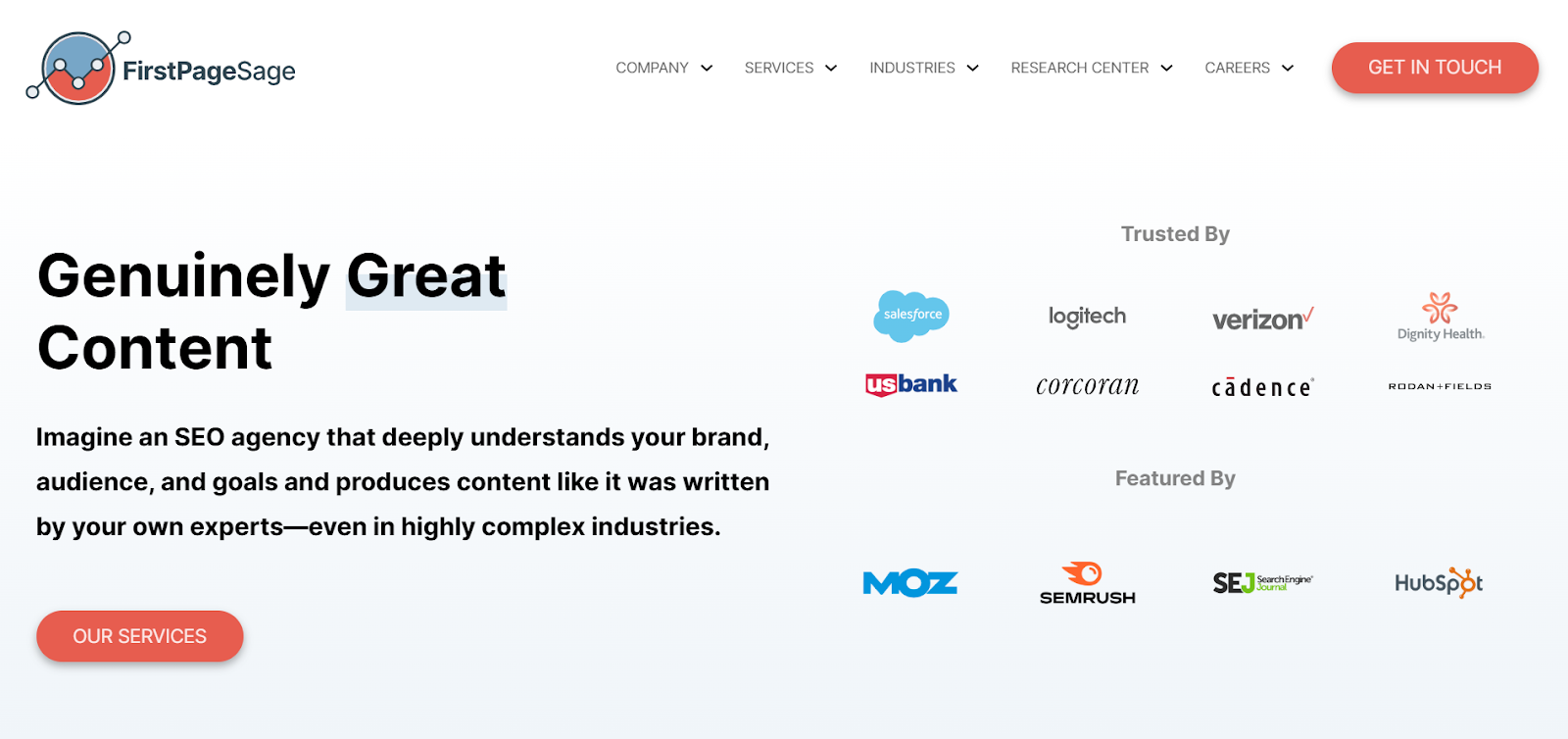
FPS focuses on thought leadership content for complex B2B verticals. Their GEO framework weaves in schema, metadata, and conversational prompts to support both crawlability and AI referencing. Best for enterprise brands that want to lead their category in AI-driven discovery.
Notable clients: US Bancorp, Logitech, Dignity Health, Salesforce, Corcoran
Pricing: Start at $12,000/month
7. WebFX: scalable GEO execution for mid-market brands
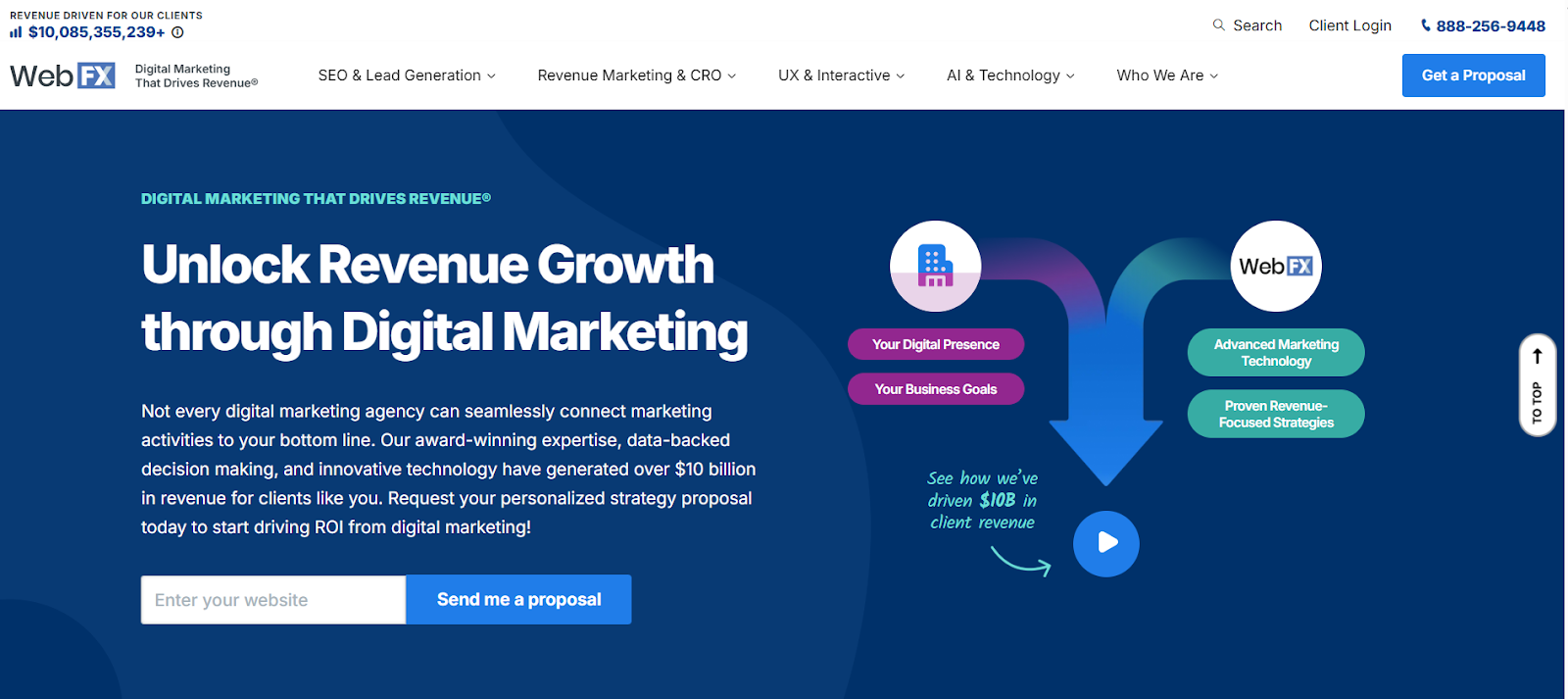
WebFX offers full SEO programs that blend structured content creation, LLM-aligned optimization, and detailed analytics via their proprietary MarketingCloudFX platform. A full-stack generative engine optimization service provider with the bandwidth to handle mid-market scale.
Notable clients: Hilton, Fuji Film, Subway, Wrangler, Arrow Quip
Pricing: Start at $3,000/month
8-15: Additional GEO agencies worth evaluating
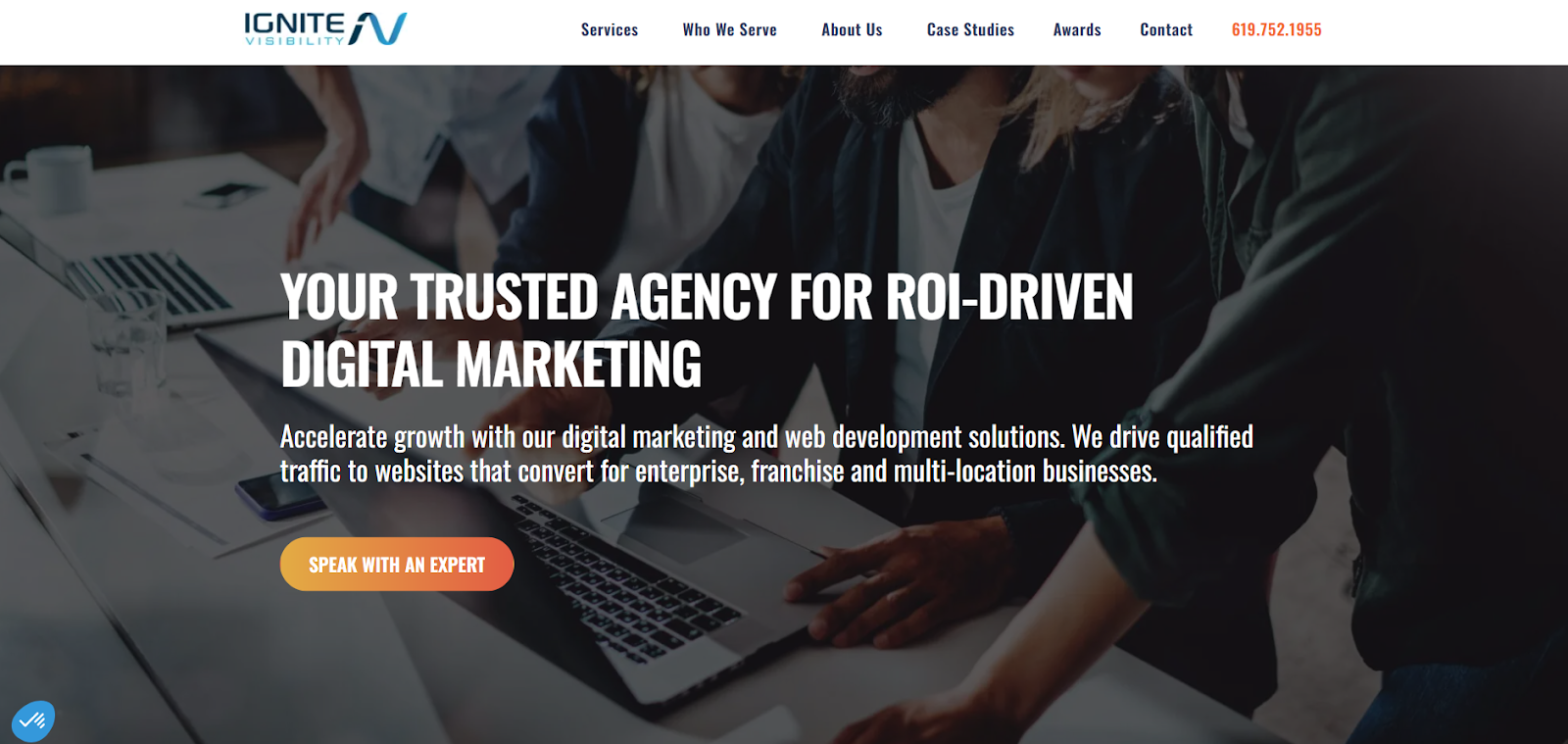
8. Ignite Visibility — Excels at local-first GEO with AI-structured FAQ sections and schema tailored to city-level search and conversational discovery. Retainers from $6,000-$10,000/month.
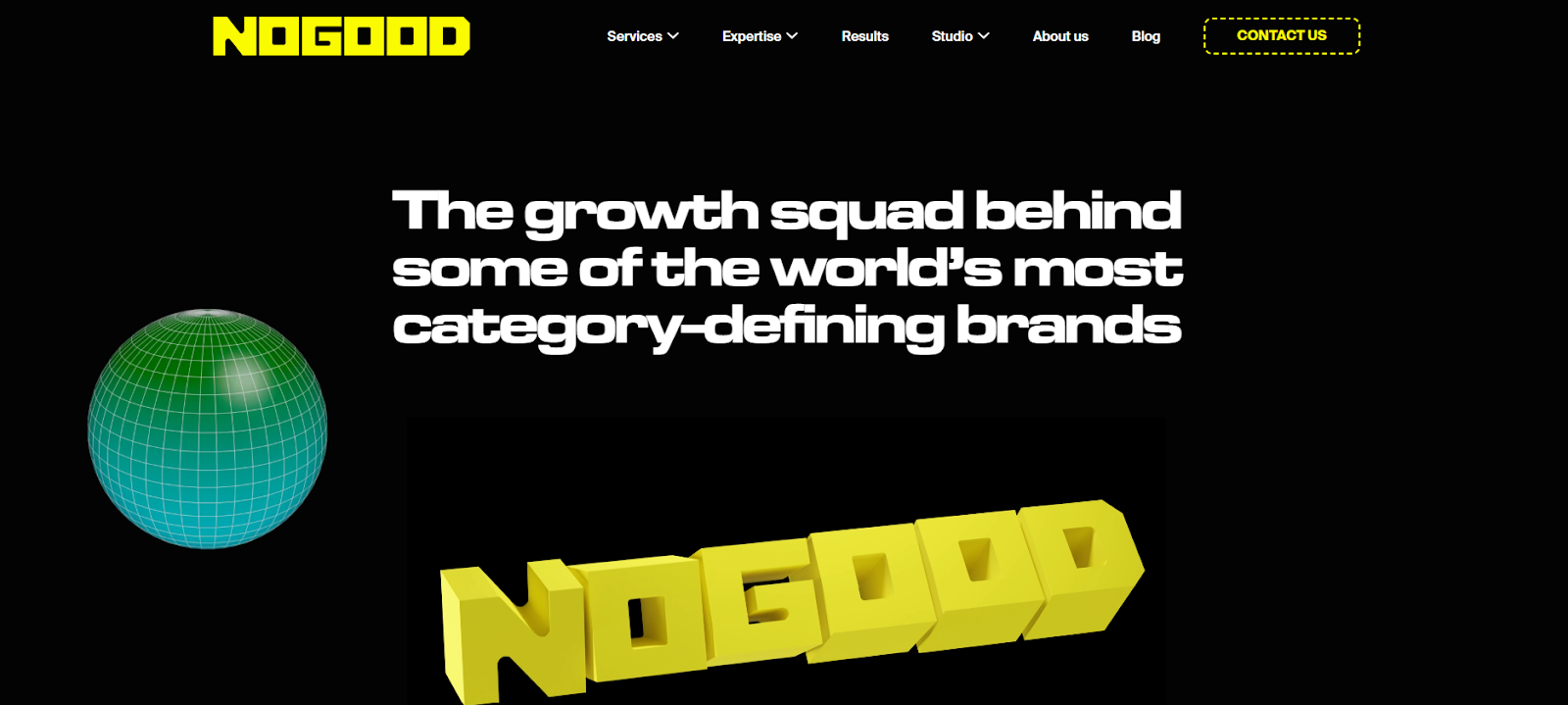
9. NoGood — Specializes in rapid-fire testing and funnel segmentation. Whether it's mapping AI query patterns or running A/B tests on content angles, NoGood delivers both reach and return. Growth retainers start at $8,000/month.
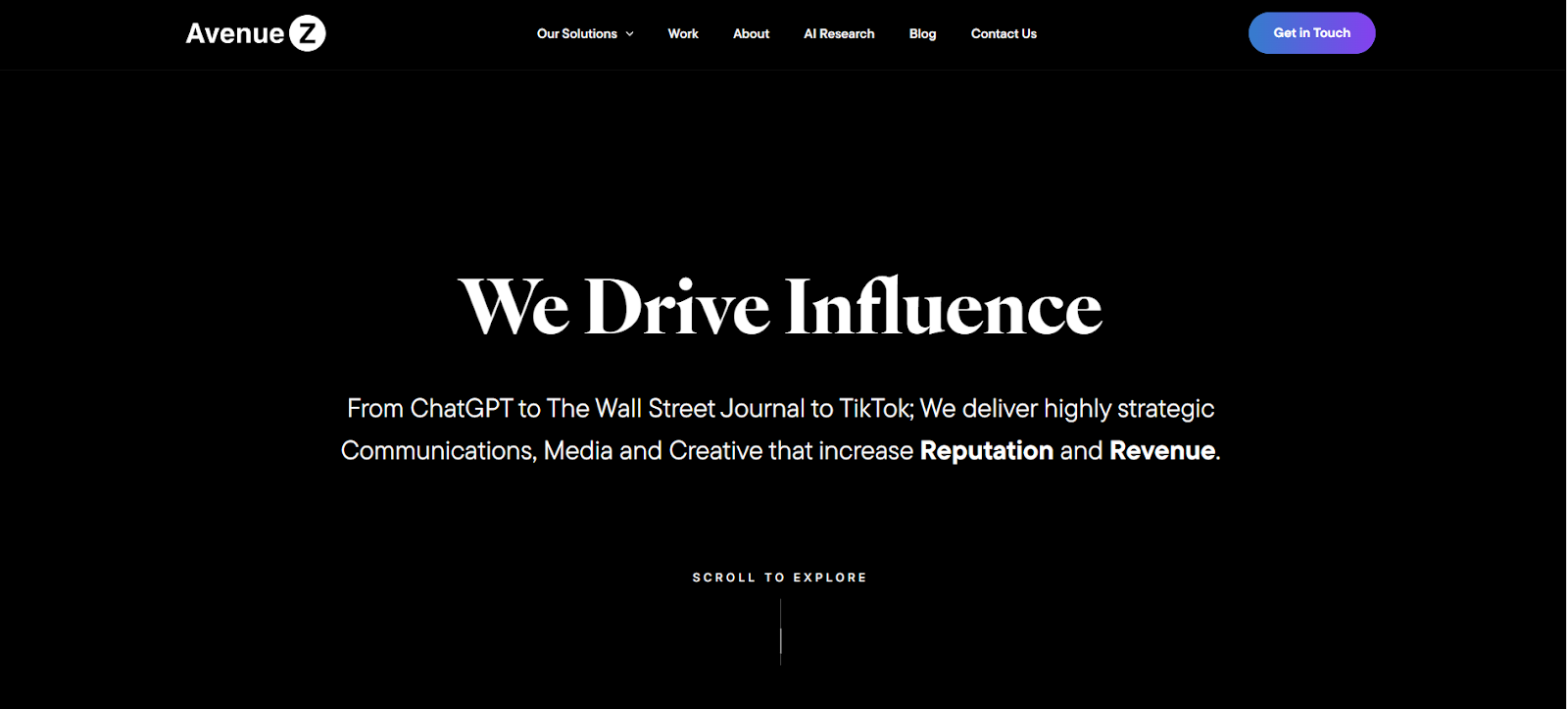
10. Avenue Z — Combines structured content optimization with strategic media placements and AI-aligned topic targeting. Think GEO agencies specializing in ChatGPT and Perplexity optimization alongside digital PR. Engagements start at $7,500/month.
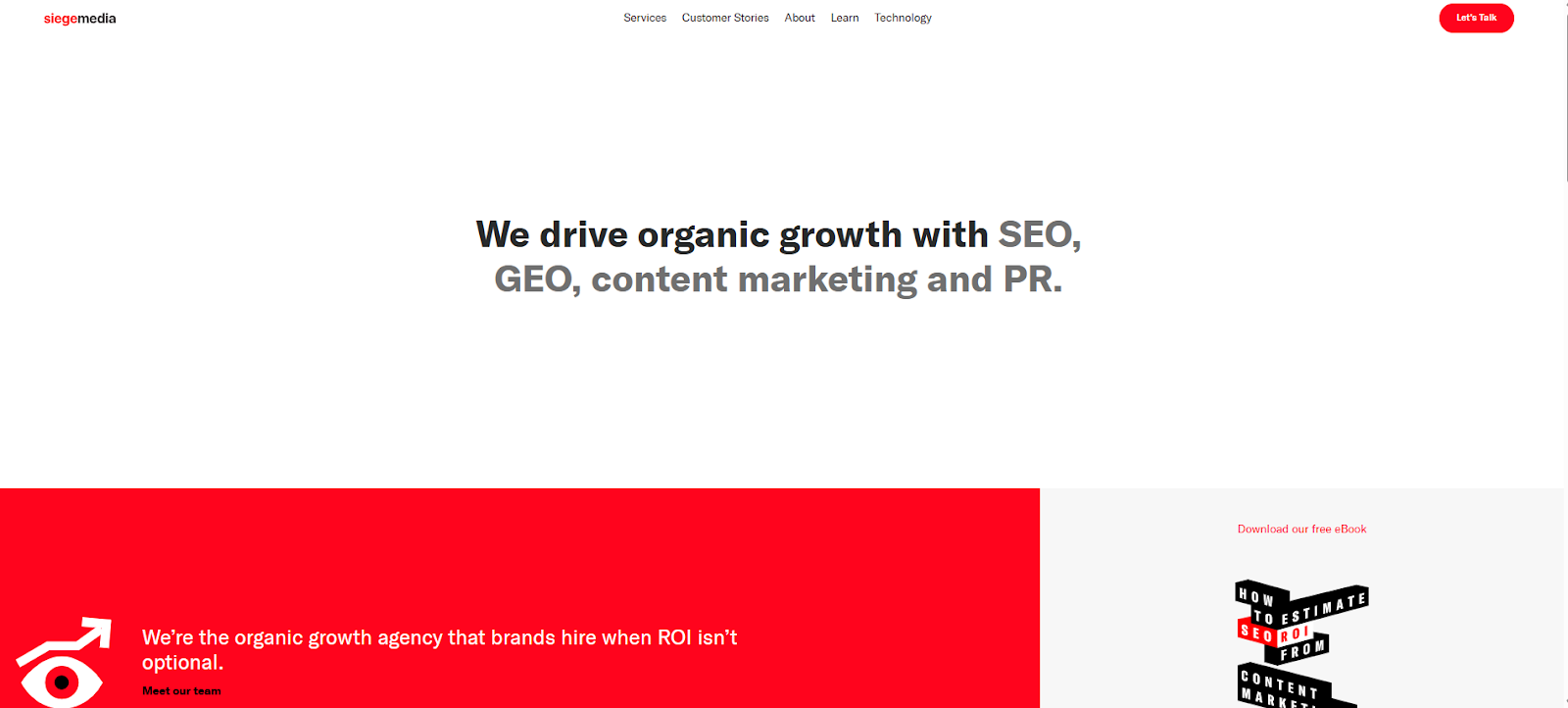
11. Siege Media — Marries data-backed SEO with visual storytelling and link-building. Their stat-rich content approach makes them strong for authority building. Monthly retainers from $7,500-$10,000.
12. Victorious — Rooted in prompt-aware keyword mapping, precise schema deployment, and consistent execution that builds domain authority. Plans start at $5,000/month.

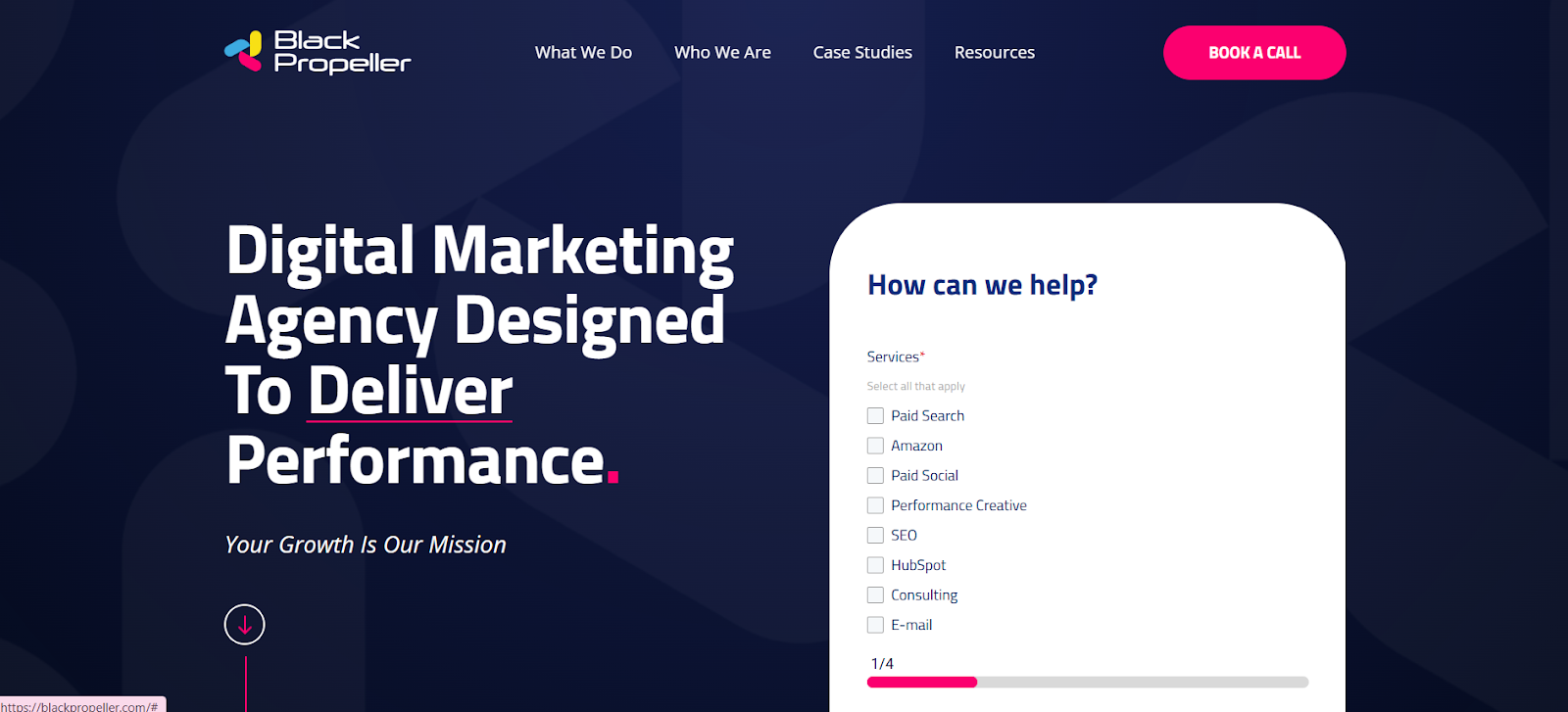
13. Black Propeller — Focuses on GEO-PPC integration, aligning landing pages and blog content with AI-driven prompts and buyer intent. PPC + SEO hybrid from $7,500/month.
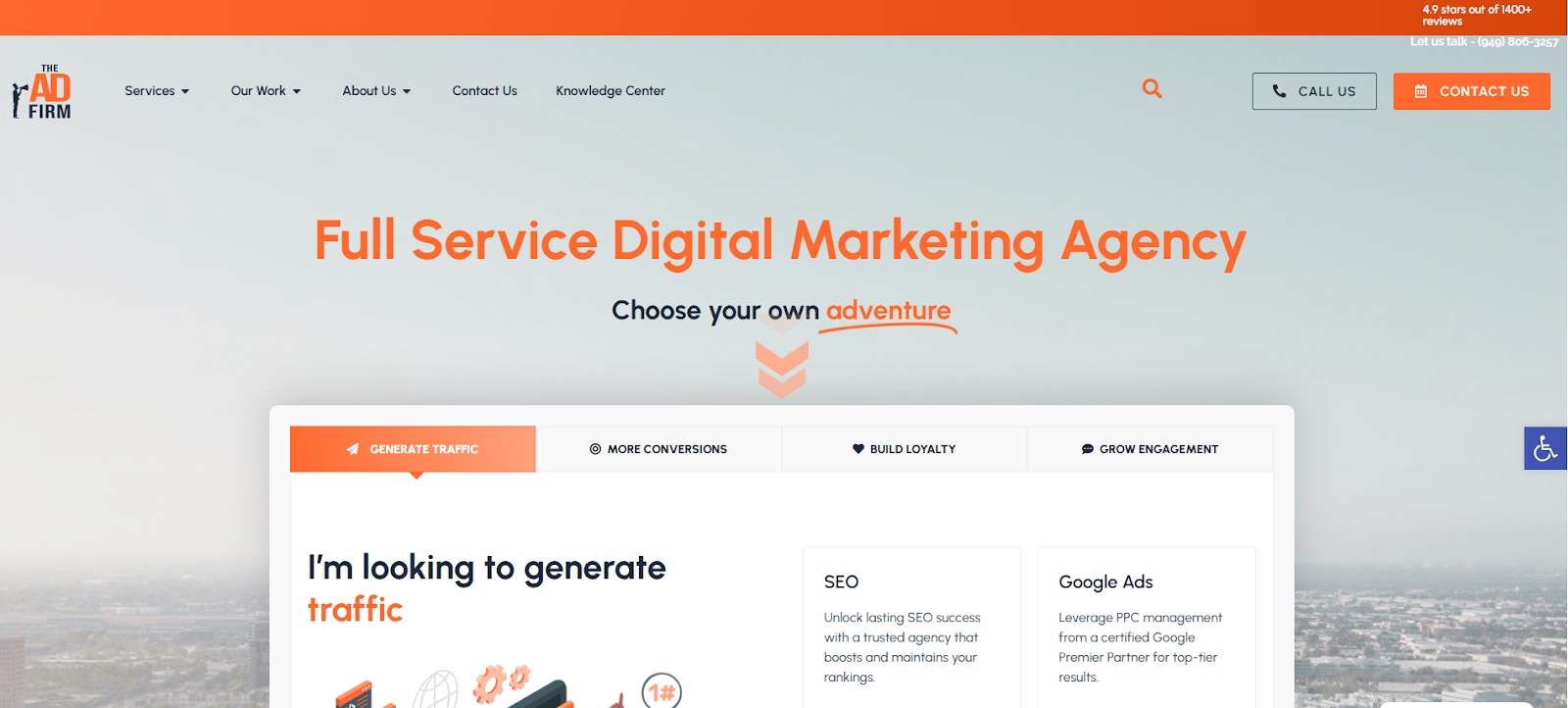
14. The AD Firm — Specializes in hyperlocal GEO, helping businesses optimize for proximity-based queries, rich snippets, and prompt-compatible FAQ structures. Flexible packages start at $2,500/month.
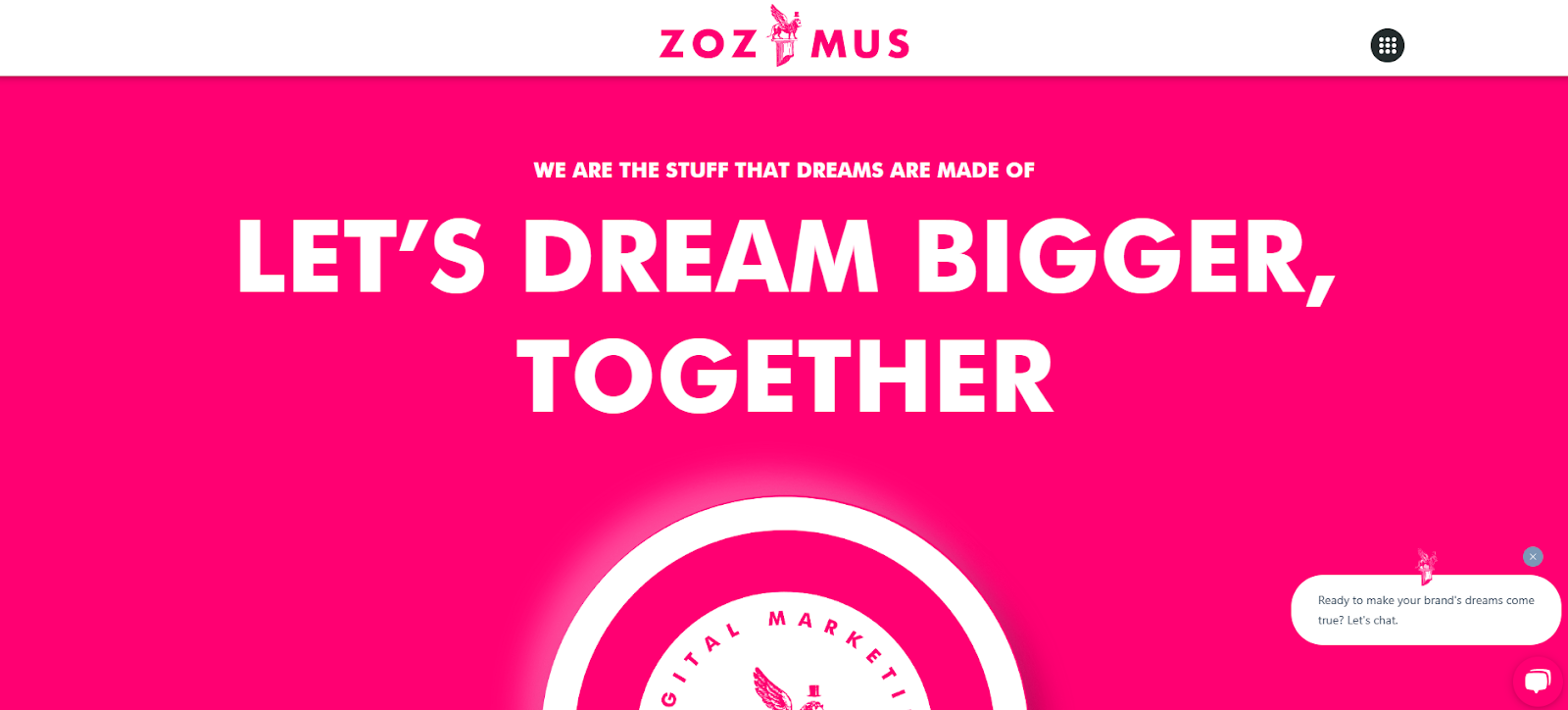
15. Zozimus — Focuses on narrative-rich content paired with AI-friendly formatting, ideal for brands seeking visibility in both human and machine-curated channels. Engagements begin at $5,000/month.
Which GEO agency is the best fit for your business stage?
Not every company needs the same kind of GEO partner. The right choice depends on your growth stage, budget, and what "success" looks like for your team.
Here's how to think about it.
For startups and early-stage companies: You need flexibility, fast learning loops, and affordable pricing. Flow Agency ($4K/month) and The AD Firm ($2.5K/month) offer lower entry points with focused execution.
For mid-market B2B SaaS: You need systems, repeatability, and real-time AI citation tracking. WebFX, Growth Plays, and Omnius bring operational scale with structured reporting.
For enterprise brands: You need technical depth, governance, and AI training for internal teams. iPullRank and First Page Sage handle complex information architectures and compliance-heavy verticals. iPullRank's emphasis on custom prompt libraries and AI governance is particularly relevant for regulated industries.
For revenue-focused teams: If your primary metric is pipeline (not traffic), TripleDart and Growth Plays tie every GEO deliverable to business outcomes.
Agency Data Insight
Across our portfolio of 40+ B2B SaaS accounts, audiences engaging with AI-themed educational content (like GEO explainers and comparison pages) convert 22% better down-funnel. B2B decision-makers increasingly research via generative tools before purchase, which means agencies need to integrate GEO signals into creative testing for sustained engagement.
What's the difference between GEO, AEO, and LLMO agencies?
These terms overlap, but they aren't interchangeable. Understanding the distinction helps you evaluate whether an agency has genuine expertise or has simply rebranded its SEO offering.
GEO (Generative Engine Optimization) focuses on making your content discoverable and citable by generative AI platforms: ChatGPT, Gemini, Perplexity, and AI Overviews. It covers content structure, entity signals, and schema markup.
AEO (Answer Engine Optimization) is a subset of GEO that specifically targets featured snippets, People Also Ask boxes, and direct-answer formats. Learn more in our AEO vs SEO comparison.
LLMO (Large Language Model Optimization) targets the training data and retrieval patterns of specific LLMs. It's more technical, often involving structured data feeds, API-level integrations, and monitoring how models like GPT-4 or Claude reference your brand.
In our PPC workflows for B2B SaaS, we've found that ad creatives mirroring conversational GEO language (question-first headlines, for example) achieve 15% higher CTRs and 12% lower CPAs. Why? Because they align with how AI engines parse and recommend content in blended search experiences.
A Reddit thread in r/SaaS titled "Who is the Best Generative Engine Optimization (GEO) Agency?" highlights how buyers are actively comparing these agency types. One commenter noted: "AEO Collective and Posirank are the top 2 AEO/GEO agencies from what I've seen" — the market is still consolidating around these distinctions.
Why are traditional SEO agencies struggling with AI search?
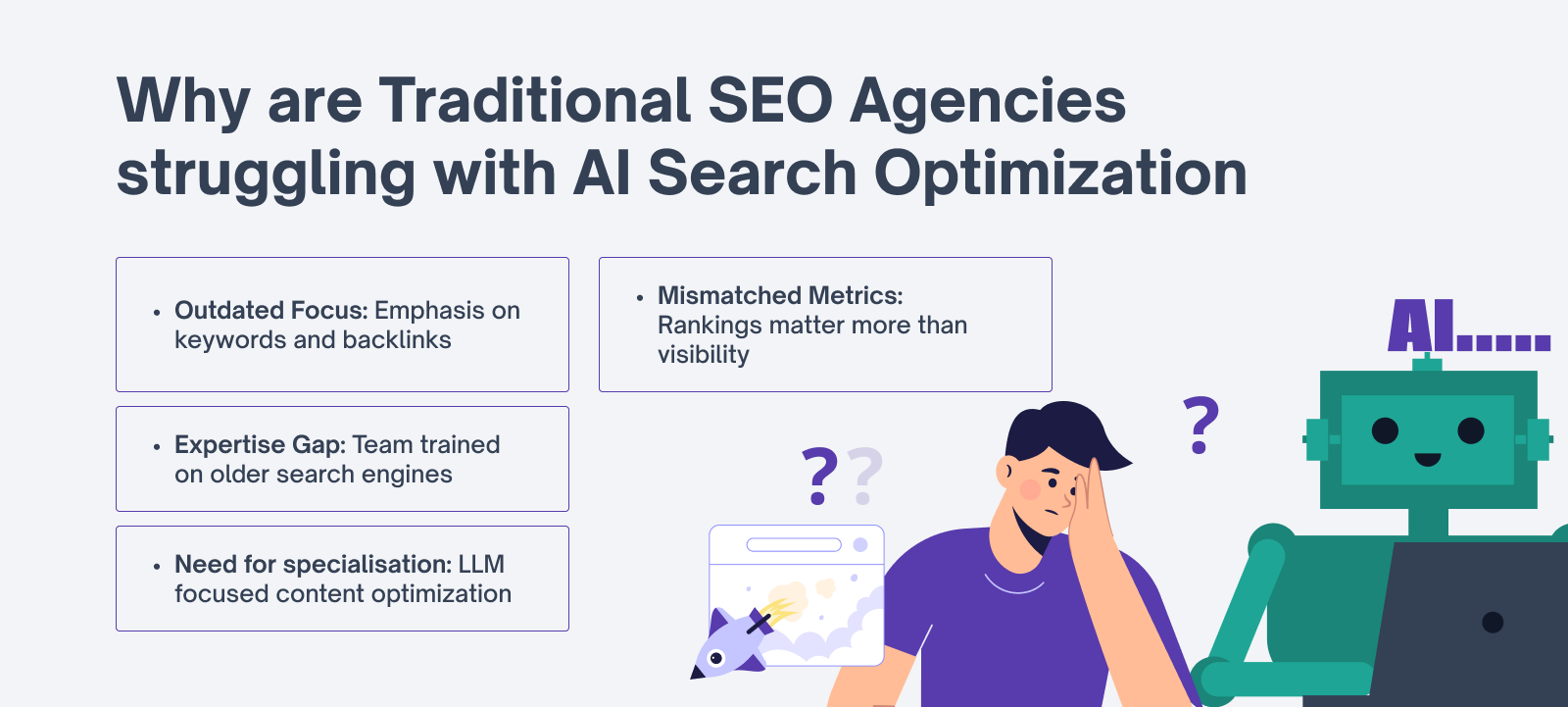
Despite the rise of LLMs like ChatGPT and Gemini, most SEO agencies are still running a decade-old playbook. And it's costing brands visibility in AI-driven search.
Four problems hold legacy agencies back:
- Outdated focus: They prioritize keywords and backlinks over authority, contextual clarity, structured content, and semantic alignment.
- Mismatched metrics: Rankings and impressions are still the gold standard, even though AI tools prioritize answer visibility and downstream engagement quality.
- Expertise gaps: Most teams know what works for SEO but aren't trained in how LLMs evaluate trust, parse entities, or select citations.
- Content specialization: GEO's backbone is content that requires the right mix of branding, language, and structure. LLMs work with stronger context signals than Google's traditional algorithm.
Agency Data Insight
Across our portfolio of 40+ B2B SaaS accounts, content optimized for generative engines sees 28% higher organic visibility in AI-driven search results compared to traditional SEO-only pages. The uplift is driven by structured question-answer formats and entity-linked authority signals — tactics most legacy agencies haven't adopted.
The results gap is widening. Position Digital achieved a 221% increase in AI citations for a MarTech company, while The Search Initiative delivered a 1,400% increase in AI traffic for a commercial plant supplier. Those numbers aren't coming from traditional SEO playbooks.
What services should you expect from a GEO agency?
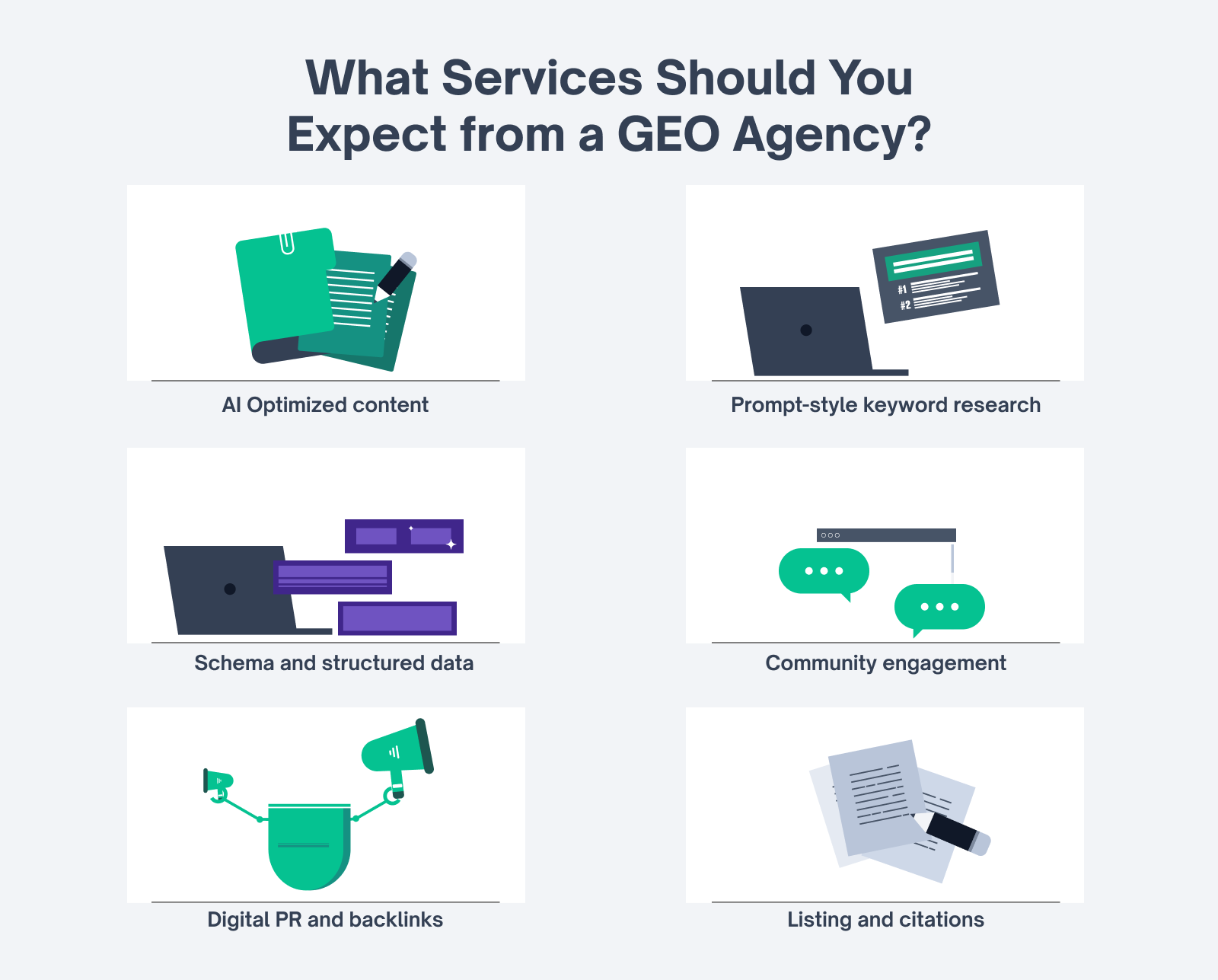
GEO agencies are built for AI-driven discovery. Here are the core services to look for:
- AI-optimized content: Engineers visibility in LLM answers through citable structures, statistical blocks, and FAQ formatting.
- Prompt-style keyword research: Aligns with how users phrase queries in tools like ChatGPT and Perplexity.
- Schema and structured data: Helps AI parse and prioritize your pages. Some agencies also implement LLMs.txt files as a quick win for AI visibility.
- Community engagement: Captures topical signals from platforms like Reddit and Quora, which are sources LLMs frequently reference.
- Digital PR and backlinks: Builds authority with strategic placements that both Google and AI engines trust.
- LLM visibility monitoring: Tracks when and how your brand appears in AI-generated responses across multiple platforms.
- AI governance and training: For enterprise teams, this includes custom prompt libraries and internal workflows for using AI at scale.
A discussion in r/GEO_optimization lists First Page Sage, Minuttia, and iPullRank as top picks for LLM search visibility, reinforcing that the market values agencies with documented, measurable GEO results.
Daniel Henderson, Glean
"TripleDart is a super helpful team, tremendously aiding in SEO enhancements from blog topics to technical recommendations."
Read the full Glean case study →
How should you evaluate and choose a GEO agency?
Here's a four-step framework we recommend to every B2B SaaS team evaluating generative engine optimization service providers.
Step 1: Define what "success" means for you
Ask yourself:
- Do you want AI citations or qualified pipeline?
- Are you optimizing for brand discovery or buyer intent?
- Do you need strategy, execution, or both?
If the agency can't connect GEO work to a business outcome, that's a red flag.
Step 2: Look beyond "AI SEO" claims
Plenty of agencies say they "do AI SEO." Fewer can explain how LLMs evaluate trust, how entity signals work, or why some brands get cited and others don't.
Evaluate whether the agency has dedicated GEO services (including proprietary tools or frameworks) or has simply rebranded its SEO offering.
Step 3: Match the agency to your stage
We covered this in the business-stage section above. The best GEO agencies are great at saying no when they're not the right fit.
Step 4: Demand proof, not promises
Look for:
- Before-and-after AI visibility examples
- AI-driven traffic performance with conversion data
- Pipeline or revenue impact tied to GEO work
Ask to see content they've produced that currently appears as a citation in ChatGPT or Perplexity. If they can't show it, keep looking.
A helpful thread in r/GenerativeSEOstrategy breaks down agency evaluations after 40+ hours of research, noting that agencies with proprietary tracking tools and documented case studies consistently outperform those without.
Agency Data Insight
Across our portfolio of 40+ B2B SaaS accounts, we've observed that brands investing in GEO alongside traditional SEO see measurable AI citation growth within 90 days. The compounding effect accelerates after month 4, when LLMs begin consistently referencing updated, entity-rich content in their responses.
Why TripleDart is different (and when it's the right choice)
TripleDart isn't trying to be everything to everyone. We're built for B2B SaaS companies that care about growth, not just presence.
What you get with TripleDart
- GEO strategy aligned to actual buyer journeys, not vanity metrics
- Slate-powered content refreshes processing hundreds of pages weekly to maintain AI citation freshness
- Content built for AI engines and humans at the same time
- Visibility that maps to pipeline, not impressions
- A team that understands the SaaS end-to-end GTM engine, from SEO strategy to paid social to RevOps
Atlas HXM — Pipeline Growth Case Study
Atlas HXM improved deal volume by 4x through an inbound engine rebuild, while the MQL-to-Opportunity rate climbed from 41% in Q2 to 55% by Q4, and the Cost per Opportunity dropped by 30%.
Read the full Atlas HXM case study →
Ready to dominate AI search?
Search volume is moving to AI. That's not a prediction; it's already happening. Let's audit your site for GEO readiness and build a plan that connects AI visibility to your revenue pipeline.
Get your free GEO strategy audit →
FAQs
Is GEO replacing SEO?
No. GEO is evolving SEO. It complements traditional search optimization by adding a layer for AI-generated answers in tools like ChatGPT and Gemini. You still need strong technical SEO; GEO builds on top of it.
What is the difference between SEO and GEO?
SEO targets traditional search engines like Google. GEO focuses on optimizing for AI-generated answers, emphasizing content structure, entity signals, and citation-worthy formatting. For a deeper comparison, see our SEO vs GEO guide.
How long do GEO agency engagements typically last?
Most GEO agency engagements run for three to six months initially, with ongoing retainers recommended for long-term visibility. AI citation growth compounds over time, so short-term engagements often miss the inflection point.
How much should I budget for professional GEO services?
Budgets typically range from $3,000 to $15,000/month, depending on your goals, existing content maturity, and deliverables like blog posts, audits, and AI structuring. Enterprise engagements can reach $30,000/month.
Do I need an agency if I already have internal SEO expertise?
If your team isn't trained in structuring content for AI tools or tracking LLM visibility, partnering with a GEO agency adds specialized capability your in-house team likely doesn't have yet. Many agencies also offer AI governance training for internal teams.
How do I measure GEO agency success?
Track AI citations, ChatGPT/Perplexity referral traffic, conversion quality from AI-attributed sessions, and performance across both traditional and AI search platforms. The best agencies provide dashboards covering all of these.
How does TripleDart help with generative engine optimization?
TripleDart combines GEO services with full-funnel B2B SaaS growth expertise. We use Slate for automated content refreshes, run LLM visibility tracking across ChatGPT, Gemini, and Perplexity, and tie every deliverable to pipeline outcomes. Our work with clients like FlowForma (5.5x AI traffic increase) and Meegle (134% citation growth) demonstrates measurable results. Book an intro call to get a free GEO readiness audit.



.webp)
.webp)

.webp)






.webp)





.webp)

.webp)


%20(1).png)


.webp)
.webp)
.webp)





%20Ads%20for%20SaaS%202026_%20Types%2C%20Strategies%20%26%20Best%20Practices%20(1).webp)






.png)


.png)





.webp)


![Creating an Enterprise SaaS Marketing Strategy [Based on Industry Insights and Trends in 2026]](https://cdn.prod.website-files.com/632b673b055f4310bdb8637d/6965f37b67d3956f981e65fe_66a22273de11b68303bdd3c7_Creating%2520an%2520Enterprise%2520SaaS%2520Marketing%2520Strategy%2520%255BBased%2520on%2520Industry%2520Insights%2520and%2520Trends%2520in%25202023%255D.png)




.png)




























.png)

.png)
.png)
.png)
.png)
.png)














.webp)
.webp)
.png)
.png)





.png)



















.webp)
.png)

.png)










.png)


.png)






![Top 9 AI SEO Content Generators for 2026 [Ranked & Reviewed]](https://cdn.prod.website-files.com/632b673b055f4310bdb8637d/6858e2c2d1f91a0c0a48811a_ai%20seo%20content%20generator.webp)




.webp)
.webp)














.webp)